
Explore this animal in Size of Extinct Animals ↗
119 / Recently extinct
Southern Gastric-brooding Frog
Rheobatrachus silus
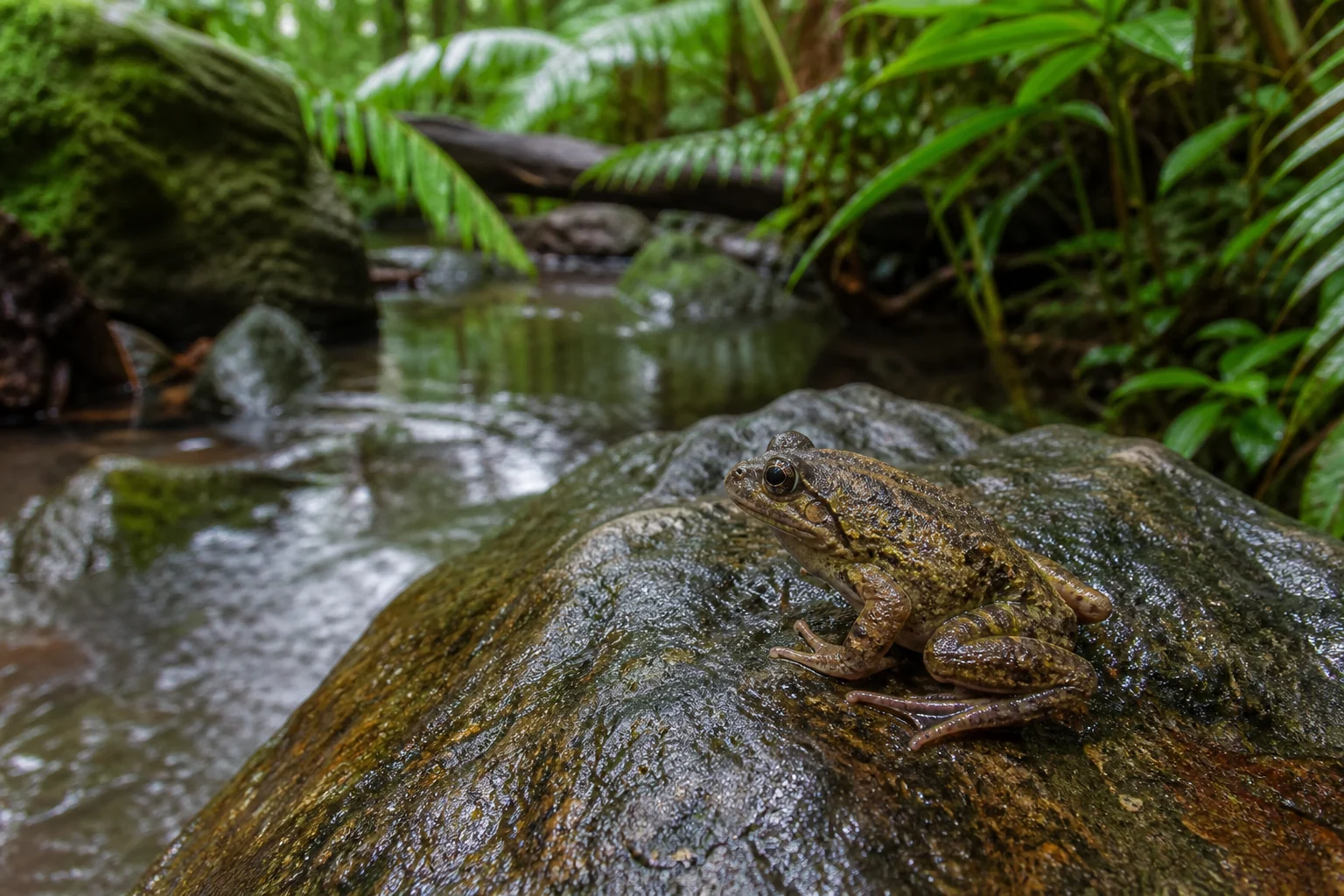
Females swallowed fertilized eggs, suppressed stomach acid and released developed froglets from the mouth.
 View original image · 1536 × 1024
Structured expansion · editorial review pending
- Time range
- Prehistory–about 1981
- Final stage
- 20th century
- Geographic range
- Streams of southeastern Queensland, Australia
01 / ANSWER FIRST
What was Southern Gastric-brooding Frog?
This archive records Southern Gastric-brooding Frog under the scientific name Rheobatrachus silus, with an age of Prehistory–about 1981 and a range of Streams of southeastern Queensland, Australia. Females swallowed fertilized eggs, suppressed stomach acid and released developed froglets from the mouth.
This frog lived beside cool, clean rainforest streams. Its extraordinary reproduction inspired physiological research, yet all wild and captive individuals disappeared within a decade of scientific discovery.
02 / QUICK FACTS
Southern Gastric-brooding Frog at a glance
- Scientific name
- Rheobatrachus silus
- Age
- Prehistory–about 1981
- Last recorded stage
- 20th century
- Known range
- Streams of southeastern Queensland, Australia
- Broad group
- amphibian or stem tetrapod
- Archive era
- Recently extinct
- Habitat signals
- freshwater, wet ground, seasonal climate and shoreline vegetation
- Documented regions
- Oceania
03 / ANATOMY
How was Southern Gastric-brooding Frog built?
Overall body plan
Females swallowed fertilized eggs, suppressed stomach acid and released developed froglets from the mouth.
Limbs, girdles and vertebral column
The available record is interpreted through preserved proportions, attachment surfaces, wear and comparison with related organisms. For Southern Gastric-brooding Frog, those observations must be separated from features added only for visual reconstruction.
Skull and aquatic adaptations
This frog lived beside cool, clean rainforest streams. Its extraordinary reproduction inspired physiological research, yet all wild and captive individuals disappeared within a decade of scientific discovery.
Growth and individual variation
A single specimen does not define the whole species. Size, maturity, preservation and possible sex differences are considered before anatomical traits are treated as typical of Southern Gastric-brooding Frog.
04 / DIET & BEHAVIOUR
How did Southern Gastric-brooding Frog live?
This frog lived beside cool, clean rainforest streams. Its extraordinary reproduction inspired physiological research, yet all wild and captive individuals disappeared within a decade of scientific discovery. This ecological reconstruction is strongest where anatomy, associated organisms and the depositional setting point in the same direction.
05 / DIET & BEHAVIOUR
What shaped its ecological limits?
Its populations depended on freshwater, wet ground, seasonal climate and shoreline vegetation. Changes in any one factor did not necessarily cause immediate extinction, but interacting pressures could reduce range, recruitment and resilience.
06 / RANGE & HABITAT
Where and when did Southern Gastric-brooding Frog live?
This archive currently lists Prehistory–about 1981; Streams of southeastern Queensland, Australia. Fossil or historical occurrence data describe where evidence has been found, not every place the taxon once occupied. Species-level age and range limits still require source-specific review.
Documented geographic range
Streams of southeastern Queensland, Australia. This boundary can change when specimens are reidentified or new localities are published.
Time window
Prehistory–about 1981, with the final recorded stage listed as 20th century. Rock units and dating uncertainty mean the true biological range may extend beyond the known record.
Environmental setting
The archive uses the broad habitat labels freshwater, wet ground, seasonal climate and shoreline vegetation. These labels help explore related records; a habitat reconstruction requires evidence from individual localities.
07 / FOSSIL EVIDENCE
What evidence supports reconstructions of Southern Gastric-brooding Frog?
Primary record
Field notes, specimens, breeding observations, tissues and cryopreserved cells preserve its biology.
Comparative anatomy
Preserved structures are compared with close and functionally similar organisms. The method can constrain posture and function, but analogy alone cannot prove colour, behaviour or soft tissue.
Age and locality
Stratigraphy and occurrence records place Southern Gastric-brooding Frog within Prehistory–about 1981 and Streams of southeastern Queensland, Australia. Reworked fossils and uncertain provenance are treated cautiously.
Open entity records
Links below connect the archive to available taxonomic and occurrence records. A matching name does not verify every ecological claim, and related-taxon links provide comparison rather than an exact species match.
08 / DISAPPEARANCE & DEBATE
Why did Southern Gastric-brooding Frog disappear?
Chytrid fungus was probably important, compounded by habitat and water disturbance in a tiny range.
The last fossil or observation marks the youngest evidence currently known, not necessarily the death of the final individual. Explanations are strongest when timing, environmental change and population biology agree; otherwise the profile preserves uncertainty instead of assigning a single dramatic cause.
09 / FREQUENTLY ASKED QUESTIONS
Southern Gastric-brooding Frog FAQ
What was Southern Gastric-brooding Frog?
This archive records Southern Gastric-brooding Frog under the scientific name Rheobatrachus silus, with an age of Prehistory–about 1981. Females swallowed fertilized eggs, suppressed stomach acid and released developed froglets from the mouth.
When did Southern Gastric-brooding Frog live?
The current archive range is Prehistory–about 1981; its youngest recorded stage is 20th century.
Where was Southern Gastric-brooding Frog found?
The archive currently lists Streams of southeastern Queensland, Australia. Species-level locality assignments and the full geographic range still require source-specific review.
How do scientists know about Southern Gastric-brooding Frog?
Field notes, specimens, breeding observations, tissues and cryopreserved cells preserve its biology.
04 / SOURCES & FURTHER READING
Check the source record
Use the scientific name to compare taxonomy, occurrence records and the fossil record. Database coverage and classifications may differ.
05 / REVISION HISTORY
How has this record changed?
- Completed an AI-assisted bilingual audit of the archive record, corrected identified issues and clarified evidence limits; independent editorial review is pending.
- Expanded into a structured bilingual profile with anatomy, ecology, range, evidence, debate and FAQs; independent editorial review is pending.
- Verified authoritative entity sources and added three responsive reconstruction sizes.
- Initial bilingual species record published.
06 / CORRECTIONS & ADDITIONS