
Explore this animal in Size of Extinct Animals ↗
213 / Paleozoic
Diplocaulus
Diplocaulus magnicornis
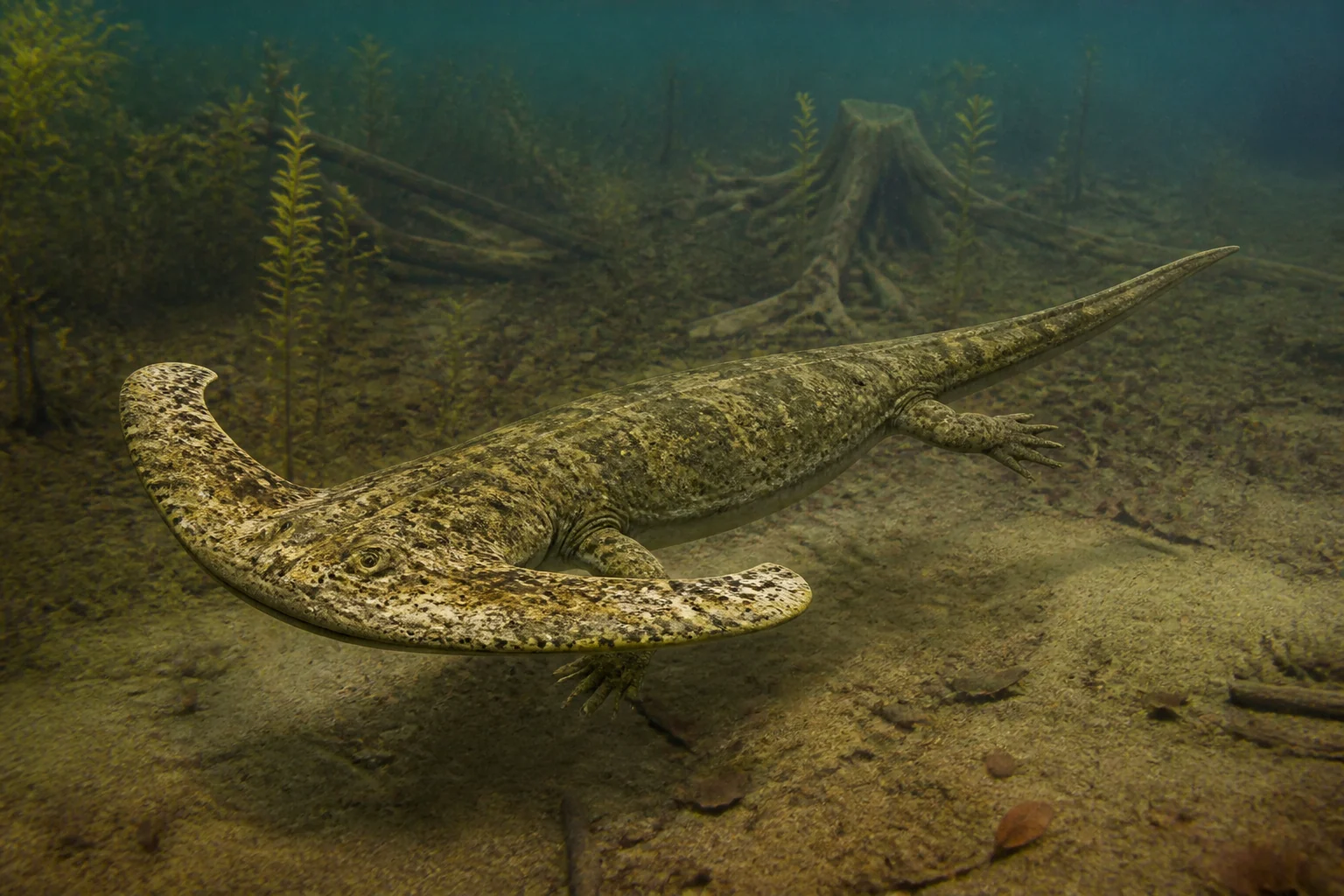
Its skull spread sideways into a boomerang, perhaps producing lift in current or making it hard to swallow.
 View original image · 1536 × 1024
- Time range
- About 298–272 million years ago
- Final stage
- Early Permian
- Geographic range
- Seasonal rivers and ponds · North America
Diplocaulus: a real amphibian with a boomerang-shaped skull
Diplocaulus magnicornis was a Permian amphibian whose skull extended sideways into two long horns. The skull is real fossil anatomy; explanations of exactly how it worked remain hypotheses tested with models.
Lift is a model result
Flow experiments can test how an assumed head shape behaves in moving water. They do not directly observe a living Diplocaulus or settle its swimming posture, soft tissues and everyday behaviour.
Defence is a separate idea
A broad head might make an animal harder for a predator to swallow. That is a plausible functional proposal, not a recorded encounter or a reason to discard the hydrodynamic tests.
01 / ANSWER FIRST
What was Diplocaulus?
Diplocaulus was an extinct aquatic amphibian with a flattened skull and long projections at its rear corners. It was not a dinosaur. This profile focuses on the well-studied Early Permian material from Texas.
The boomerang outline is preserved in bone. Its effect on swimming is a question tested with models, rather than a behaviour directly preserved in a skeleton.
02 / QUICK FACTS
Diplocaulus at a glance
- Group
- Nectridean amphibian
- Featured species
- Diplocaulus magnicornis
- Featured fossils
- Early Permian · Texas
- Distinctive feature
- Broad skull with tabular horns
03 / ANATOMY
Why did Diplocaulus have a boomerang head?
Bone, not separate antlers
The side projections are extensions of skull bones. Calling them horns describes their shape, not the structure of a mammal’s horn or antler.
A head that changed with growth
Olson’s 1951 study compared 47 complete or partial skulls. Different growth stages show why a juvenile cannot be reconstructed simply as a reduced adult.
A possible hydrofoil
Flow experiments test whether the broad head generated lift and turning forces. The 2016 model changed both head and body angle, finding conditions compatible with manoeuvrability rather than constant passive stability.
04 / DIET & BEHAVIOUR
Was it always on the bottom?
A flat outline does not establish a bottom-dwelling lifestyle. The flow work also allows movement and feeding in the water column; exact posture remains a reconstruction.
05 / DIET & BEHAVIOUR
What did Diplocaulus eat?
Small aquatic prey is a reasonable ecological inference, but the skull-growth and flow studies cited here do not identify stomach contents. They cannot establish a favourite prey species or exact menu.
06 / RANGE & HABITAT
Where are the studied fossils from?
The classic growth sample came from the Arroyo Formation of the Clear Fork succession in Texas. This local sample should not be mistaken for a complete map of every Diplocaulus species.
Many skulls, uneven preservation
Olson excluded excessively distorted or restored specimens from the measured sample. Preservation affects the comparisons we can make.
07 / FOSSIL EVIDENCE
What do the experiments actually show?
A test of forces
Skews measured lift, drag and pitching effects on a physical reconstruction. These constrain possible motion; they do not show that a living animal used only one swimming strategy.
Missing soft tissue matters
The model omitted legs and tail, and its body outline and density required assumptions. Those limits matter when interpreting balance and buoyancy.
08 / DISAPPEARANCE & DEBATE
Why did Diplocaulus go extinct?
The sources reviewed here do not establish a specific extinction trigger for Diplocaulus.
A growth series and a swimming model answer different questions from a dated study of population disappearance.
09 / FREQUENTLY ASKED QUESTIONS
Diplocaulus FAQ
Was Diplocaulus a dinosaur?
No. It was a nectridean amphibian, outside Dinosauria.
Did its head work like a wing?
A hydrofoil is one tested interpretation. Flow models support possible lift and control effects, but do not prove a single purpose.
Does Diplocaulus still exist?
No living Diplocaulus is known. Its anatomy is reconstructed from fossils, not living specimens.
04 / SOURCES & FURTHER READING
Check the source record
Use the scientific name to compare taxonomy, occurrence records and the fossil record. Database coverage and classifications may differ.
05 / REVISION HISTORY
How has this record changed?
- Expanded answers to reader questions, clarified the scope of fossil evidence and improved routes to related explanations.
- Expanded this profile with research sources, focused questions and explicit limits on reconstructions; updated search metadata.
- Verified authoritative entity sources and added three responsive reconstruction sizes.
- Initial bilingual species record published.
06 / CORRECTIONS & ADDITIONS