
Explore this animal in Size of Extinct Animals ↗
247 / Cenozoic
Megistotherium
Megistotherium osteothlastes
A giant hyaenodont with a skull about 66 cm long. Body-mass estimates are uncertain, and it was neither a hyena nor a big cat.
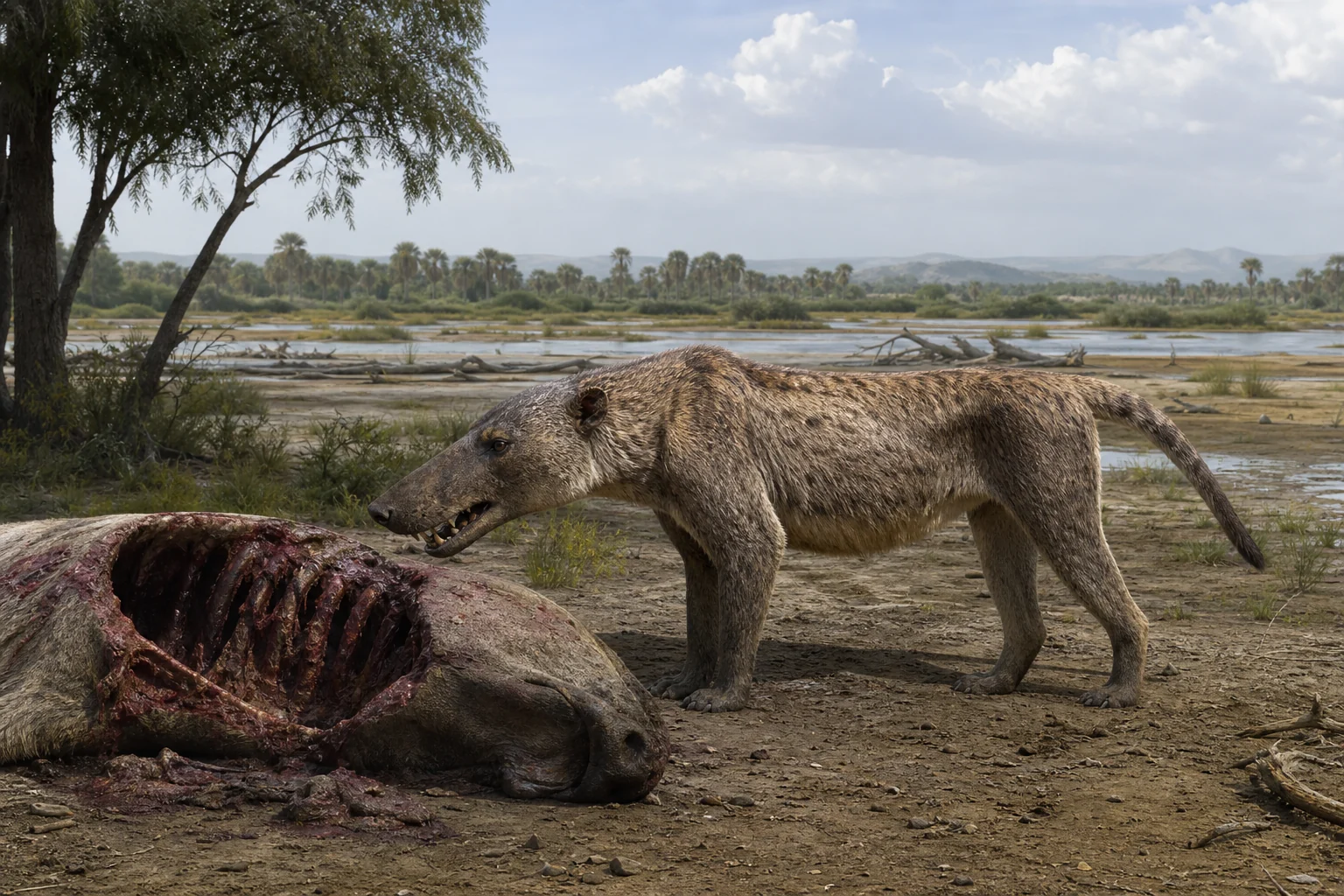 View original image · 1536 × 1024
- Time range
- Early Miocene (Libyan material)
- Final stage
- Last occurrence uncertain
- Geographic range
- River plains and woodland · North Africa
01 / ANSWER FIRST
What was Megistotherium?
Megistotherium was a giant meat-eating mammal belonging to Hyaenodonta, a lineage distinct from living cats, dogs and hyenas. Its most informative remains include a very large skull from Gebel Zelten, Libya.
The name osteothlastes draws attention to its imposing feeding apparatus. That name is not evidence of a particular prey item, and a huge head does not translate automatically into an equally secure body-mass estimate.
02 / QUICK FACTS
Megistotherium at a glance
- Group
- Hyainailourine hyaenodont; not a hyena
- Reference skull length
- About 66 cm in the 2015 research discussion
- Body mass
- Uncertain; large published estimates are reconstructions
- Key locality
- Gebel Zelten, Libya; Marada Formation
- Time
- Miocene; the Libyan material is Early Miocene
Megistotherium size: skull length is not body weight
Solé and colleagues' 2015 comparison discusses a skull about 66 centimetres long and cites earlier proposals of body mass as high as 800 kilograms. The skull dimension and the mass proposal are different kinds of evidence: one describes preserved anatomy; the other extrapolates the missing body.
Hyainailourines had elongated faces and proportions unlike modern big cats. Applying a lion's head-to-body ratio can therefore mislead. A cautious comparison records the specimen, the anatomical measurement and the scaling method before ranking the animal against bears or other giant predators.
03 / ANATOMY
Teeth and skull: a different carnivore design
Shearing teeth
Hyaenodonts processed flesh with specialised cheek teeth. Similar feeding roles do not make them members of Carnivora, the order containing modern cats and dogs.
An unusually long face
The large skull and long facial region are central to reconstructions. They also make body estimates sensitive to which living or fossil comparison is selected.
04 / DIET & BEHAVIOUR
What did Megistotherium eat?
It was a meat eater. Large mammals are plausible prey or carrion resources, but association with herbivore fossils is not equivalent to preserved gut contents. The cited research discusses ecological possibilities rather than a verified species-by-species menu.
05 / DIET & BEHAVIOUR
Hunter or scavenger?
These roles are compatible: a predator can also consume carcasses. Teeth reveal food-processing adaptations more directly than hunting frequency, running speed or the success rate of an attack.
06 / RANGE & HABITAT
Where were Megistotherium fossils found?
The Libyan material anchors this profile; broad maps of related hyaenodonts should not be substituted for records of this named animal.
Gebel Zelten
The Natural History Museum catalogue records Megistotherium osteothlastes material from Gebel Zelten in the Marada Formation. A catalogue identifies an object and locality; it does not independently validate every popular reconstruction.
07 / FOSSIL EVIDENCE
Why do scientific names and estimates differ?
Megistotherium and Hyainailouros
Researchers have discussed whether material called Megistotherium should be united with Hyainailouros. Follow the specimen and the publication's taxonomic usage when comparing measurements; a renamed fossil is not automatically a new independent size record.
A measured skull, an inferred body
The 2015 study places giant hyainailourines in a wider evolutionary and ecological comparison. Its large mass values should be read alongside the authors' discussion of proportions and uncertain ecological interpretations.
08 / DISAPPEARANCE & DEBATE
Why did Megistotherium go extinct?
A specific extinction mechanism is not established by the cited fossils.
Changes in Miocene climates and predator communities provide background, but they do not by themselves demonstrate that cats or dogs competitively eliminated this animal.
09 / FREQUENTLY ASKED QUESTIONS
Megistotherium FAQ
Was Megistotherium a giant hyena?
No. It was a hyaenodont. Hyenas belong to Carnivora, a different mammalian lineage.
How much did Megistotherium weigh?
Its weight is uncertain. Estimates as high as 800 kg have been discussed in the literature, but they are reconstructions and should not be presented as a measured or typical adult weight.
Was Megistotherium bigger than a lion?
Its approximately 66-cm skull was much longer than a lion's. Comparing whole-body mass is less secure because head proportions differ and the body must be reconstructed.
04 / SOURCES & FURTHER READING
Check the source record
Use the scientific name to compare taxonomy, occurrence records and the fossil record. Database coverage and classifications may differ.
05 / REVISION HISTORY
How has this record changed?
- Expanded answers to reader questions, clarified the scope of fossil evidence and improved routes to related explanations.
- Added a sourced bilingual topic hub covering size, discovery history, anatomy, diet, habitat, uncertainty and FAQs; updated search metadata.
- Verified authoritative entity sources and added three responsive reconstruction sizes.
- Initial bilingual species record published.
06 / CORRECTIONS & ADDITIONS