
Explore this animal in Size of Extinct Animals ↗
245 / Cenozoic
Hyaenodon
Hyaenodon horridus
Hyaenodon horridus was a meat-eating hyaenodont mammal, not a hyena; its large skull can inflate skull-length mass estimates.
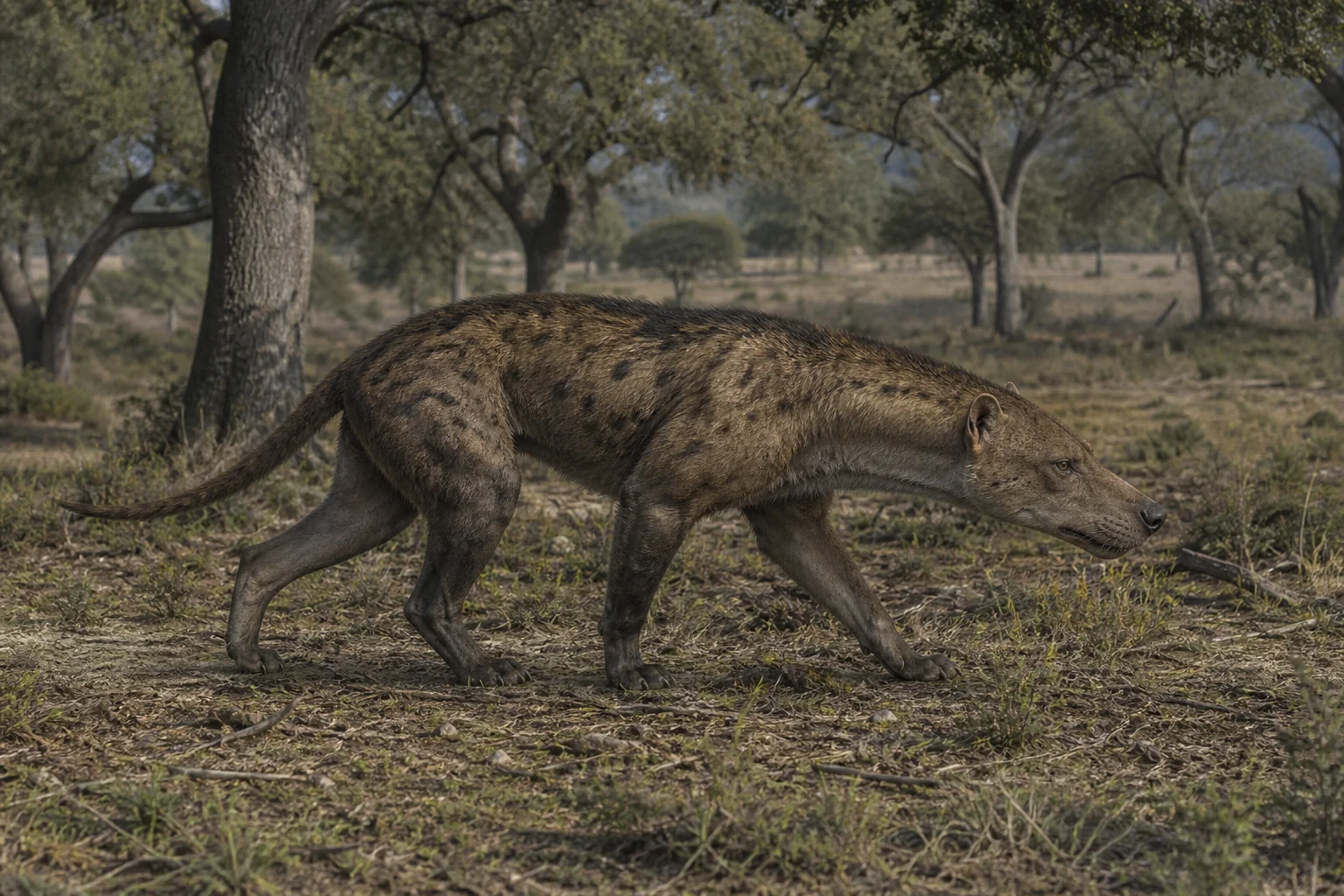 View original image · 1536 × 1024
- Time range
- Late Eocene–early Oligocene
- Final stage
- Last occurrence uncertain
- Geographic range
- North America · Including the Calf Creek fauna of Saskatchewan
01 / ANSWER FIRST
What was Hyaenodon horridus?
Hyaenodon horridus was a North American meat-eating mammal in Hyaenodonta, an extinct group distinct from the carnivoran lineage containing living hyenas.
Hyaenodon contains multiple species. A size estimate for H. horridus should not be transferred to every member of the genus.
02 / QUICK FACTS
Hyaenodon horridus at a glance
- Record
- Late Eocene and early Oligocene
- Region
- North America
- Diet
- Meat eating inferred from teeth
- Mass
- Model-dependent estimates, not a measured live weight
How big was Hyaenodon horridus?
Engelman's 2022 study estimated 32.2 kg from occipital condyle width, the width across the skull's joint with the neck. Its reported 95% interval was 14.9–69.3 kg. Those bounds describe model uncertainty, not an observed adult size range.
The same comparison lists 41.4 kg from an earlier limb-bone method and 130.6 kg from skull length. The disproportionately large head helps explain the disagreement; the estimates are not all from the same individual.
03 / ANATOMY
How did Hyaenodon differ from a hyena?
A separate mammal lineage
A similar carnivorous appearance does not establish close ancestry. Hyaenodonta and Carnivora evolved their specialized slicing dentitions independently.
Different cutting teeth
The main hyaenodont shearing pair uses the upper second and lower third molars. Carnivorans instead use an upper fourth premolar and lower first molar.
04 / DIET & BEHAVIOUR
What did it eat?
A 2022 study compared tooth shape and estimated body size in the Calf Creek fauna of Saskatchewan. H. horridus occupied a strongly meat-eating dietary niche; a predicted prey size is not an identified meal.
05 / DIET & BEHAVIOUR
Did it compete with other predators?
The Calf Creek analysis found varied dietary overlap among predators. Ecological overlap can test competition hypotheses, but it does not document a direct encounter or prove a species' extinction cause.
06 / RANGE & HABITAT
When and where did it live?
The cited studies document H. horridus on both sides of the Eocene–Oligocene boundary.
Late Eocene Canada
The Cypress Hills Formation study includes H. horridus in the Calf Creek Local Fauna of southern Saskatchewan.
Early Oligocene North America
The 2022 mass study explicitly uses early Oligocene H. horridus material. An end-Eocene extinction date would exclude this younger record.
07 / FOSSIL EVIDENCE
How should the fossil estimates be read?
Name the method
Mass inferred from a skull joint, a tooth or a limb is a model result. Compare methods and specimens before presenting one number as definitive.
Keep hypotheses testable
Teeth preserve feeding anatomy. Exact prey choice, hunting speed and social behavior require additional evidence.
08 / DISAPPEARANCE & DEBATE
Why did Hyaenodon horridus go extinct?
These studies do not establish a single species-specific cause or an exact final date.
Broad climatic change and predator turnover provide context. Neither alone demonstrates that hyenas or other carnivorans directly eliminated H. horridus.
09 / FREQUENTLY ASKED QUESTIONS
Hyaenodon horridus FAQ
Was Hyaenodon a hyena?
No. Hyaenodon belonged to Hyaenodonta; living hyenas belong to Carnivora. Their cutting teeth evolved in different lineages.
Did Hyaenodon horridus survive into the Oligocene?
Yes. The cited mass study uses early Oligocene North American material, so the species did not disappear at the end of the Eocene.
Is one Hyaenodon weight valid for every species?
No. Identify the species, specimen and estimation method. This profile concerns H. horridus, not the largest animal in the entire genus.
04 / SOURCES & FURTHER READING
Check the source record
Use the scientific name to compare taxonomy, occurrence records and the fossil record. Database coverage and classifications may differ.
05 / REVISION HISTORY
How has this record changed?
- Expanded this profile with research sources, focused questions and explicit limits on reconstructions; updated search metadata.
- Verified authoritative entity sources and added three responsive reconstruction sizes.
- Initial bilingual species record published.
06 / CORRECTIONS & ADDITIONS