
Explore this animal in Size of Extinct Animals ↗
521 / Paleozoic
Iniopteryx
Iniopteryx rushlaui
Iniopteryx rushlaui was a small cartilaginous fish with broad pectoral fins attached high on its body; the fins suggest underwater strokes, not flight.
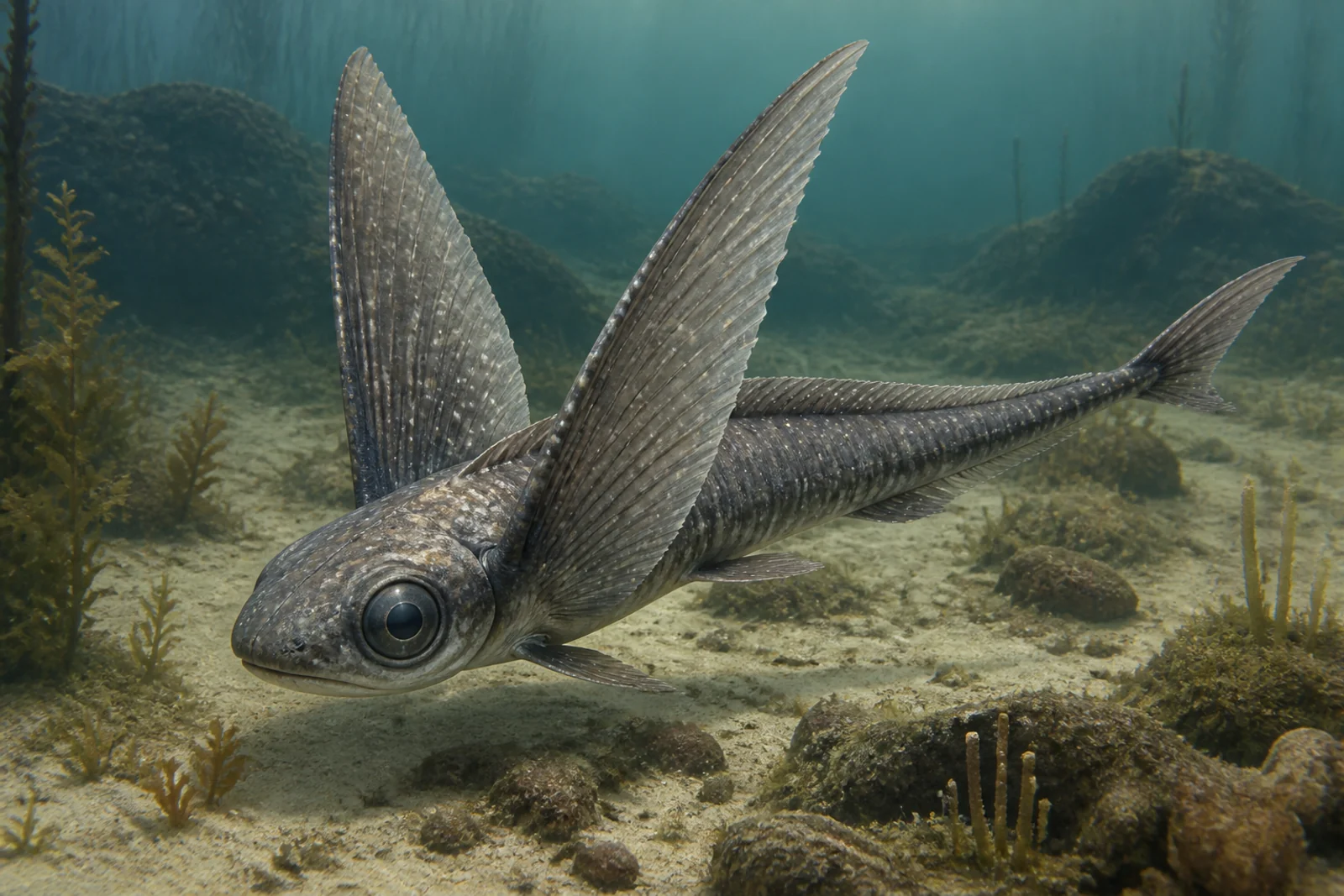 View original image · 1600 × 1067
- Time range
- Pennsylvanian · late Carboniferous
- Final stage
- Exact last occurrence uncertain
- Geographic range
- Marine and coastal deposits · American midcontinent, including Nebraska and Indiana
01 / ANSWER FIRST
What was Iniopteryx?
Iniopteryx was a small Carboniferous cartilaginous fish with broad pectoral fins attached unusually high on the body. This profile concerns the species Iniopteryx rushlaui.
Its wing-like appearance inspired a swimming reconstruction. It does not demonstrate powered flight or gliding above water.
02 / QUICK FACTS
Iniopteryx at a glance
- Interval
- Pennsylvanian · late Carboniferous
- Largest studied skeletons
- About 30–35 cm overall length
- Type specimen
- FMNH PF 6678
- Type locality
- Stark Shale, Nebraska, USA
03 / ANATOMY
Did Iniopteryx have wings?
Fins positioned high on the body
The broad paired structures are pectoral fins. Zangerl and Case proposed that their joint arrangement allowed wing-like strokes underwater; the movement itself is reconstructed.
A changing view of the jaw
Stahl's 1980 re-examination found that jaw fusion to the braincase was not universal among iniopterygians. Iniopteryx rushlaui retained a separate articulating upper-jaw element, revising the original reconstruction.
04 / DIET & BEHAVIOUR
What did Iniopteryx eat?
The 1973 study reported arthropod fragments, conodont elements and plant debris in phosphate masses in the abdominal region. The authors interpreted these as digestive contents dispersed after death; they do not establish a complete diet or prove herbivory.
05 / DIET & BEHAVIOUR
How did it swim?
Large pectoral fins support a hypothesis of fin-driven maneuvering. Comparisons with flapping wings describe a possible underwater motion, not evidence of aerial locomotion.
06 / RANGE & HABITAT
Where did Iniopteryx live?
The original monograph describes Pennsylvanian fossils from the American midcontinent, including Nebraska and Indiana.
The Nebraska type specimen
FMNH PF 6678 came from the Stark Shale of the Dennis Formation near Fort Calhoun. It preserves an articulated, nearly complete skeleton with part of the skull missing.
07 / FOSSIL EVIDENCE
How big was Iniopteryx?
Measured fossil lengths
The 1973 authors reported overall lengths of approximately 30–35 cm for their largest Iniopteryx rushlaui skeletons, PF 6678 and PF 6645. This is a description of studied specimens, not a proven maximum for the entire genus.
Re-examining preserved anatomy
The 1980 jaw study shows why a reconstruction can change when existing specimens are studied again. Structural resemblance to living chimaeras does not settle every detail of relationships or function.
08 / DISAPPEARANCE & DEBATE
Why did Iniopteryx go extinct?
The cited anatomical studies do not establish a specific extinction cause for I. rushlaui.
Its Pennsylvanian fossil record should not be converted into an exact date for the last individual or a claim that later fishes competitively replaced it.
09 / FREQUENTLY ASKED QUESTIONS
Iniopteryx FAQ
Could Iniopteryx fly?
There is no flight evidence in the cited studies. The wing-like pectoral fins were interpreted as swimming structures.
How large was Iniopteryx rushlaui?
The largest skeletons described in 1973 were about 30–35 cm long. That specimen-based estimate is not a size limit for every Iniopteryx species.
Was Iniopteryx a dinosaur?
No. It was a cartilaginous fish from the late Carboniferous, before dinosaurs appeared.
04 / SOURCES & FURTHER READING
Check the source record
Use the scientific name to compare taxonomy, occurrence records and the fossil record. Database coverage and classifications may differ.
05 / REVISION HISTORY
How has this record changed?
- Expanded this profile with research sources, focused questions and explicit limits on reconstructions; updated search metadata.
- Verified authoritative entity sources and added three responsive reconstruction sizes.
- Initial bilingual species record published.
06 / CORRECTIONS & ADDITIONS