
Explore this animal in Size of Extinct Animals ↗
49 / Mesozoic
Iguanodon
Iguanodon bernissartensis
A conical thumb spike and batteries of chewing teeth equipped this adaptable herbivore.
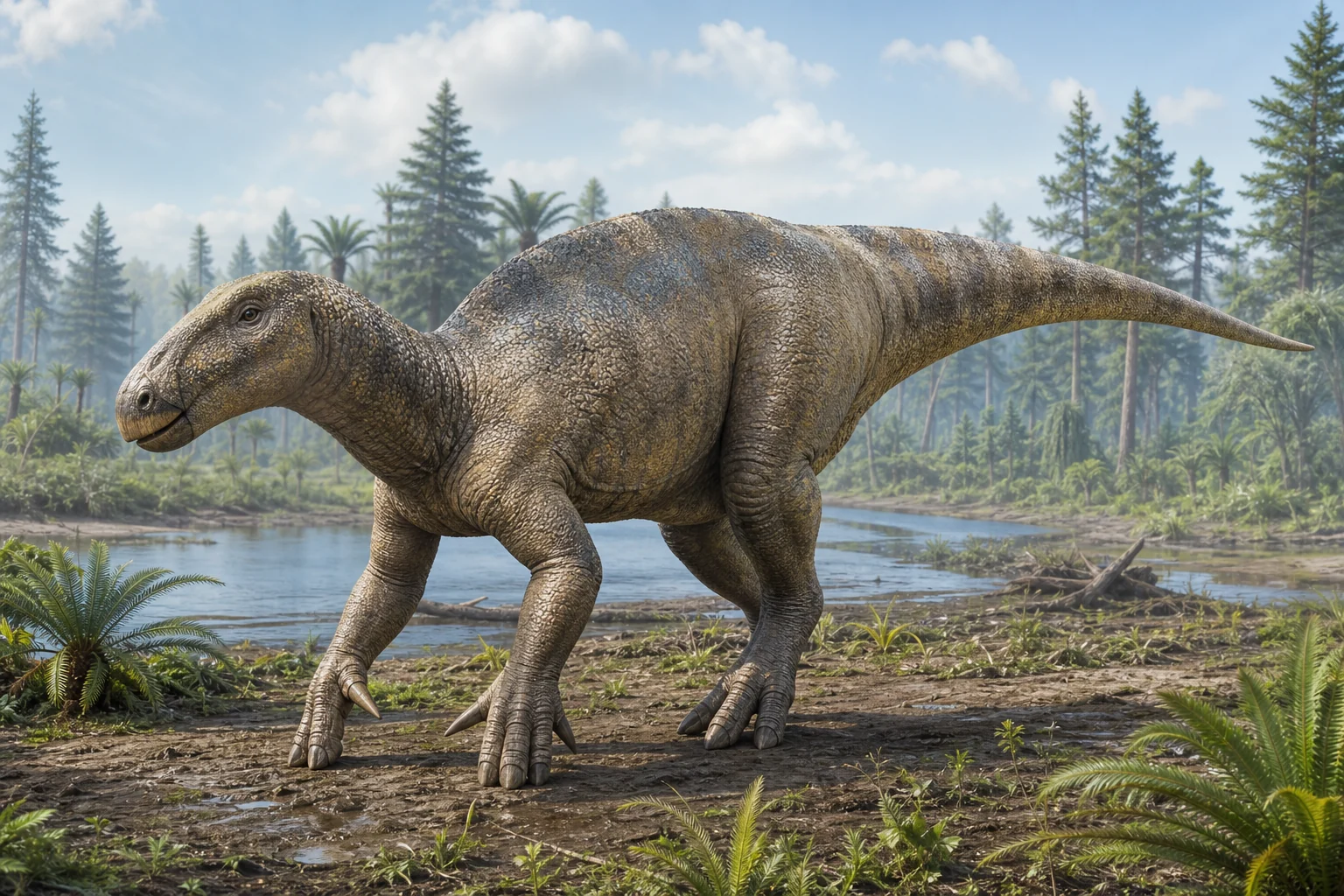 View original image · 1536 × 1024
- Time range
- About 126–122 million years ago
- Final stage
- Early Cretaceous
- Geographic range
- Western Europe
01 / ANSWER FIRST
What was Iguanodon?
Iguanodon was a large Early Cretaceous plant-eating ornithopod with a beaked mouth, powerful hindlimbs, weight-bearing middle fingers and a conical thumb spike.
It was one of the first dinosaurs named, but its image changed dramatically. The famous spike was first placed on the nose; Bernissart skeletons moved it to the hand, and modern biomechanics replaced the upright kangaroo pose with a mostly horizontal body capable of both quadrupedal and bipedal movement.
02 / QUICK FACTS
Iguanodon at a glance
- Scientific name
- Iguanodon bernissartensis
- Age
- Early Cretaceous, about 126–122 Ma
- Length
- About 9–10 m
- Mass
- Several tonnes; estimate varies
- Diet
- Leaves, shoots and other vegetation
- Range
- Western Europe
- Locomotion
- Mostly quadrupedal, capable of bipedal movement
- Key locality
- Bernissart, Belgium
03 / ANATOMY
A five-fingered hand with three different jobs
Thumb spike
The first digit formed a keratin-covered cone. Defence is plausible, but display, plant handling and intraspecific use remain possible.
Weight-bearing middle fingers
Digits two to four were bound into a hoof-like support for walking on all fours.
Flexible fifth finger
The outer digit could bend and oppose the others, helping pull branches or manipulate food.
Horizontal spine and tail
A stiffened back and tail held the trunk horizontally; the tail was not dragged as in nineteenth-century mounts.
04 / DIET & BEHAVIOUR
What did Iguanodon eat?
A keratinous beak cropped vegetation while batteries of cheek teeth shredded it. Jaw movement was more complex than simple up-and-down biting but not identical to mammal chewing.
05 / DIET & BEHAVIOUR
Did Iguanodon live in herds?
Many Bernissart individuals were buried together, but a mass death assemblage does not automatically prove permanent social herds. Trackways and repeated group sites provide additional, still debated context.
06 / RANGE & HABITAT
Where did Iguanodon live?
Secure Iguanodon bernissartensis material is best known from Belgium and nearby western Europe; older global assignments have often been moved to other iguanodontian genera.
River floodplains
Channels, lakes and vegetated margins provided food and burial settings.
Bernissart sinkhole
Dozens of skeletons accumulated deep below the surface, preserving a uniquely informative assemblage.
Fragmented European islands
Early Cretaceous sea levels divided western Europe into islands and continental margins, influencing dinosaur distribution.
07 / FOSSIL EVIDENCE
How did Iguanodon change the image of dinosaurs?
Mantell's teeth
Large herbivorous teeth inspired the name 'iguana tooth' and demonstrated that giant fossil reptiles were not all carnivores.
Bernissart skeletons
About thirty relatively complete skeletons revealed hands, feet and body proportions unavailable from isolated British fragments.
Changing museum mounts
Historical mounts record scientific ideas of their time: nose horn, upright biped and later horizontal facultative quadruped.
Taxonomic revision
Many species once called Iguanodon are now Mantellisaurus or other genera, narrowing what the name reliably represents.
08 / DISAPPEARANCE & DEBATE
Why did Iguanodon disappear?
Iguanodon bernissartensis disappeared during Early Cretaceous regional faunal and environmental turnover, long before the end-Cretaceous asteroid impact.
The fossil record rarely captures a final population. Changing geography, vegetation and dinosaur communities can explain replacement at broad scale, but no single event is documented as the species' direct cause.
09 / FREQUENTLY ASKED QUESTIONS
Iguanodon FAQ
Was Iguanodon's spike on its nose?
No. Complete hands from Bernissart showed that the cone was the first finger—a specialised thumb spike.
Did Iguanodon walk on two legs or four?
It could use both. Adults probably spent much time on all fours but could rise or move bipedally when useful.
How big was Iguanodon?
Iguanodon bernissartensis was roughly nine to ten metres long and weighed several tonnes, with individual and model variation.
Why were so many found at Bernissart?
The animals accumulated in a deep geological structure, but whether one disaster, repeated deaths or transport produced the assemblage remains studied.
04 / SOURCES & FURTHER READING
Check the source record
Use the scientific name to compare taxonomy, occurrence records and the fossil record. Database coverage and classifications may differ.
05 / REVISION HISTORY
How has this record changed?
- Rewrote an extinction cause that presented environmental or faunal turnover as established; it is now given as context the record does not prove.
- Expanded into a curated bilingual A-tier profile with anatomy, ecology, range, evidence, debate and FAQs.
- Verified authoritative entity sources and added three responsive reconstruction sizes.
- Initial bilingual species record published.
06 / CORRECTIONS & ADDITIONS