
Explore this animal in Size of Extinct Animals ↗
436 / Paleozoic
Hibbertopterus
Hibbertopterus scouleri
A giant sea scorpion that raked soft sediment for food; a Scottish trackway suggests an animal about 1.6 m long.
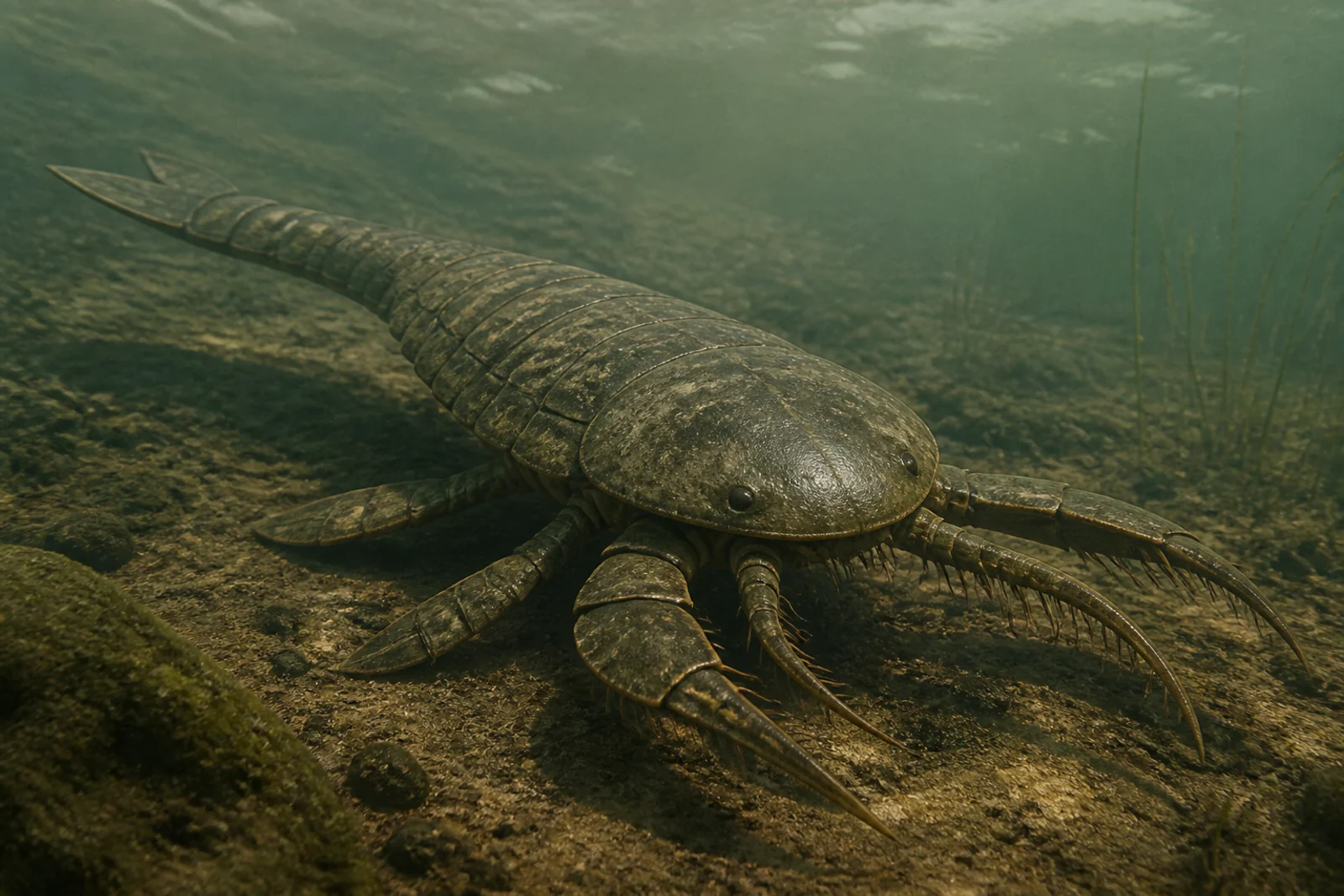 View original image · 1600 × 1067
- Time range
- About 330–300 million years ago
- Final stage
- End of the Carboniferous
- Geographic range
- Freshwater estuary and lagoon · Scotland
01 / ANSWER FIRST
What was Hibbertopterus?
Hibbertopterus was a giant eurypterid, or sea scorpion, from the Carboniferous. Rather than chasing prey, it is interpreted as a sweep-feeder that raked soft sediment for small animals.
Its most striking evidence is a trackway in Scotland, the largest known land trackway of a walking arthropod.
02 / QUICK FACTS
Hibbertopterus at a glance
- Animal group
- Hibbertopterid eurypterid (sea scorpion)
- Trackmaker size
- About 1.6 m long and 1 m wide (2005 trackway)
- Feeding
- Sweep-feeding with bladed front limbs
- Age
- Carboniferous; trackway about 330 million years old
How big was Hibbertopterus?
Martin Whyte described a 330-million-year-old trackway from Fife, Scotland, in 2005. He attributed it to a six-legged Hibbertopterus about 1.6 metres long and a metre wide, and it was the first record of this genus moving on land.
Larger figures near 2 metres circulate for H. scouleri, but they are extrapolated from partial armour. A trackway size also comes from spacing and width, so both kinds of estimate carry uncertainty.
03 / ANATOMY
How did Hibbertopterus feed?
Raking blades
Hibbertopterids carried specialized blades on forward-facing limbs, used to rake through soft sediment and capture small invertebrates.
Broad, heavy body
Hibbertopterus was unusually wide for a eurypterid. That shape suits slow movement along the bottom rather than fast pursuit.
04 / DIET & BEHAVIOUR
What did Hibbertopterus eat?
Small invertebrates and organic matter swept from the sediment. Sweep-feeding may have let hibbertopterids stay large while avoiding competition with fish.
05 / DIET & BEHAVIOUR
Could it walk on land?
The trackway shows it could move out of water, at least briefly. It records a slow, lumbering gait with the tail dragging.
06 / RANGE & HABITAT
Where did Hibbertopterus live?
H. scouleri comes from Carboniferous rocks in Scotland; related species are known elsewhere.
Scotland
The type species and the giant trackway are both Scottish, from Carboniferous coastal and freshwater-influenced settings.
A wider family
A 2022 study named a smaller species, H. lamsdelli, about 1.1 m long, from the Late Carboniferous of New Mexico, and reviewed the family.
07 / FOSSIL EVIDENCE
What does the evidence establish?
A trackway is behaviour
Footprints record a living animal moving over sediment. They show land movement more directly than body armour can.
Attribution is inferred
No body was found at the end of the trackway. It is linked to Hibbertopterus by size and limb arrangement.
08 / DISAPPEARANCE & DEBATE
Why did Hibbertopterus go extinct?
The cited sources do not establish a species-specific extinction cause.
Sweep-feeding hibbertopterids as a group persisted into the Permian, so the disappearance of H. scouleri is not the end of its lineage.
09 / FREQUENTLY ASKED QUESTIONS
Hibbertopterus FAQ
Was Hibbertopterus a scorpion?
No. Eurypterids are called sea scorpions, but they form a separate extinct group of chelicerates.
How big was Hibbertopterus?
The Scottish trackway suggests an animal about 1.6 m long and 1 m wide; larger figures are less certain extrapolations.
Did Hibbertopterus hunt?
It is interpreted as a sweep-feeder that raked sediment for small prey, not an active pursuit predator.
04 / SOURCES & FURTHER READING
Check the source record
Use the scientific name to compare taxonomy, occurrence records and the fossil record. Database coverage and classifications may differ.
05 / REVISION HISTORY
How has this record changed?
- Expanded answers to reader questions, clarified the scope of fossil evidence and improved routes to related explanations.
- Added a sourced bilingual topic hub covering size, discovery history, anatomy, diet, habitat, uncertainty and FAQs; updated search metadata.
- Verified authoritative entity sources and added three responsive reconstruction sizes.
- Initial bilingual species record published.
06 / CORRECTIONS & ADDITIONS