
Explore this animal in Size of Extinct Animals ↗
212 / Paleozoic
Acanthostega
Acanthostega gunnari
Each forelimb carried eight digits, yet the animal was still mainly aquatic—digits evolved before true land walking.
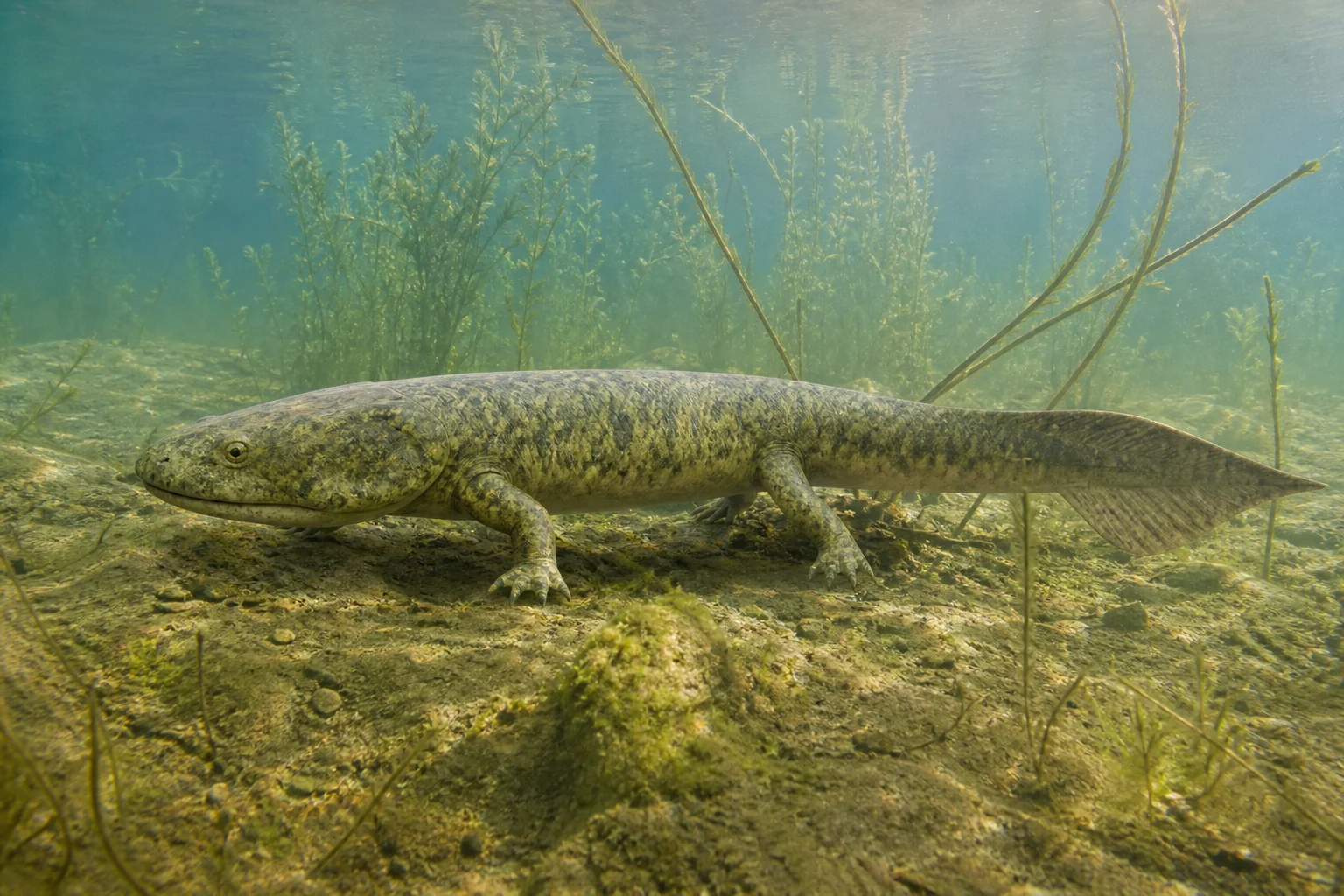 View original image · 1536 × 1024
- Time range
- About 365 million years ago
- Final stage
- Late Devonian
- Geographic range
- Channels and seasonal shallows · East Greenland
01 / ANSWER FIRST
What was Acanthostega?
Acanthostega gunnari was an early limbed vertebrate from the Late Devonian of East Greenland. It had legs with digits but remained mainly aquatic.
Its forelimb had eight digits, and it kept fish-like internal gills. Together these show that limbs with digits evolved before animals were fully adapted to walking on land.
02 / QUICK FACTS
Acanthostega at a glance
- Digits
- Eight on each forelimb
- Breathing
- Fish-like internal gills retained
- Age
- Late Devonian, about 365 million years ago
- Known specimens
- Mass-death deposit; studied individuals were juveniles
Why did Acanthostega have eight fingers?
Coates and Clack reported in 1990 that the forelimb of Acanthostega had eight digits, while the hindlimb of its relative Ichthyostega had seven. The earliest known tetrapod limbs were therefore polydactylous: the five-digit pattern of later tetrapods was not there from the start.
The authors argued that such limbs were probably adaptations for aquatic life, such as moving through vegetation in shallow water, rather than for walking on dry ground.
03 / ANATOMY
How aquatic was Acanthostega?
Fish-like gills
In 1991 Coates and Clack described grooved gill-arch bones like those of fishes, indicating internal gills and aquatic breathing. The earliest tetrapods were not fully terrestrial.
Limbs not built for land
Its wrists and ankles were poorly suited to bearing body weight, and it kept a finned tail. Limbs helped support and steer it in water.
04 / DIET & BEHAVIOUR
What did Acanthostega eat?
Its teeth and aquatic lifestyle suggest it caught small aquatic prey. The fossils do not preserve a specific diet.
05 / DIET & BEHAVIOUR
Where did it live?
Its fossils come from river channel deposits in East Greenland, then part of a tropical landmass.
06 / RANGE & HABITAT
What does the Greenland deposit reveal?
Many Acanthostega specimens come from a single mass-death deposit.
All juveniles
In 2016 Sanchez and colleagues used synchrotron scans of upper-arm bones to read growth histories. Even the largest individuals studied were still juveniles, at least six years old, whose growth had not yet slowed.
What that changes
The adult form of Acanthostega may not be represented. Conclusions about its aquatic life apply at least to young animals and may differ for adults.
07 / FOSSIL EVIDENCE
Why Acanthostega matters
Limbs before land
Digits, gills and a finned tail in one animal show that key tetrapod features evolved in water.
08 / DISAPPEARANCE & DEBATE
Why did Acanthostega go extinct?
The cited studies do not establish a species-specific extinction cause.
The Late Devonian saw major biotic crises, but a broad crisis is not direct evidence of what ended this species.
09 / FREQUENTLY ASKED QUESTIONS
Acanthostega FAQ
How many fingers did Acanthostega have?
Eight on each forelimb.
Could Acanthostega walk on land?
Probably not well. Its limbs were suited to water, and it kept internal gills.
Was Acanthostega a fish or an amphibian?
Neither in the modern sense: it was an early stem tetrapod, a limbed vertebrate close to the origin of all land vertebrates.
04 / SOURCES & FURTHER READING
Check the source record
Use the scientific name to compare taxonomy, occurrence records and the fossil record. Database coverage and classifications may differ.
05 / REVISION HISTORY
How has this record changed?
- Expanded answers to reader questions, clarified the scope of fossil evidence and improved routes to related explanations.
- Added a sourced bilingual topic hub covering size, discovery history, anatomy, diet, habitat, uncertainty and FAQs; updated search metadata.
- Verified authoritative entity sources and added three responsive reconstruction sizes.
- Initial bilingual species record published.
06 / CORRECTIONS & ADDITIONS