
Explore this animal in Size of Extinct Animals ↗
53 / Mesozoic
Dilophosaurus
Dilophosaurus wetherilli
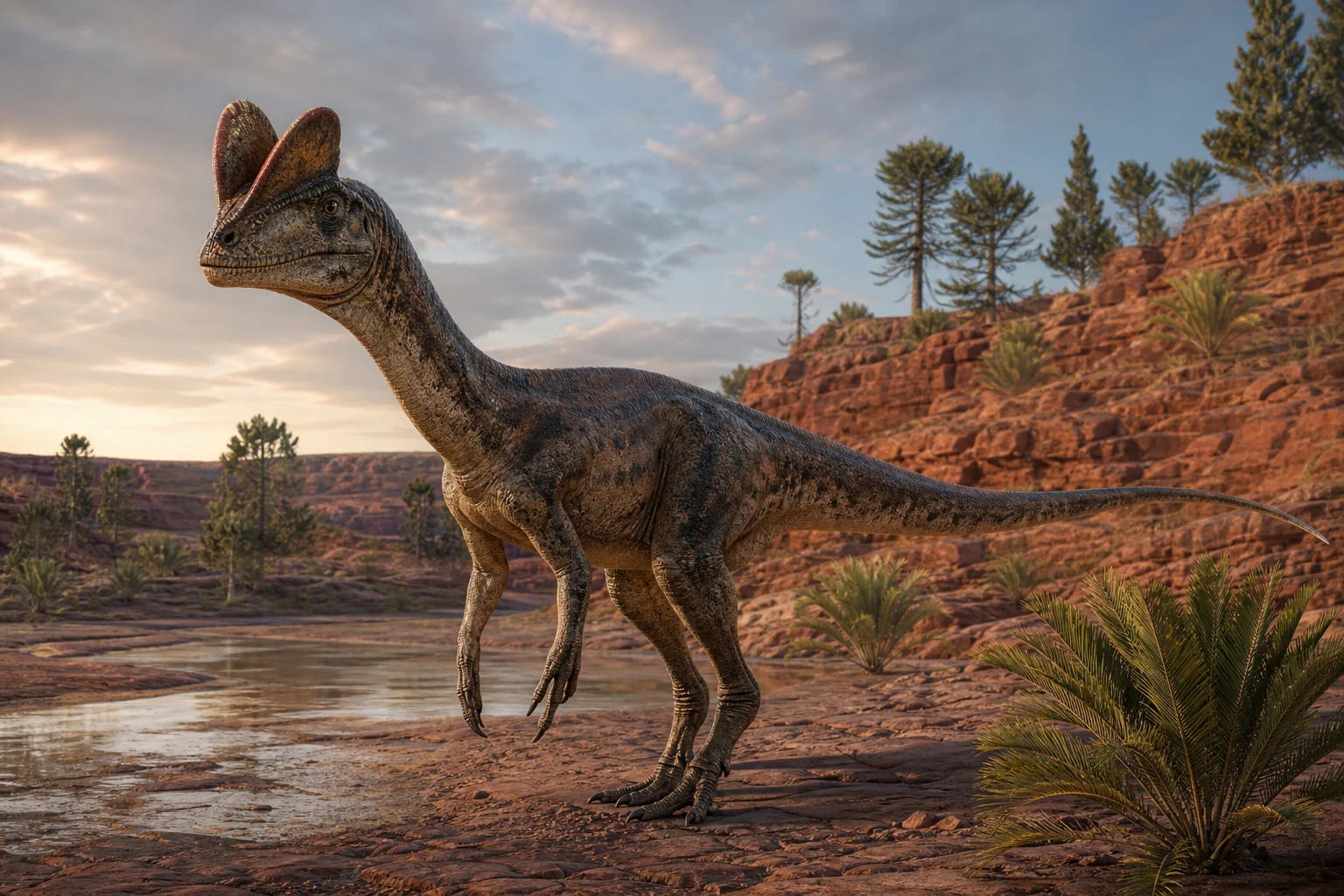
Dilophosaurus wetherilli was a large Early Jurassic predator from northern Arizona. Two thin crests on its skull gave it its name.
 View original image · 1536 × 1024
Structured expansion · editorial review pending
- Time range
- About 193 million years ago
- Final stage
- Early Jurassic
- Geographic range
- Southwestern North America
01 / ANSWER FIRST
What does the evidence show about Dilophosaurus?
Dilophosaurus wetherilli was a large Early Jurassic predator from northern Arizona. Two thin crests on its skull gave it its name.
The 2020 redescription by Marsh and Rowe examined five specimens, providing a stronger anatomical basis than its familiar film portrayal.
02 / QUICK FACTS
Dilophosaurus at a glance
- Scientific name
- Dilophosaurus wetherilli
- Research focus
- Paired crests
03 / ANATOMY
How was Dilophosaurus built?
Paired crests
Nasal and lacrimal bones contribute to the crests. Their presence is fossil evidence; their precise color is not.
A substantial predator
The revised skull and skeleton support a powerful animal, with air-filled spaces in parts of the bones.
04 / DIET & BEHAVIOUR
Carnivory
Teeth and jaws support meat eating. Identifying a particular prey species requires evidence beyond the predator's size.
05 / DIET & BEHAVIOUR
Movie features
No fossil evidence establishes a deployable neck frill or venom spitting in Dilophosaurus.
06 / RANGE & HABITAT
Where and when did Dilophosaurus live?
The discussed skeletons come from the Kayenta Formation on Navajo Nation land in northern Arizona. Collection history and specimen stewardship are part of their scientific context.
07 / FOSSIL EVIDENCE
What evidence supports reconstructions of Dilophosaurus?
Five specimens compared
The 2020 analysis grouped the examined specimens as one crested species rather than splitting their differences into several taxa.
Anatomy can change
Newly described material and closer preparation changed interpretations of the skull and body. Reconstructions should state which study they follow.
08 / DISAPPEARANCE & DEBATE
What remains uncertain?
Its Early Jurassic occurrence is far earlier than the end-Cretaceous impact. The linked anatomy study does not establish its extinction cause.
The linked sources support the specific observations above. An occurrence record alone does not identify an extinction mechanism.
09 / FREQUENTLY ASKED QUESTIONS
Dilophosaurus FAQ
Did it spit venom?
That is a fictional feature, not a demonstrated fossil finding.
Is the neck frill real?
It is not supported by the known Dilophosaurus fossils.
04 / SOURCES & FURTHER READING
Check the source record
Use the scientific name to compare taxonomy, occurrence records and the fossil record. Database coverage and classifications may differ.
05 / REVISION HISTORY
How has this record changed?
- Replaced repeated expansion text with specimen-specific evidence, linked research and explicit limits; independent editorial review is pending.
- Completed an AI-assisted bilingual audit of the archive record, corrected identified issues and clarified evidence limits; independent editorial review is pending.
- Expanded into a structured bilingual profile with anatomy, ecology, range, evidence, debate and FAQs; independent editorial review is pending.
- Verified authoritative entity sources and added three responsive reconstruction sizes.
- Initial bilingual species record published.
06 / CORRECTIONS & ADDITIONS