
Explore this animal in Size of Extinct Animals ↗
368 / Paleozoic
Zatrachys
Zatrachys serratus
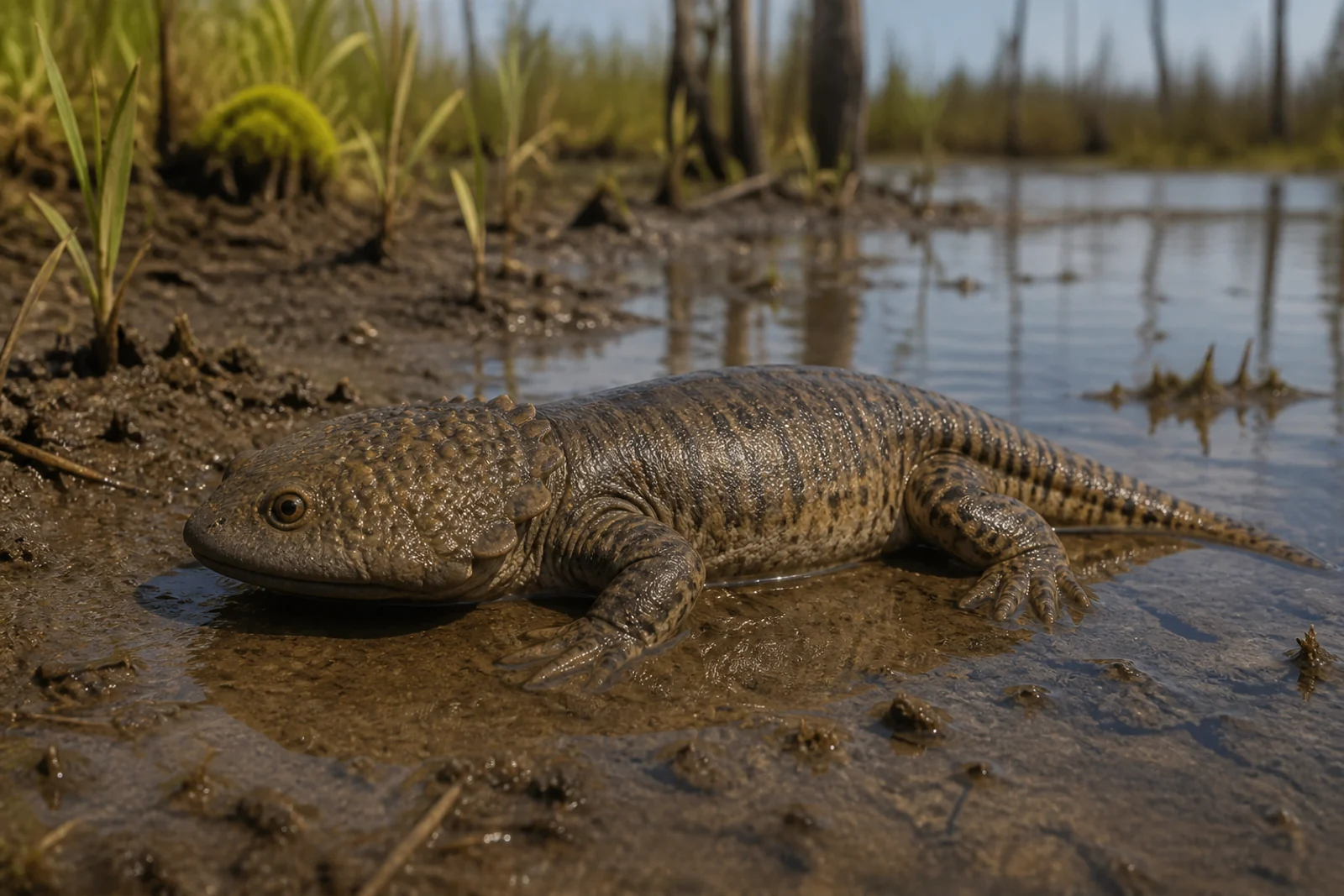
Its expanded skull margin bears bony projections; their function is unproven.
 View original image · 1600 × 1067
- Time range
- Late Carboniferous–Early Permian
- Final stage
- Last occurrence uncertain
- Geographic range
- Present-day United States, including West Virginia
01 / ANSWER FIRST
What was Zatrachys serratus?
Zatrachys serratus was an extinct temnospondyl known chiefly from skull material in North America. Its expanded, ornamented skull margins gave it an unusual outline.
A striking skull does not establish how an animal hunted, what its soft tissues looked like, or why its lineage disappeared.
02 / QUICK FACTS
Zatrachys at a glance
- Group
- Temnospondyl · Zatracheidae
- Known interval
- Late Carboniferous–Early Permian
- Fossil evidence
- Skulls and isolated cranial bones
- Reported localities
- Present-day United States, including West Virginia
03 / ANATOMY
What makes the Zatrachys skull distinctive?
Expanded skull margins
Schoch's 1997 anatomical study examined the cranial characters used to distinguish Zatrachys and its relatives. The bony projections are preserved; any proposed protective role needs separate testing.
An incomplete body
Skull fossils do not supply a complete skeleton or direct measurements of body length. Drawings that add a full body are reconstructions.
04 / DIET & BEHAVIOUR
What did it eat?
Its skull and jaws can inform feeding hypotheses, but the cited cranial studies do not document a particular prey species or a witnessed hunting sequence.
05 / DIET & BEHAVIOUR
Was it aquatic?
Temnospondyl relationships and fossil settings provide context. With little postcranial material, an exact division of time between land and water remains uncertain for Zatrachys.
06 / RANGE & HABITAT
When and where did Zatrachys live?
The record spans more than a single Early Permian date. A 2007 report identifies Z. serratus cranial material from two different geological intervals in West Virginia.
Late Carboniferous
Urban and Berman reported a partial skull table from the Upper Pennsylvanian Benwood Limestone Member in West Virginia.
Early Permian
The same paper reported isolated cranial elements from the Lower Permian Greene Formation. Fossil-bearing layers establish occurrences, not an exact birth or extinction date for the species.
07 / FOSSIL EVIDENCE
What can the fossils actually establish?
Skull anatomy
Comparative cranial characters are the basis for classification. A fragmentary specimen carries less anatomical information than a complete skull.
Geological range
The eastern US material extends the reported range into the Late Carboniferous. Do not convert the geological intervals into a precise 295–270-million-year lifespan.
08 / DISAPPEARANCE & DEBATE
Why did Zatrachys go extinct?
The cited studies do not establish a specific extinction cause or the date of the last individual.
A gap after the youngest identified fossil may reflect preservation and sampling. Wetland drying or competitive replacement cannot be treated as demonstrated causes for this species.
09 / FREQUENTLY ASKED QUESTIONS
Zatrachys FAQ
Did Zatrachys live only in the Permian?
No. A 2007 study reported Z. serratus cranial material from Upper Pennsylvanian as well as Lower Permian strata in West Virginia.
How big was Zatrachys?
The cited skull material does not give a reliable whole-body length. A precise length would depend on an explicit reconstruction and specimen.
04 / SOURCES & FURTHER READING
Check the source record
Use the scientific name to compare taxonomy, occurrence records and the fossil record. Database coverage and classifications may differ.
05 / REVISION HISTORY
How has this record changed?
- Expanded this profile with research sources, focused questions and explicit limits on reconstructions; updated search metadata.
- Verified authoritative entity sources and added three responsive reconstruction sizes.
- Initial bilingual species record published.
06 / CORRECTIONS & ADDITIONS