
Explore this animal in Size of Extinct Animals ↗
167 / Paleozoic
Sacabambaspis
Sacabambaspis janvieri
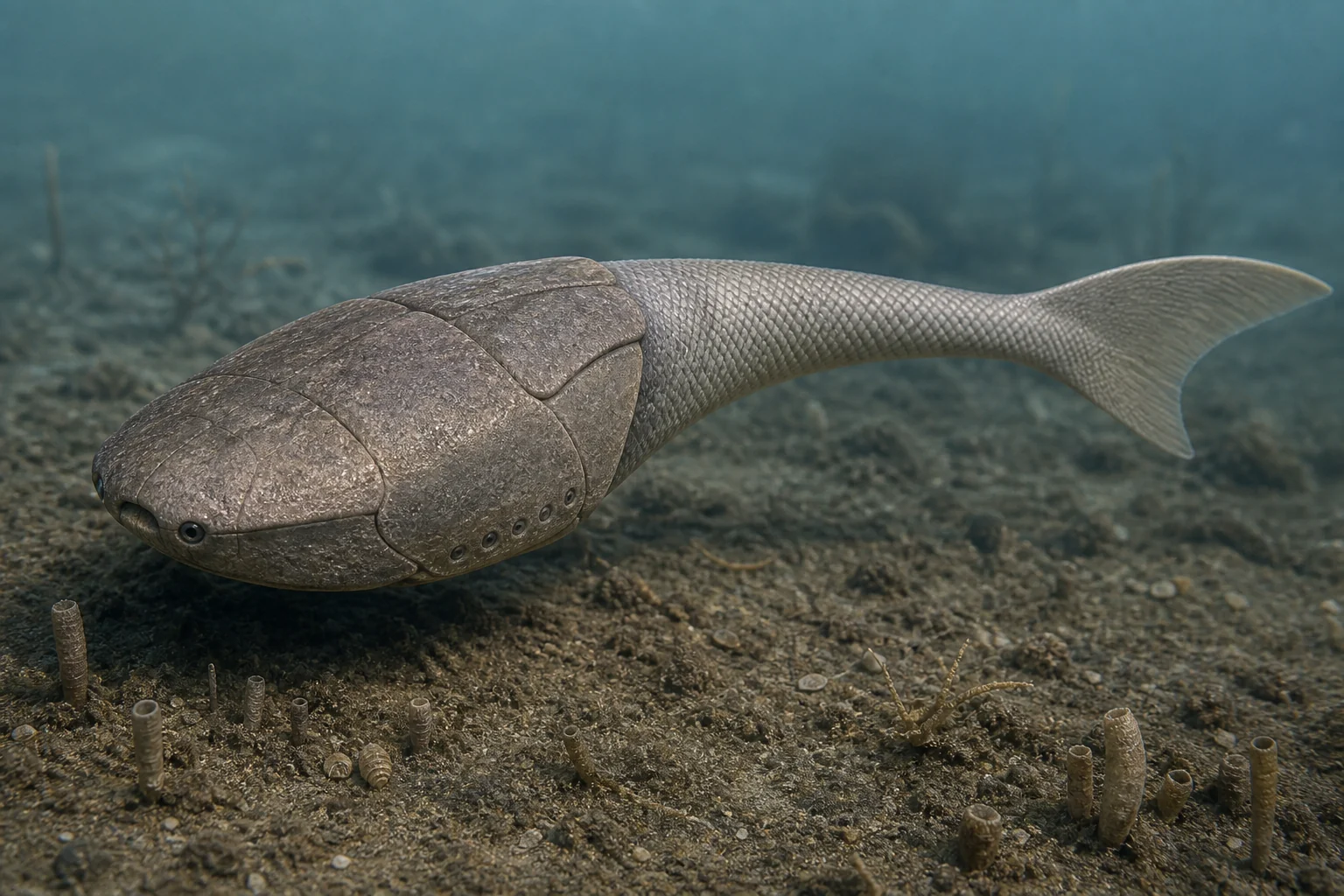
An armored jawless fish with a broad head shield and an elongated tail; fossil distortion leaves parts of the tail outline uncertain.
 View original image · 1536 × 1024
- Time range
- Middle–Late Ordovician
- Final stage
- Last occurrence uncertain
- Geographic range
- Gondwanan shallow seas · Species records in Bolivia and Argentina
01 / ANSWER FIRST
Was Sacabambaspis a real animal?
Yes. Sacabambaspis janvieri is a fossil jawless fish from the Ordovician. Articulated specimens from Bolivia preserve more than isolated pieces of armor.
A model is an interpretation of these remains. The scientific name anchors this profile to a particular species rather than every fossil assigned to the genus.
02 / QUICK FACTS
Sacabambaspis at a glance
- Group
- Armored jawless fish · Arandaspididae
- Interval
- Middle–Late Ordovician records
- Key locality
- Anzaldo Formation, Bolivia
- Tail specimen
- MHNC 1182 · redescribed in 2007
03 / ANATOMY
What did its armor and tail look like?
Mineralized armor
A 2005 microscopic study identified layered armor with acellular bone, dentine and enameloid. External shape and tissue structure provide different kinds of evidence.
A long tail extension
The 2007 re-preparation of MHNC 1182 revealed an elongated notochordal lobe with a small fin web at its tip. Unequal upper and lower webs suggest a downward-directed, or hypocercal, tail; distortion leaves the exact outline uncertain.
04 / DIET & BEHAVIOUR
Did it have jaws?
No. It was an arandaspid jawless vertebrate. Mineralized tissues in its armor do not mean it possessed the biting jaws of modern jawed fish.
05 / DIET & BEHAVIOUR
What did it eat?
The cited armor and tail studies do not establish an exact menu. Feeding reconstructions should remain hypotheses rather than lists of confirmed prey.
06 / RANGE & HABITAT
Where did Sacabambaspis live?
Ordovician deposits around Gondwana preserve different levels of evidence, from articulated bodies to isolated plates.
South American species records
S. janvieri is documented from Bolivia and Argentina. The Bolivian Anzaldo material anchors the published tail reconstruction.
Wider genus records
A 2009 paper assigned Omani armor fragments to Sacabambaspis sp. Genus-level finds, including records discussed from Australia, should not automatically enlarge this species' confirmed range.
07 / FOSSIL EVIDENCE
How are fossil and reconstruction separated?
Check the specimen
MHNC 1182 supplies a testable reference for the tail. A restoration should show where preserved structures end and inferred connections begin.
Check the identification
The label “sp.” means the fossil was assigned to a genus without a named species identification. It matters when comparing maps or geological ranges.
08 / DISAPPEARANCE & DEBATE
Why did Sacabambaspis go extinct?
The cited studies do not establish a specific extinction mechanism for S. janvieri.
An Ordovician fossil does not by itself demonstrate survival until the end-Ordovician mass extinction. A last known fossil and the death of the final individual are different claims.
09 / FREQUENTLY ASKED QUESTIONS
Sacabambaspis FAQ
Was Sacabambaspis a dinosaur?
No. It was an Ordovician jawless fish, not a dinosaur.
Did Sacabambaspis have a symmetrical tail?
The 2007 study favored unequal fin webs around a long notochordal extension, with a small terminal web. Fossil distortion prevents a fully certain outline.
Are all Sacabambaspis fossils the same species?
Not necessarily. Material identified only as Sacabambaspis sp., such as the described Oman fragments, is not a confirmed record of S. janvieri.
04 / SOURCES & FURTHER READING
Check the source record
Use the scientific name to compare taxonomy, occurrence records and the fossil record. Database coverage and classifications may differ.
05 / REVISION HISTORY
How has this record changed?
- Expanded this profile with research sources, focused questions and explicit limits on reconstructions; updated search metadata.
- Verified authoritative entity sources and added three responsive reconstruction sizes.
- Initial bilingual species record published.
06 / CORRECTIONS & ADDITIONS