
Explore this animal in Size of Extinct Animals ↗
34 / Paleozoic
Cameroceras
Cameroceras trentonense
A long straight shell housed one of the largest predators of Ordovician seas.
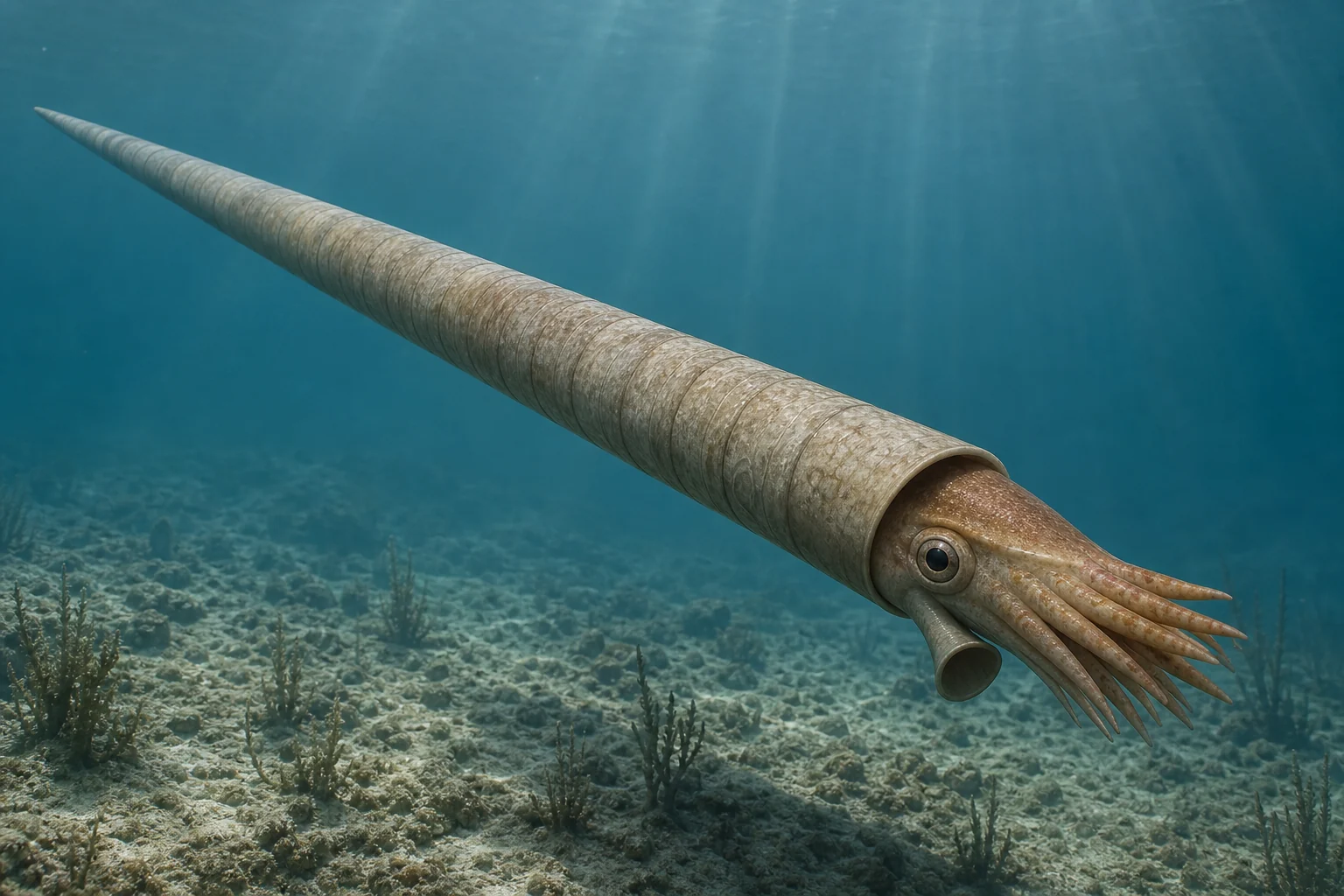 View original image · 1536 × 1024
- Time range
- About 470–450 million years ago
- Final stage
- Middle Ordovician
- Geographic range
- Laurentian shallows · Present-day North America
Cameroceras size: shell length is only part of the animal
Cameroceras was a straight-shelled cephalopod. Chambered shell fossils are the main evidence; the largest complete body size and the full soft anatomy remain uncertain.
What can be measured?
Preserved shell length and diameter are measurements of an object. Reconstructing a missing tip or the head and arms adds assumptions. Keep those parts separate when comparing a fossil with a full-body illustration.
Is it a giant squid?
No. Both are cephalopods, but Cameroceras carried an external chambered shell and belonged to an extinct endocerid group. Modern squid anatomy cannot simply be attached to a long fossil shell.
01 / ANSWER FIRST
What was Cameroceras?
Cameroceras was a large straight-shelled endocerid cephalopod that lived in warm shallow seas during the Middle Ordovician.
Its conical shell was divided into chambers and penetrated by an unusually large siphuncle used in buoyancy and shell growth. Popular images often show a many-metre super-predator, but incomplete shells and tangled historical taxonomy make exact size and identity difficult.
02 / QUICK FACTS
Cameroceras at a glance
- Scientific name
- Cameroceras trentonense
- Age
- Middle Ordovician, about 470–450 Ma
- Group
- Endocerid cephalopod
- Shell
- Long, straight and chambered
- Size
- Large; complete maximum uncertain
- Diet
- Likely mobile marine prey and carrion
- Range
- Laurentian seas, especially North America
- Main evidence
- Shells, septa and siphuncles
03 / ANATOMY
What survives of a giant orthocone?
Chambered shell
Septa divided the shell into chambers behind the living chamber, strengthening it and participating in buoyancy control.
Large siphuncle
The siphuncle occupied an unusually large part of the shell and accumulated internal deposits that changed mass distribution through growth.
Soft body unknown
No complete arms, eyes or skin are preserved with Cameroceras, so reconstructions borrow cautiously from other cephalopods.
Horizontal or oblique posture
Shell geometry and internal weights inform posture, but a perfectly horizontal submarine-like pose is not directly fossilised.
04 / DIET & BEHAVIOUR
Was Cameroceras an apex predator?
Its size and cephalopod feeding apparatus make predation plausible, yet prey and hunting method are inferred because gut contents and soft mouthparts are rare. It may have taken trilobites, smaller cephalopods and other animals.
05 / DIET & BEHAVIOUR
How did it move?
Jet propulsion could adjust position, while the long shell likely limited tight turns. Buoyancy control may have supported slow cruising or ambush rather than agile pursuit.
06 / RANGE & HABITAT
Where did Cameroceras live?
Named material is associated with Ordovician carbonate seas of Laurentia. Many old reports need taxonomic rechecking before being treated as the same genus.
Warm continental shelves
Carbonate seafloors supported trilobites, brachiopods, cephalopods and complex predator-prey networks.
Open shallow water
Long shells required room to manoeuvre and may have stayed above the substrate.
Shell beds
Currents can sort and break orthocones, so a concentration of fragments does not automatically mark a living aggregation.
07 / FOSSIL EVIDENCE
Why are Cameroceras reconstructions uncertain?
Incomplete shells
The tip or living chamber is often missing, so total length must be extrapolated from fragments.
Historical wastebasket taxonomy
Large straight endocerids were often assigned to Cameroceras broadly; later work may move specimens to Endoceras or other genera.
Internal shell anatomy
Septa, connecting rings and siphuncle deposits carry more taxonomic information than overall straight shape alone.
Soft-tissue inference
Arms, funnel, eyes and diet are reconstructed from cephalopod relationships rather than direct complete preservation.
08 / DISAPPEARANCE & DEBATE
Why did Cameroceras disappear?
Cameroceras disappeared during long-term Ordovician cephalopod turnover; a single species-level extinction trigger is not known.
Changing seas, competitors, prey communities and later crises reshaped straight-shelled cephalopods. It is safer to describe this as lineage turnover than to assign one dramatic cause without direct evidence.
09 / FREQUENTLY ASKED QUESTIONS
Cameroceras FAQ
How big was Cameroceras?
It was a large orthocone, but popular six-to-nine-metre claims often combine incomplete specimens and uncertain identifications. Exact maxima remain unresolved.
Was Cameroceras a squid?
No. It was an externally shelled cephalopod, more comparable in broad anatomy to ancient nautiloid-grade forms than to shell-less squid.
Did it have tentacles?
Almost certainly some form of arms or tentacles as a cephalopod, but their exact number and shape are not preserved for Cameroceras.
Was it the largest Ordovician predator?
It was among the largest animals in its seas, but incomplete material makes exact size rankings and ecological dominance uncertain.
04 / SOURCES & FURTHER READING
Check the source record
Use the scientific name to compare taxonomy, occurrence records and the fossil record. Database coverage and classifications may differ.
05 / REVISION HISTORY
How has this record changed?
- Rewrote an extinction cause that presented environmental or faunal turnover as established; it is now given as context the record does not prove.
- Expanded into a curated bilingual A-tier profile with anatomy, ecology, range, evidence, debate and FAQs.
- Verified authoritative entity sources and added three responsive reconstruction sizes.
- Initial bilingual species record published.
06 / CORRECTIONS & ADDITIONS