
MEGANEURA TOPIC HUB · SIZE & FLIGHT
Meganeura Size, Wings and Flight vs Dragonflies
Measure Meganeura monyi, distinguish griffinflies from true dragonflies and test how a 65-centimetre wingspan affected aerial hunting.
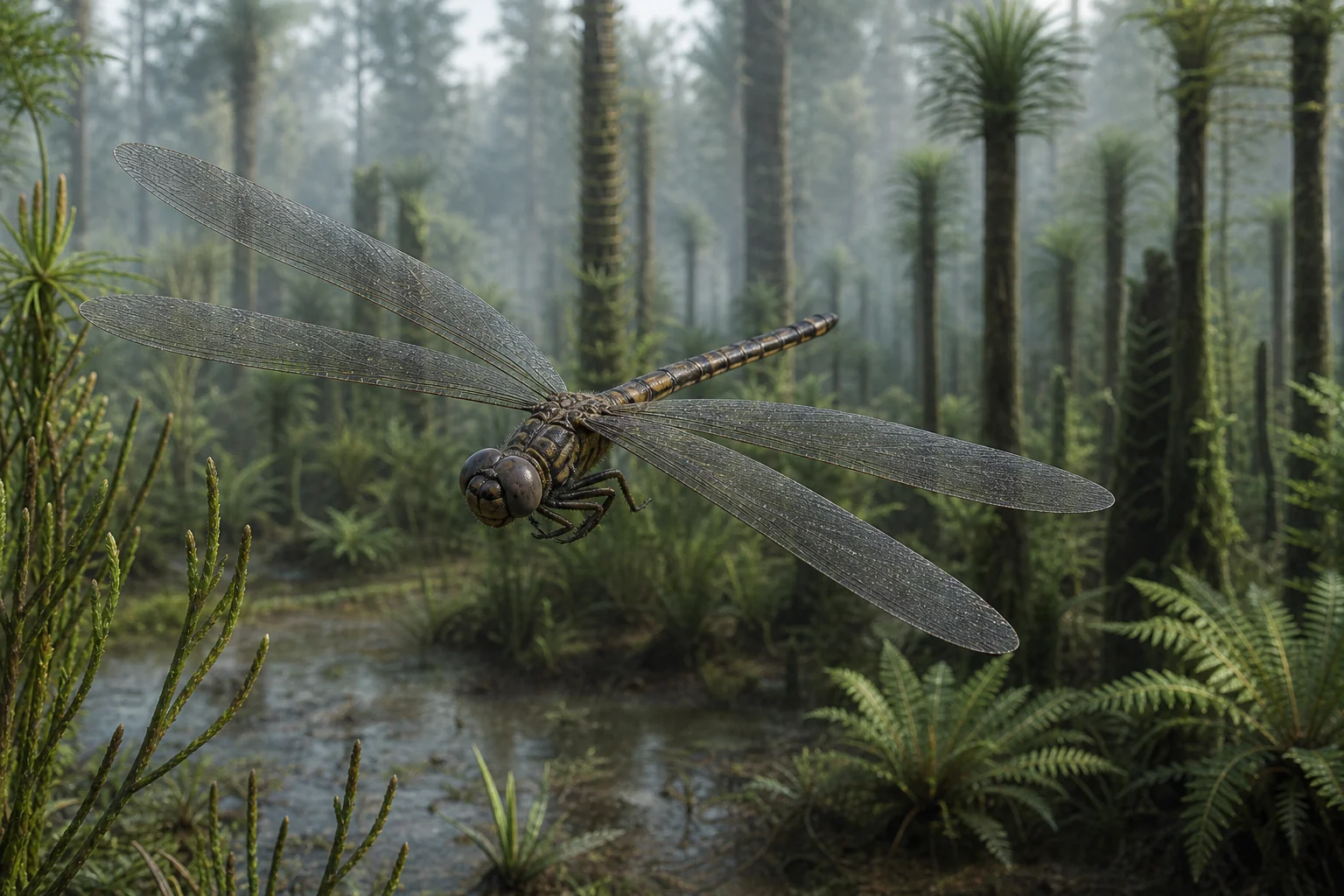 View full-resolution reconstruction ↗
This is an original generative reconstruction, not a photograph or scientific plate. Measurements and interpretations below are tied to named sources.
01 / FOSSIL MEASUREMENT
How is the wingspan estimated?
The Commentry type includes a large wing whose preserved length and base position support about 32 centimetres per side. Doubling wing length and allowing for the thorax yields a span near 65 centimetres, with reconstruction error.
02 / 71-CM CLAIM
Was Meganeura the largest insect ever?
The 71-centimetre figure usually comes from Permian Meganeuropsis or the maximum griffinfly range. Meganeura remains enormous, but genus-specific measurements should not be merged into a single record-holder image.
03 / GRIFFINFLY IDENTITY
How did it differ from a true dragonfly?
Meganeura belonged to extinct Meganisoptera, close to crown Odonata but with distinctive wing venation and other basal traits. 'Giant dragonfly' is a useful shape comparison, not a precise taxonomic label.
04 / FLIGHT MODEL
Could such a large insect stay airborne?
Four broad wings generated enough lift in modelling, and high Paleozoic air density and oxygen may have helped physiology. Flight feasibility is well supported; exact beat frequency, speed and endurance are not directly measured.
05 / AERIAL HAWKER
How did it catch prey?
Wing shape, visual head and spiny legs support intercepting insects in flight and holding them in a leg basket. Large size increased reach and momentum but also made rapid acceleration and tight turns more costly.
06 / MODERN COMPARISON
Why are modern dragonflies smaller?
Modern oxygen, developmental constraints, bird and bat competition and altered ecosystems all differ. No single comparison proves which factor set the upper limit, and living Odonata are not miniature copies of Meganeura.
FREQUENTLY ASKED QUESTIONS
Questions readers ask
How large was Meganeura?
Meganeura monyi is commonly reconstructed with a wingspan around 65 centimetres.
Was Meganeura a dragonfly?
No. It was a griffinfly in the extinct order Meganisoptera, close to but outside true Odonata.
Did Meganeura have a 71-centimetre wingspan?
About 71 cm is the upper range for giant griffinflies generally; M. monyi itself is more often reconstructed near 65 cm.
What did Meganeura eat?
It was probably an aerial predator of other insects, though exact prey is not preserved.
Did oxygen alone create giant insects?
No. High oxygen may have enabled larger bodies, but ecology, development and flight mechanics also mattered.
When did Meganeura live?
It lived in the late Carboniferous, roughly 305–299 million years ago.
SOURCES & FURTHER READING
Evidence used in this guide
Measurements and interpretations are tied to museum resources or peer-reviewed studies; disputed conclusions include evidence on both sides.
- 01Giant dragonflies ↗Natural History Museum, London
Museum overview of griffinfly identity, scale and Paleozoic insect flight.
- 02Fossil insect collection ↗Muséum national d'Histoire naturelle
Official account of the Commentry collection containing Meganeura monyi.
- 03Palaeozoic giant dragonflies were hawker predators ↗Scientific Reports · PMC6092361
Peer-reviewed aerodynamic evidence for active aerial predation.
- 04Atmospheric oxygen and the evolution of insect body size ↗Proceedings of the Royal Society B · PMC3390886
Large fossil-wing dataset testing oxygen and ecological controls through time.