
MEGANEURA TOPIC HUB · OXYGEN & GIGANTISM
Why Were Carboniferous Insects So Large?
Test the high-oxygen explanation for Meganeura and other giant insects against fossil size trends, tracheal physiology, flight mechanics and ecology.
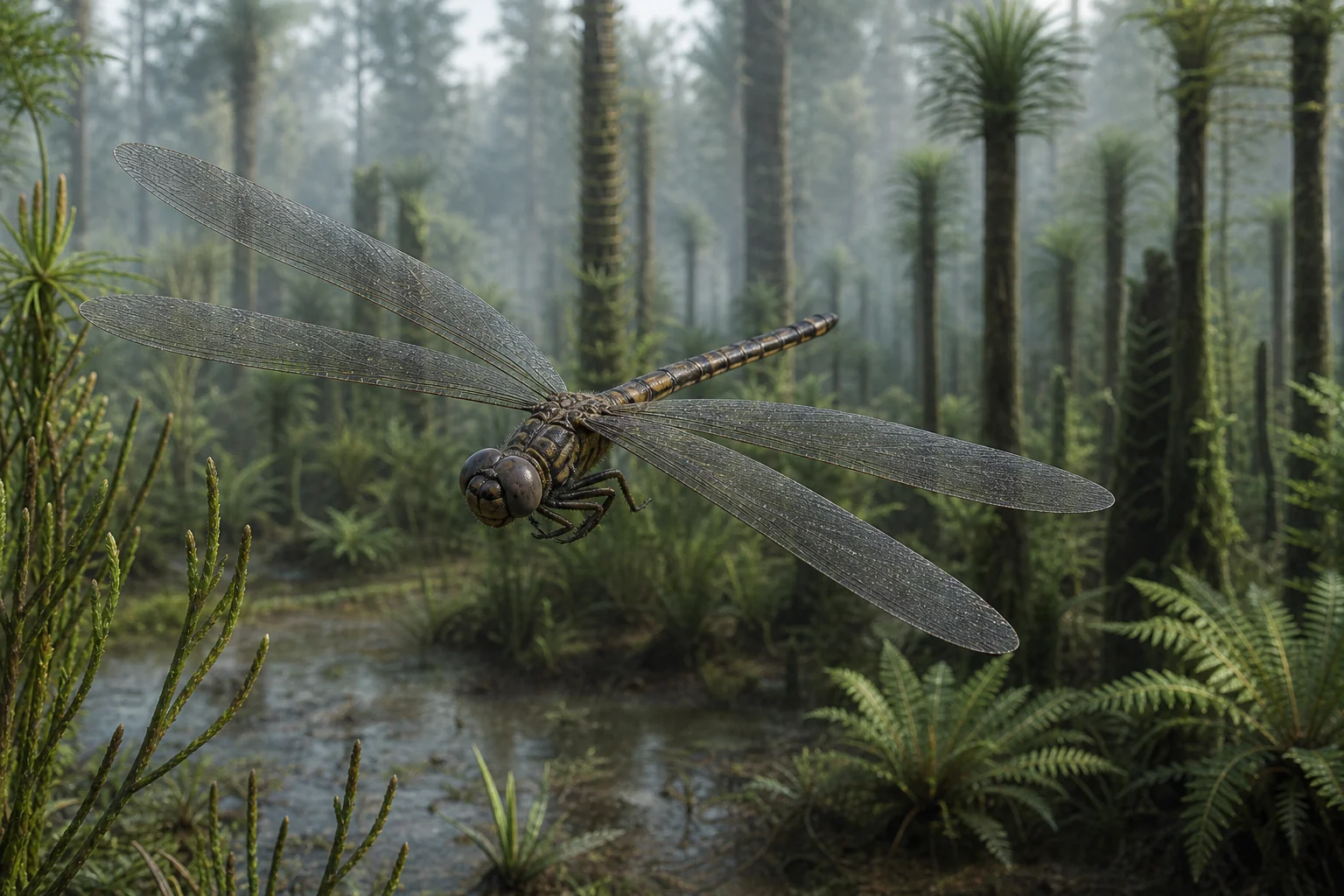 View full-resolution reconstruction ↗
This is an original generative reconstruction, not a photograph or scientific plate. Measurements and interpretations below are tied to named sources.
01 / CARBONIFEROUS AIR
How much oxygen was in the air?
Geochemical models reconstruct late Paleozoic oxygen above today's 21 percent, with exact peaks varying among models. A range is more defensible than a single dramatic percentage because proxies and carbon-cycle assumptions differ.
02 / TRACHEAL BREATHING
Why should oxygen matter to insects?
Insects deliver oxygen through branching tracheae rather than blood-borne lungs. Higher external concentration can increase diffusion and reduce the body volume devoted to air tubes, potentially easing respiratory constraints at large size.
03 / FOSSIL TREND
Do fossil insects track oxygen?
A dataset of more than 10,500 fossil wings found broad Paleozoic associations between maximum size and oxygen. Later intervals depart from a simple curve, showing that ecological and evolutionary changes can override atmospheric opportunity.
04 / PHYSIOLOGY DEBATE
Does oxygen impose a hard ceiling?
Recent modelling argues oxygen delivery through terminal tracheoles and muscle does not create a simple universal gigantism limit. Oxygen can affect performance without functioning as an on-off switch for every lineage.
05 / ECOLOGY
What other factors favoured giants?
Productive wetlands supplied prey, early aerial food webs offered open niches and vertebrate aerial competitors were absent. Developmental timing, temperature and wing construction determined which insect lineages could exploit that opportunity.
06 / DECLINE
Did falling oxygen eliminate giant insects?
Oxygen decline likely increased costs, but giant griffinflies persisted into the Permian. Drying climate, habitat turnover and later competition and predation also changed selection, so disappearance was staggered rather than one atmospheric event.
FREQUENTLY ASKED QUESTIONS
Questions readers ask
How large was Meganeura?
Meganeura monyi is commonly reconstructed with a wingspan around 65 centimetres.
Was Meganeura a dragonfly?
No. It was a griffinfly in the extinct order Meganisoptera, close to but outside true Odonata.
Did Meganeura have a 71-centimetre wingspan?
About 71 cm is the upper range for giant griffinflies generally; M. monyi itself is more often reconstructed near 65 cm.
What did Meganeura eat?
It was probably an aerial predator of other insects, though exact prey is not preserved.
Did oxygen alone create giant insects?
No. High oxygen may have enabled larger bodies, but ecology, development and flight mechanics also mattered.
When did Meganeura live?
It lived in the late Carboniferous, roughly 305–299 million years ago.
SOURCES & FURTHER READING
Evidence used in this guide
Measurements and interpretations are tied to museum resources or peer-reviewed studies; disputed conclusions include evidence on both sides.
- 01Giant dragonflies ↗Natural History Museum, London
Museum overview of griffinfly identity, scale and Paleozoic insect flight.
- 02Fossil insect collection ↗Muséum national d'Histoire naturelle
Official account of the Commentry collection containing Meganeura monyi.
- 03Palaeozoic giant dragonflies were hawker predators ↗Scientific Reports · PMC6092361
Peer-reviewed aerodynamic evidence for active aerial predation.
- 04Atmospheric oxygen and the evolution of insect body size ↗Proceedings of the Royal Society B · PMC3390886
Large fossil-wing dataset testing oxygen and ecological controls through time.