
Explore this animal in Size of Extinct Animals ↗
59 / Mesozoic
Liopleurodon
Liopleurodon ferox
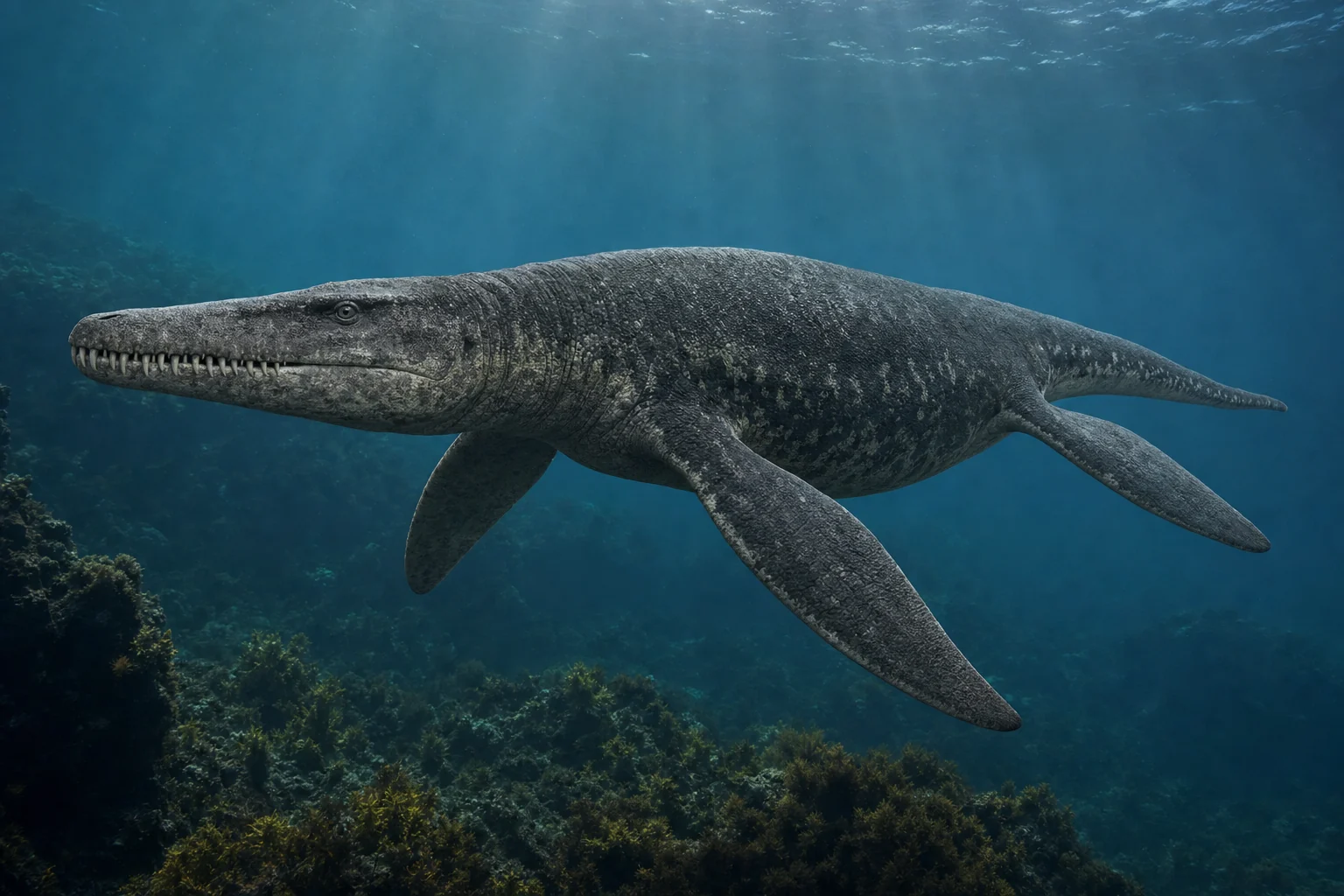
Liopleurodon was a Jurassic pliosaur: a marine reptile with a large skull, short neck and four flippers. Its teeth and bones should be distinguished from television size reconstructions.
 View original image · 1536 × 1024
Structured expansion · editorial review pending
- Time range
- About 166–155 million years ago
- Final stage
- Late Jurassic
- Geographic range
- European seas
01 / ANSWER FIRST
What does the evidence show about Liopleurodon?
Liopleurodon was a Jurassic pliosaur: a marine reptile with a large skull, short neck and four flippers. Its teeth and bones should be distinguished from television size reconstructions.
Species identification is especially important for isolated teeth. A spectacular tooth does not automatically identify a whole animal or its total length.
02 / QUICK FACTS
Liopleurodon at a glance
- Scientific name
- Liopleurodon ferox
- Research focus
- Large jaws
03 / ANATOMY
How was Liopleurodon built?
Large jaws
A large skull and pointed teeth fit a predatory pliosaur body plan.
Short neck, swimming limbs
Unlike long-necked plesiosaurs, pliosaurs concentrated much of their length in the head and trunk.
04 / DIET & BEHAVIOUR
Predation
Pliosaur fossils document predation on marine animals. Group-level stomach contents must not be assigned to Liopleurodon without a specimen identification.
05 / DIET & BEHAVIOUR
Marine setting
The marine setting explains associated aquatic fossils, but association alone does not prove one species ate another.
06 / RANGE & HABITAT
Where and when did Liopleurodon live?
Liopleurodon is known from Jurassic European marine deposits. NHM's catalog includes specimen PV R 2449, recorded as five teeth of L. ferox.
07 / FOSSIL EVIDENCE
What evidence supports reconstructions of Liopleurodon?
A traceable specimen
PV R 2449 gives readers an actual catalog record. Five teeth are valuable evidence, but are not a complete skeleton.
Size needs a basis
Published maximum estimates differ with material and reconstruction. A single dramatic length should not be treated as a measured adult standard.
08 / DISAPPEARANCE & DEBATE
What remains uncertain?
The sources cited here do not establish a single extinction mechanism. Disappearance from sampled Jurassic rocks is not evidence for the much later end-Cretaceous impact.
The linked sources support the specific observations above. An occurrence record alone does not identify an extinction mechanism.
09 / FREQUENTLY ASKED QUESTIONS
Liopleurodon FAQ
Was it a marine dinosaur?
No. It was a pliosaur within Plesiosauria.
Can one tooth establish total body length?
Not directly. Scaling requires comparative material and explicit assumptions.
04 / SOURCES & FURTHER READING
Check the source record
Use the scientific name to compare taxonomy, occurrence records and the fossil record. Database coverage and classifications may differ.
05 / REVISION HISTORY
How has this record changed?
- Replaced repeated expansion text with specimen-specific evidence, linked research and explicit limits; independent editorial review is pending.
- Completed an AI-assisted bilingual audit of the archive record, corrected identified issues and clarified evidence limits; independent editorial review is pending.
- Expanded into a structured bilingual profile with anatomy, ecology, range, evidence, debate and FAQs; independent editorial review is pending.
- Verified authoritative entity sources and added three responsive reconstruction sizes.
- Initial bilingual species record published.
06 / CORRECTIONS & ADDITIONS