
Explore this animal in Size of Extinct Animals ↗
432 / Paleozoic
Isoxys
Isoxys curvirostratus
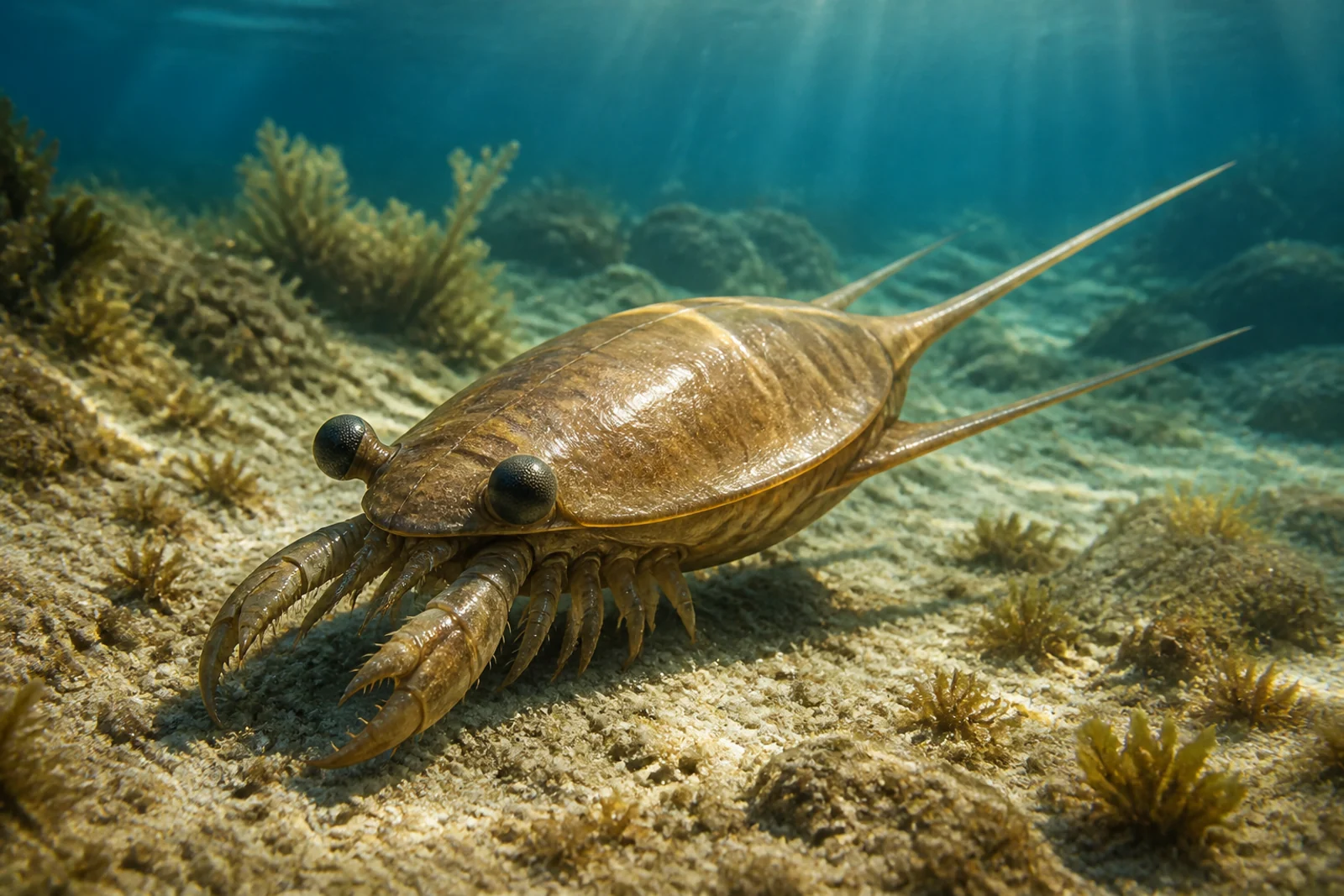
Isoxys curvirostratus was a small arthropod with a spined carapace, stalked eyes and grasping frontal appendages.
 View original image · 1600 × 1067
- Time range
- Early Cambrian (Chengjiang records)
- Final stage
- Early Cambrian
- Geographic range
- Marine waters · Chengjiang, China
01 / ANSWER FIRST
What was Isoxys?
Isoxys was a genus of Cambrian arthropods with a broad carapace, projecting spines and stalked eyes. This record focuses on I. curvirostratus from the early Cambrian Chengjiang biota of China.
Its shell-like outline can hide a complex animal. Exceptionally preserved appendages show why it should not be mistaken for a clam, and why different Isoxys species need separate descriptions.
02 / QUICK FACTS
Isoxys at a glance
- Featured species
- Isoxys curvirostratus
- Age and place
- Early Cambrian · Chengjiang, China
- Reported animal length
- 2–4 cm (Fu et al., 2011)
- 2023 sample carapaces
- 24–28 mm, excluding the spines
03 / ANATOMY
Size, eyes and grasping appendages
Which length is being measured?
Fu et al. (2011) describe a 2–4 cm animal. Zhang et al. (2023) measured I. curvirostratus carapaces between the bases of their anterior and posterior spines. Their 24–28 mm sample range is not the genus's maximum total length.
Eyes outside the carapace
Large eyes extend forward on stalks. Together with spiny frontal appendages, they support a visually guided, prey-grasping interpretation for this species.
Jointed limbs, a different trunk
The 2023 micro-CT study found feeding-specialized front limbs and longer locomotor limbs behind them. The trunk lacked the articulated dorsal armour familiar in many later arthropods.
04 / DIET & BEHAVIOUR
What did Isoxys eat?
Grasping appendages and well-developed eyes support predation, but do not identify an exact prey list. The 2009 study of visual predators compares this evidence in Chengjiang and Burgess Shale animals.
05 / DIET & BEHAVIOUR
How did it swim?
Paddle-like outer limb branches provided surfaces for movement through water. Fossils constrain a swimming reconstruction; they do not give a directly measured cruising speed.
06 / RANGE & HABITAT
Chengjiang and Burgess Shale: different species
Isoxys is known from more than one Cambrian deposit. The genus's distribution should not be copied into the geographic range of I. curvirostratus.
I. curvirostratus in China
The 2011 and 2023 studies examine early Cambrian Chengjiang material, including specimens with delicate appendages preserved beneath the carapace.
Other species in Canada
The Royal Ontario Museum illustrates I. acutangulus and I. longissimus from the Burgess Shale. Their specimen lengths and soft anatomy are comparisons, not records of I. curvirostratus in Canada.
07 / FOSSIL EVIDENCE
What do Isoxys fossils reveal?
Seeing beneath the shield
Zhang and colleagues used micro-CT to resolve limbs partly hidden by the carapace. This revised earlier descriptions that treated the succeeding limbs as essentially uniform.
A step in arthropod evolution
The combination of jointed limbs and an unarthrodized trunk supports a stepwise origin of the arthropod body plan. It does not demonstrate that this named species was the direct ancestor of every living arthropod.
08 / DISAPPEARANCE & DEBATE
Why did Isoxys disappear?
The cited anatomical studies do not establish a specific extinction cause for I. curvirostratus. Records of other Isoxys species should not be treated as its exact last appearance.
Its importance is the information preserved about early arthropod structure, rather than a known dramatic extinction event.
09 / FREQUENTLY ASKED QUESTIONS
Isoxys FAQ
Was Isoxys a clam?
No. It was an arthropod. A folded, shell-like carapace does not make it a bivalve mollusc.
How big was Isoxys curvirostratus?
The 2011 description gives 2–4 cm for the animal. State whether a comparison uses total length or carapace length, and which species was measured.
Did Isoxys have eyes?
Yes. Fossils preserve paired stalked eyes extending beyond the front of the carapace.
04 / SOURCES & FURTHER READING
Check the source record
Use the scientific name to compare taxonomy, occurrence records and the fossil record. Database coverage and classifications may differ.
05 / REVISION HISTORY
How has this record changed?
- Expanded this profile with research sources, focused questions and explicit limits on reconstructions; updated search metadata.
- Verified authoritative entity sources and added three responsive reconstruction sizes.
- Initial bilingual species record published.
06 / CORRECTIONS & ADDITIONS