
Explore this animal in Size of Extinct Animals ↗
449 / Mesozoic
Sharovipteryx
Sharovipteryx mirabilis
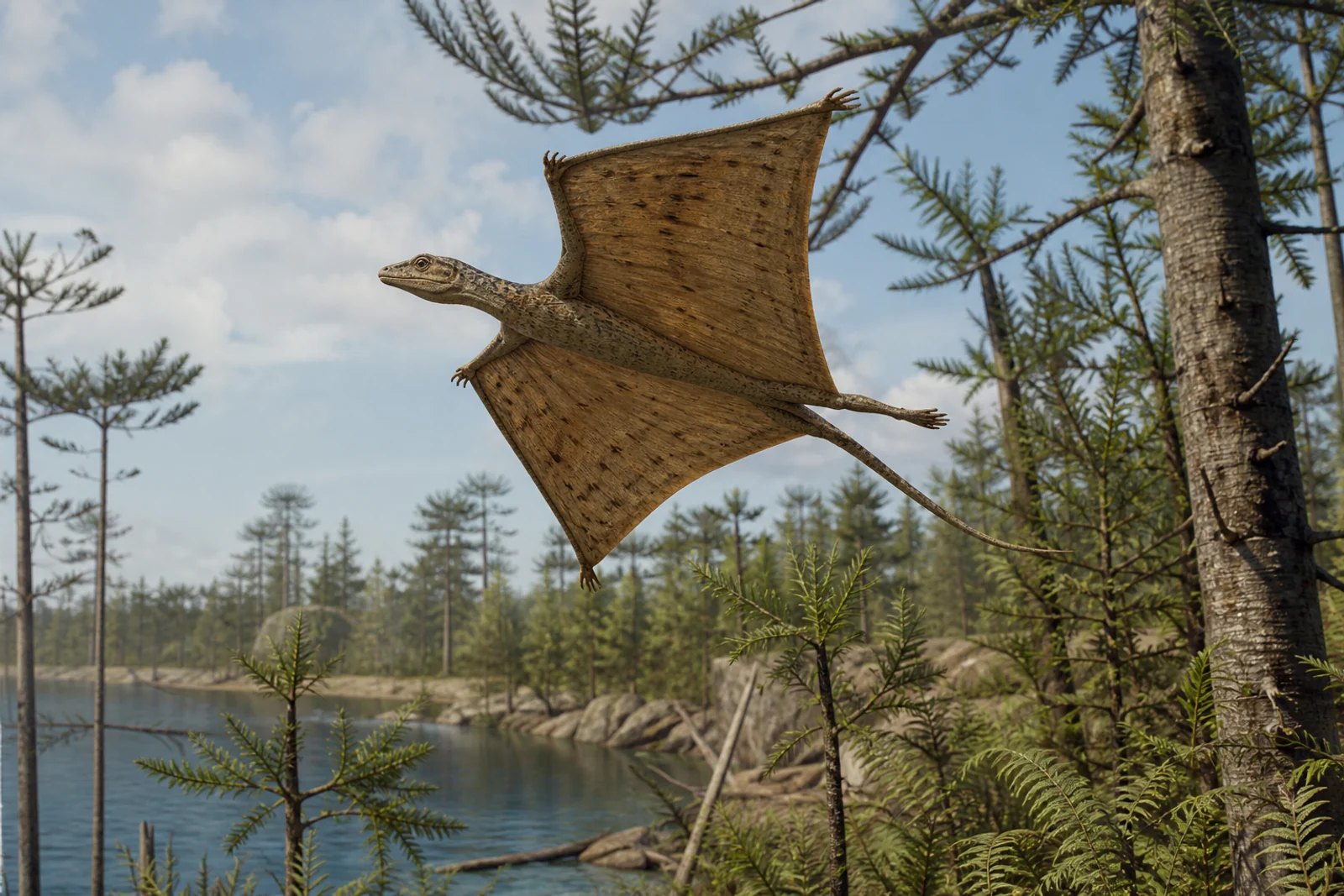
Its main flight membrane stretched between extraordinarily long hind legs.
 View original image · 1600 × 1067
- Time range
- About 230 million years ago
- Final stage
- Late Triassic
- Geographic range
- Lakeshore woodland · Kyrgyzstan
01 / ANSWER FIRST
What was Sharovipteryx?
Sharovipteryx mirabilis was a small Triassic reptile whose main gliding membrane stretched between its very long hind legs. It is known from a single fossil from the Madygen Formation of Kyrgyzstan.
Aleksandr Sharov described it in 1971 as Podopteryx, meaning foot wing. That name was already in use, so the animal was later renamed in his honour.
02 / QUICK FACTS
Sharovipteryx at a glance
- Known material
- One holotype specimen
- Size
- Small; roughly 25 cm long in common reconstructions
- Wing
- Membrane mainly on the hind limbs
- Locality
- Madygen Formation, Kyrgyzstan
How did Sharovipteryx glide?
Dyke, Nudds and Rayner applied standard delta-wing aerodynamics in 2006 and called Sharovipteryx the world's first delta-winged glider. In their model, the wing shape could be controlled by moving the thighs forward at the knees, while a small forelimb surface acted like a canard.
This is a reconstruction from one flattened fossil. The extent of the membranes and the posture in flight are modelled, so the glide performance should be treated as a hypothesis.
03 / ANATOMY
Why is Sharovipteryx so unusual?
Wings behind, not in front
Most gliding vertebrates spread a membrane from the forelimbs or ribs. Sharovipteryx is the only known glider whose main membrane surrounded the pelvis and hind legs.
Not a pterosaur
It is sometimes proposed as a relative of pterosaurs, but that idea is not widely supported. It is generally treated as an archosauromorph reptile.
04 / DIET & BEHAVIOUR
What did Sharovipteryx eat?
The single fossil does not establish its diet. Small insects are a plausible guess for an animal of its size, but remain an inference.
05 / DIET & BEHAVIOUR
Where did it live?
The Madygen Formation preserves lake, river and floodplain deposits rich in plants and insects, a setting with vegetation to glide between.
06 / RANGE & HABITAT
When did Sharovipteryx live?
Its age comes from the dating of the Madygen Formation, not from the fossil itself.
Middle to Late Triassic
The formation is generally placed near the Middle–Late Triassic boundary. Some papers, including the 2006 flight study, cite about 225 million years; others give older dates.
07 / FOSSIL EVIDENCE
What does one fossil establish?
A single specimen
With only one fossil, individual variation, age at death and full body proportions cannot be checked against other individuals.
08 / DISAPPEARANCE & DEBATE
Why did Sharovipteryx go extinct?
A single fossil cannot establish when or why the species disappeared.
Claims that a specific Triassic event ended it have no direct support in the known material.
09 / FREQUENTLY ASKED QUESTIONS
Sharovipteryx FAQ
Could Sharovipteryx fly?
It is interpreted as a glider, not a powered flier. It could not flap its hind-limb membranes to gain height.
Was Sharovipteryx a pterosaur?
No. It is usually treated as a separate archosauromorph reptile.
How many Sharovipteryx fossils are known?
One: the holotype from the Madygen Formation of Kyrgyzstan.
04 / SOURCES & FURTHER READING
Check the source record
Use the scientific name to compare taxonomy, occurrence records and the fossil record. Database coverage and classifications may differ.
05 / REVISION HISTORY
How has this record changed?
- Expanded answers to reader questions, clarified the scope of fossil evidence and improved routes to related explanations.
- Added a sourced bilingual topic hub covering size, discovery history, anatomy, diet, habitat, uncertainty and FAQs; updated search metadata.
- Verified authoritative entity sources and added three responsive reconstruction sizes.
- Initial bilingual species record published.
06 / CORRECTIONS & ADDITIONS