
Explore this animal in Size of Extinct Animals ↗
241 / Cenozoic
Moeritherium
Moeritherium lyonsi
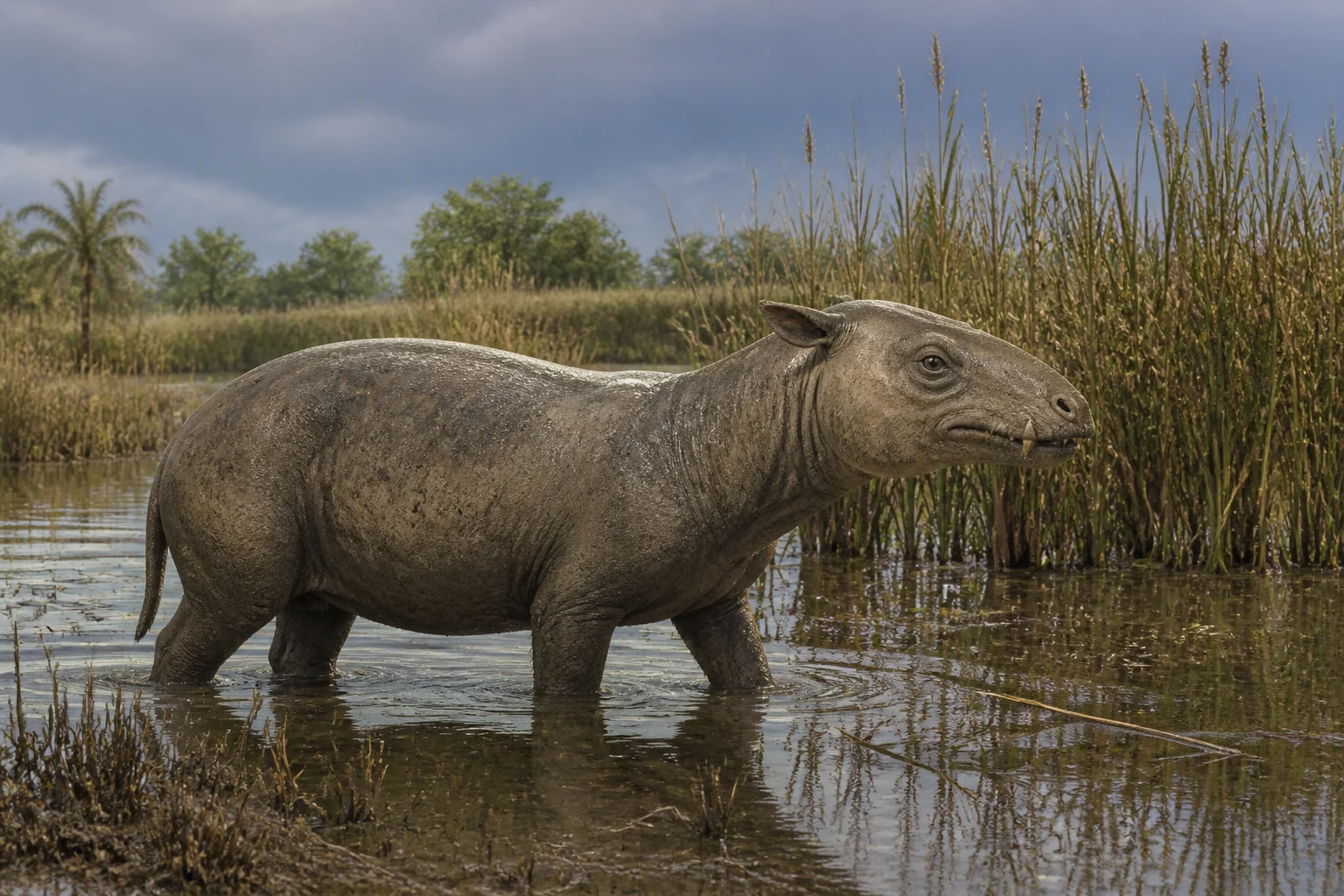
Tapir-sized and short-faced, it lived before proboscideans acquired the elephant's long trunk and giant body.
 View original image · 1536 × 1024
- Time range
- About 37–35 million years ago
- Final stage
- Late Eocene
- Geographic range
- Wetlands and floodplains · North Africa
01 / ANSWER FIRST
What was Moeritherium?
Moeritherium was an early proboscidean—a member of the elephant order—from the Eocene of North Africa. It was about the size of a tapir and had no long trunk.
Charles Andrews named it in 1901 from fossils in the Fayum of Egypt. It is a branch near the base of the elephant order, not the direct ancestor of modern elephants.
02 / QUICK FACTS
Moeritherium at a glance
- Animal group
- Early proboscidean (elephant order)
- Size
- Roughly tapir-sized
- Age
- Late Eocene, about 37–35 million years ago
- Lifestyle
- At least semi-aquatic, from tooth isotopes
Did Moeritherium live in water?
Liu, Seiffert and Simons measured oxygen isotopes in the tooth enamel of Moeritherium and Barytherium in 2008. The low values, with little variation, match the pattern of aquatic and semi-aquatic mammals rather than land mammals.
Combining isotopes, tooth shape and the rocks where the fossils were found, they concluded that both were at least semi-aquatic and lived in freshwater swamps or rivers, feeding on freshwater plants. This supports an amphibious phase early in proboscidean evolution.
03 / ANATOMY
How elephant-like was Moeritherium?
No long trunk
Its skull shows no sign of a modern elephant trunk. It may have had a mobile upper lip, but it did not look like a small elephant.
Low body, short legs
With a long body and short limbs, it resembled a tapir or pygmy hippopotamus more than an elephant.
04 / DIET & BEHAVIOUR
What did Moeritherium eat?
Freshwater vegetation is the interpretation from isotopes, tooth shape and depositional setting.
05 / DIET & BEHAVIOUR
Where did it live?
Swamps and rivers in North Africa. Its best-known fossils are from the Fayum, Egypt.
06 / RANGE & HABITAT
Where are Moeritherium fossils found?
The Fayum Depression of Egypt is the key locality.
The Fayum
Late Eocene deposits in the Fayum preserve many early African mammals, including early proboscideans such as Moeritherium.
07 / FOSSIL EVIDENCE
What does Moeritherium tell us about elephants?
A side branch
Moeritherium diverged before the lineages leading to deinotheres and elephants. It shows an early stage of the order without being on the direct line to living elephants.
08 / DISAPPEARANCE & DEBATE
Why did Moeritherium go extinct?
The cited sources do not establish a specific extinction cause.
Environmental change around the end of the Eocene is a plausible setting, but it is not direct evidence of what ended this genus.
09 / FREQUENTLY ASKED QUESTIONS
Moeritherium FAQ
Was Moeritherium the ancestor of elephants?
No. It was an early member of the elephant order on a side branch, not a direct ancestor.
Did Moeritherium have a trunk?
Not a long trunk like modern elephants; at most it may have had a mobile upper lip.
How big was Moeritherium?
About the size of a tapir, with a long body and short legs.
04 / SOURCES & FURTHER READING
Check the source record
Use the scientific name to compare taxonomy, occurrence records and the fossil record. Database coverage and classifications may differ.
05 / REVISION HISTORY
How has this record changed?
- Expanded answers to reader questions, clarified the scope of fossil evidence and improved routes to related explanations.
- Added a sourced bilingual topic hub covering size, discovery history, anatomy, diet, habitat, uncertainty and FAQs; updated search metadata.
- Verified authoritative entity sources and added three responsive reconstruction sizes.
- Initial bilingual species record published.
06 / CORRECTIONS & ADDITIONS