
Explore this animal in Size of Extinct Animals ↗
463 / Recently extinct
Emeus
Emeus crassus
Emeus crassus was a medium-sized, flightless moa with a bulky body and short, robust legs.
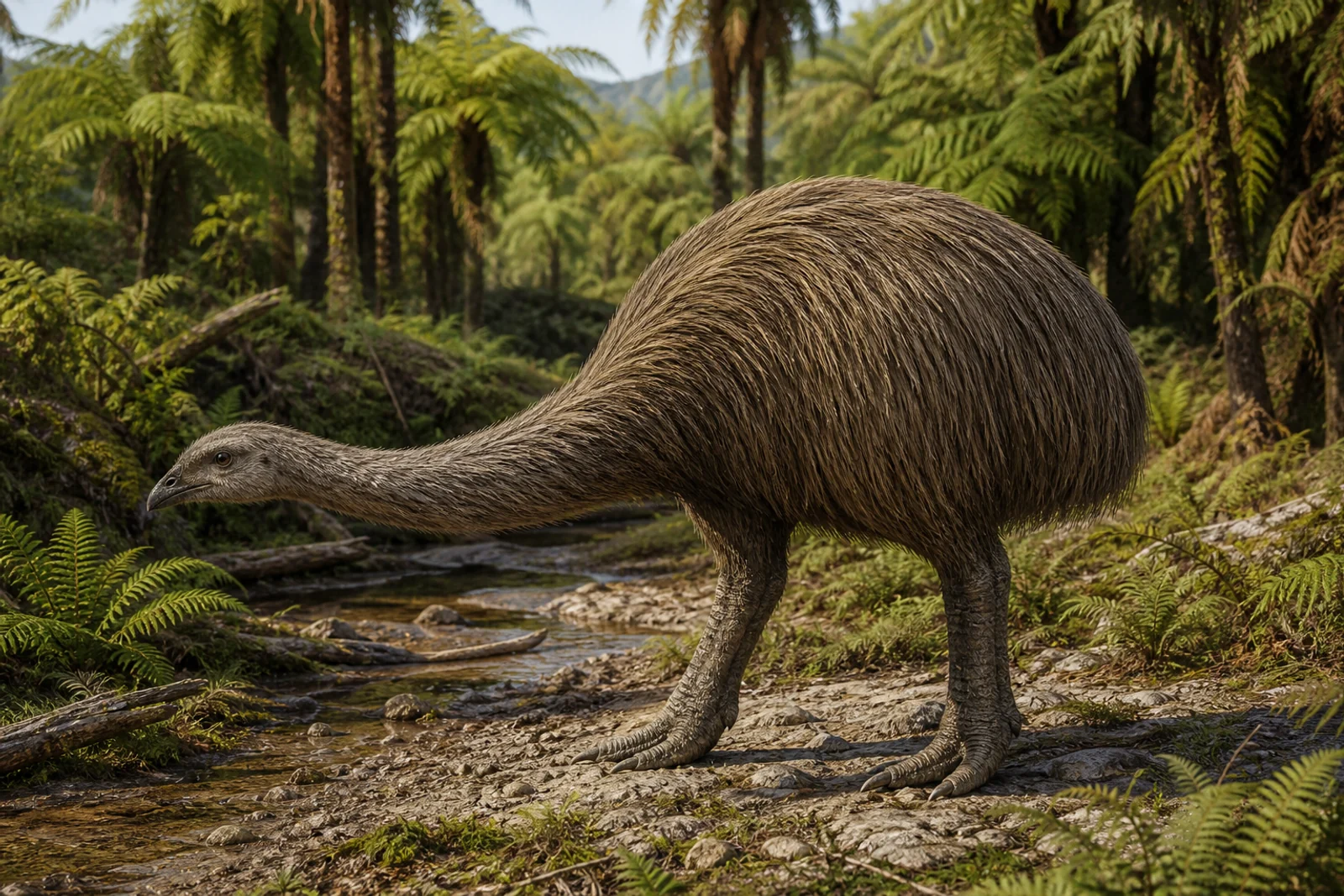 View original image · 1600 × 1067
- Time range
- Late Pleistocene–Holocene
- Final stage
- Extinct after Polynesian settlement, broadly by the 15th century
- Geographic range
- Lowland forest, wetlands and scrub · South Island, New Zealand
01 / ANSWER FIRST
What was Emeus crassus?
Emeus crassus, the eastern moa, was a flightless plant-eating bird from New Zealand's South Island. It was a medium-sized moa with a bulky body and short, sturdy legs.
Its name can be confused with emu, but Emeus is a moa genus. Nor should size figures for the much taller South Island giant moa be transferred to this species.
02 / QUICK FACTS
Eastern Moa at a glance
- Scientific name
- Emeus crassus
- Known records
- Late Pleistocene–Holocene
- Estimated mass
- 36–79 kg (NZ Birds Online)
- Distribution
- South Island, New Zealand
03 / ANATOMY
How big was the eastern moa?
Keep measurement labels
NZ Birds Online lists a length of 73–99 cm and mass of 36–79 kg. Length is not labelled standing height, so it should not become a height claim in a comparison chart.
Variation between individuals
The same account describes females as 15–20% larger than males and notes geographical and climatic size variation. One silhouette cannot represent every adult.
04 / DIET & BEHAVIOUR
What did Emeus eat?
Soft leaves and fruit are the broad dietary interpretation. Wood and colleagues' 2020 review stresses the small amount of direct dietary evidence for this species; a detailed menu would overstate what is known.
05 / DIET & BEHAVIOUR
Food remains need an owner
The 2020 review lists four Emeus gizzard samples and no attributed coprolites. Those few meals support plant eating, but cannot show everything the species ate across its range.
06 / RANGE & HABITAT
Where did Emeus live?
It occupied South Island lowlands, especially eastern districts. Forest, wetland and scrub habitats offered different vegetation from the island's alpine environments.
An ice-age history
Verry and colleagues (2022) analysed 46 ancient mitochondrial genomes from Late Pleistocene and Holocene bones. The species was present well before the last 1,200 years.
A southern refuge
Higher southern genetic diversity supports survival in a southern glacial refuge followed by expansion after the Last Glacial Maximum. This is a population-history inference, not a map of every individual bird.
07 / FOSSIL EVIDENCE
What do fossils and DNA tell us?
Separate kinds of evidence
Bones constrain body form; ancient DNA tests relationships and population change. Neither alone supplies the contents of a meal or an exact date for the last survivor.
Climate survival versus final extinction
Post-glacial expansion in the 2022 study concerns an earlier episode. It should not be presented as proof that climate change caused the much later human-era extinction.
08 / DISAPPEARANCE & DEBATE
Why and when did the eastern moa go extinct?
Human hunting was the main driver after Polynesian settlement. Habitat burning added pressure; moa disappeared within a few centuries, broadly by the fifteenth century.
Perry and colleagues' 2014 chronology examines the rapid moa extinction across New Zealand. Its wider chronology should not be turned into a precisely observed death date for the final Emeus.
09 / FREQUENTLY ASKED QUESTIONS
Eastern Moa FAQ
Was Emeus the same as an emu?
No. Emeus crassus was a New Zealand moa. Similar spelling does not make it the living Australian emu.
Did Emeus live only in the last 1,200 years?
No. Dated Late Pleistocene and Holocene bones used in genetic research establish a much longer record.
04 / SOURCES & FURTHER READING
Check the source record
Use the scientific name to compare taxonomy, occurrence records and the fossil record. Database coverage and classifications may differ.
05 / REVISION HISTORY
How has this record changed?
- Expanded this profile with research sources, focused questions and explicit limits on reconstructions; updated search metadata.
- Verified authoritative entity sources and added three responsive reconstruction sizes.
- Initial bilingual species record published.
06 / CORRECTIONS & ADDITIONS