
Explore this animal in Size of Extinct Animals ↗
531 / Mesozoic
Placochelys
Placochelys placodonta
Placochelys placodonta was an armored placodont marine reptile, not a turtle; broad teeth support a hard-prey feeding interpretation.
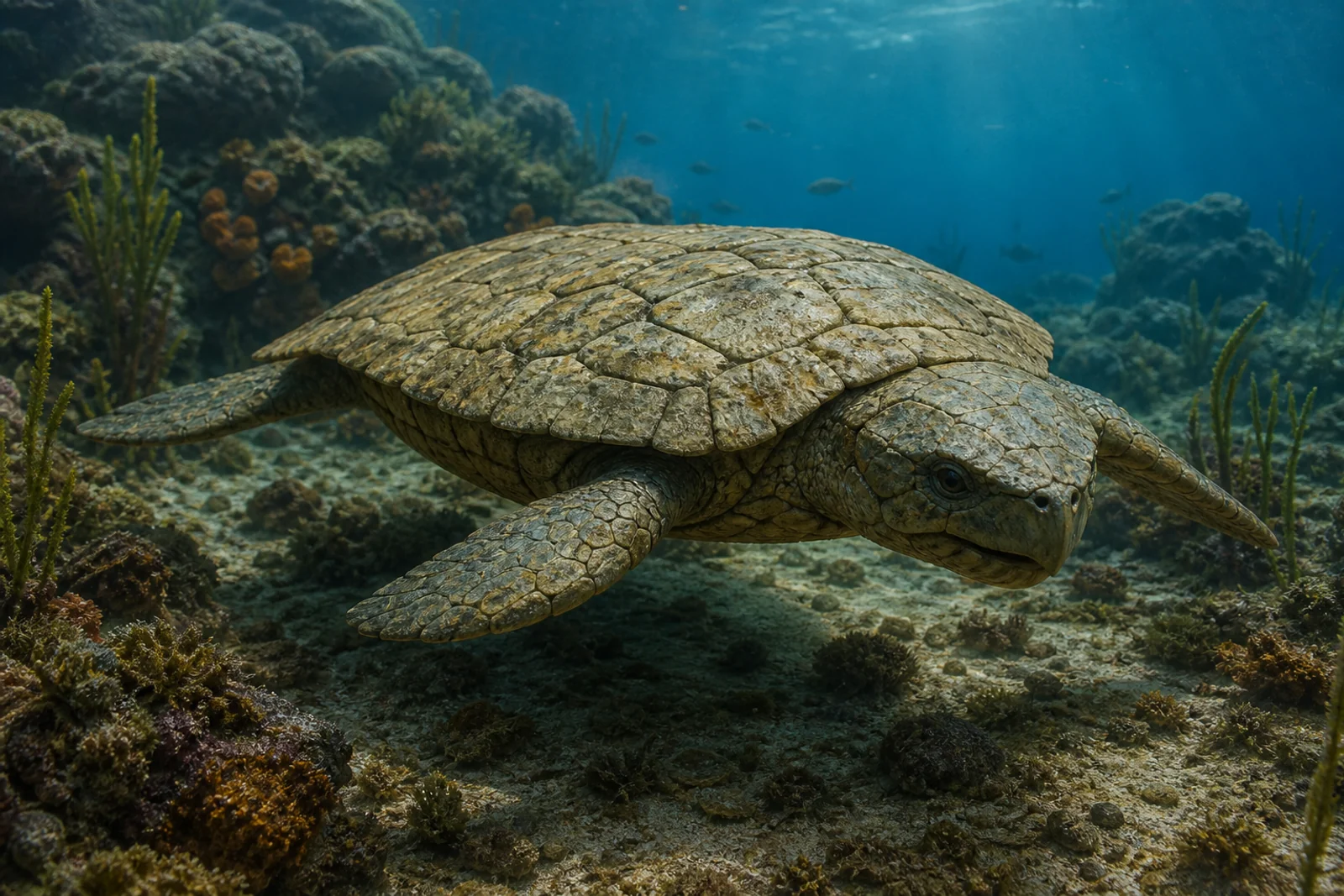 View original image · 1600 × 1067
- Time range
- Carnian · Late Triassic
- Final stage
- Exact last occurrence uncertain
- Geographic range
- Marine deposits · Veszprém, Hungary
01 / ANSWER FIRST
Was Placochelys a turtle?
No. Placochelys placodonta was an armored marine reptile in Placodontia, a group of sauropterygians. Its turtle-like armor is a resemblance between different reptile lineages.
The species is documented in Carnian deposits of Hungary. Records of other placodonts do not automatically extend its range to the end of the Triassic.
02 / QUICK FACTS
Placochelys at a glance
- Group
- Placodont marine reptile
- Documented interval
- Carnian · Late Triassic
- Locality
- Veszprém, Hungary
- 2020 jaw fragment
- 3.5 cm long; not a body-length estimate
03 / ANATOMY
What did Placochelys look like?
Armor and a distinctive skull
The original material included a skull with its lower jaw and a partial postcranial skeleton with armor elements. It should not be described as a completely preserved shell and body.
Broad crushing teeth
The 2020 study described worn tooth surfaces, including exposed dentine. Tooth form and wear help test a hard-prey feeding interpretation, without preserving a filmed feeding sequence.
04 / DIET & BEHAVIOUR
What did Placochelys eat?
Broad teeth are consistent with crushing hard food. An exact prey list, or a claim that it always pried shells from the seabed with its snout, goes beyond the cited specimens.
05 / DIET & BEHAVIOUR
A marine setting
The Hungarian fossils occur in marine deposits. The 2020 paper discusses alternative formation assignments for the classic material; both place it in the Carnian.
06 / RANGE & HABITAT
When and where did Placochelys live?
Jeruzsálem Hill at Veszprém in Hungary anchors the species record discussed here.
Species and family records differ
The same 2020 survey also reported younger, Rhaetian placochelyid teeth elsewhere in Hungary. Family-level teeth are not confirmed occurrences of Placochelys placodonta.
07 / FOSSIL EVIDENCE
What do its fossils actually preserve?
A 3.5 cm jaw fragment
The newly described material included a right dentary fragment and two isolated teeth. The 3.5 cm measurement belongs to that jaw fragment, not to the whole reptile, and the material is separate from the holotype.
An incomplete collection history
Many original postcranial elements were lost during the Second World War. The 2020 review notes surviving casts of the humerus and femur in London; older descriptions and casts remain important evidence.
08 / DISAPPEARANCE & DEBATE
Why did Placochelys go extinct?
The cited studies do not determine a precise extinction date or species-specific cause for P. placodonta.
Its Carnian record alone does not show that it survived until the end-Triassic mass extinction. The history of the wider placodont group is a different question.
09 / FREQUENTLY ASKED QUESTIONS
Placochelys FAQ
Was Placochelys a dinosaur?
No. It was a placodont marine reptile, separate from dinosaurs and turtles.
Was Placochelys only 3.5 cm long?
No. The 2020 paper's 3.5 cm measurement describes a jaw fragment. It is not a whole-body length.
Did Placochelys disappear at the end of the Triassic?
That is not established for P. placodonta. The cited Hungarian species records are Carnian; later teeth assigned to its family do not prove the species survived longer.
04 / SOURCES & FURTHER READING
Check the source record
Use the scientific name to compare taxonomy, occurrence records and the fossil record. Database coverage and classifications may differ.
05 / REVISION HISTORY
How has this record changed?
- Expanded this profile with research sources, focused questions and explicit limits on reconstructions; updated search metadata.
- Verified authoritative entity sources and added three responsive reconstruction sizes.
- Initial bilingual species record published.
06 / CORRECTIONS & ADDITIONS