
Explore this animal in Size of Extinct Animals ↗
294 / Cenozoic
Pakicetus
Pakicetus attocki
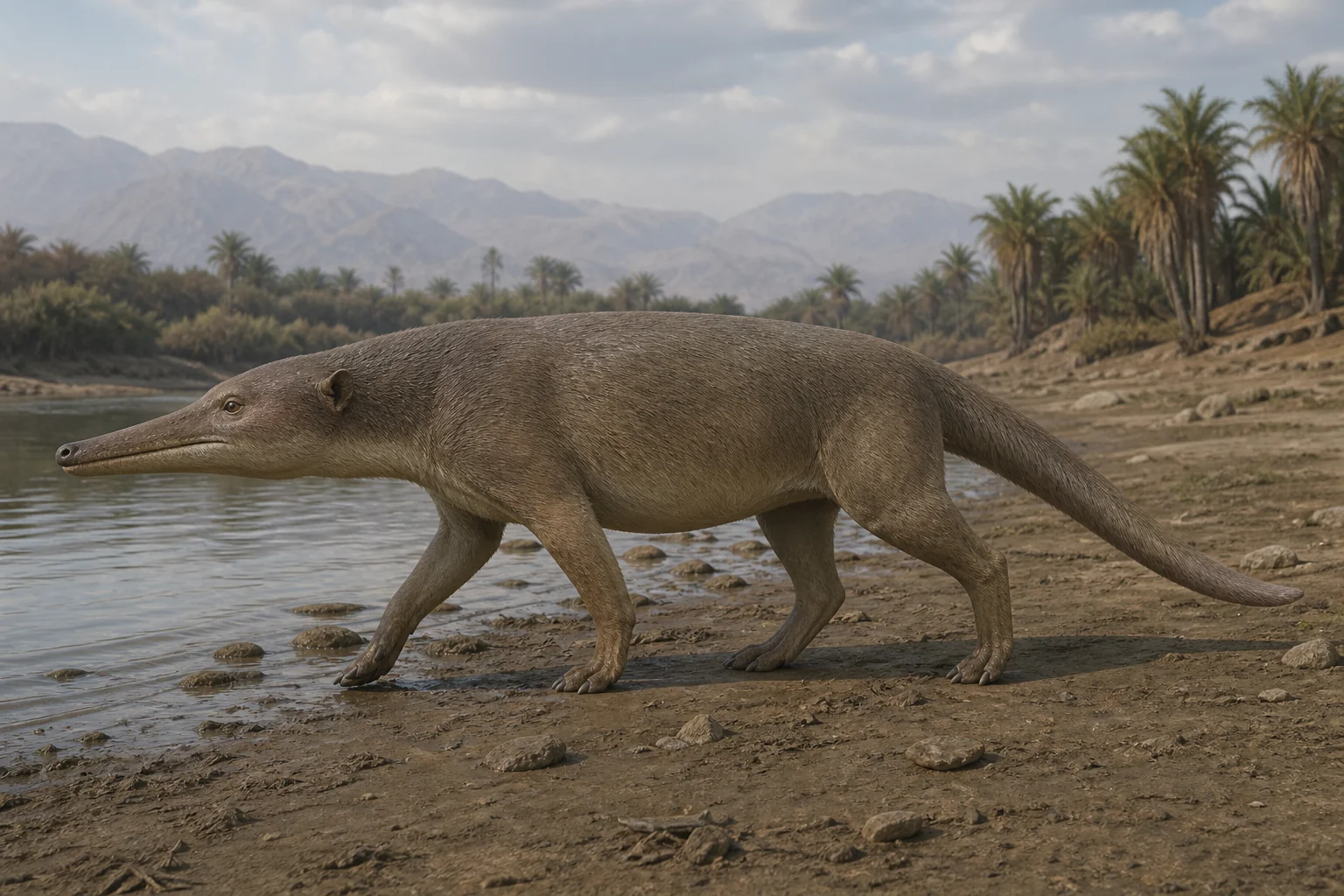
An early whale with four weight-bearing legs: Pakicetus attocki was wolf-sized and lived near rivers in Pakistan about 50 million years ago.
 View original image · 1536 × 1024
- Time range
- About 50 million years ago
- Final stage
- Early Eocene
- Geographic range
- Rivers and floodplains · Pakistan
01 / ANSWER FIRST
What was Pakicetus?
Pakicetus was an early whale with four weight-bearing legs, living near rivers in what is now Pakistan about 50 million years ago. Pakicetus attocki is often described as wolf-sized, although its skull and ears reveal a very different evolutionary identity.
This record names P. attocki. Some commonly quoted size and habitat summaries concern the genus Pakicetus or pakicetids as a family; those broader comparisons are labelled below rather than treated as measurements of one complete skeleton.
02 / QUICK FACTS
Pakicetus at a glance
- Time
- Early Eocene, about 50 million years ago
- Location
- Pakistan; river and floodplain deposits
- P. attocki size
- Wolf-sized in the 2001 skeletal study
- Genus-level length
- About 1–2 m; reconstructed Pakicetus range
- Limbs
- Four legs capable of supporting the body on land
- Whale evidence
- Diagnostic anatomy of the ear region
How big was Pakicetus, and what did it look like?
The 2001 skeletal study describes P. attocki as wolf-sized. New York Institute of Technology's genus-level account gives reconstructed lengths of about 1–2 metres for Pakicetus. These statements use different scopes and should not be converted into a precise weight or a species-wide maximum.
Reconstructions show a long snout, a long tail and four legs beneath the body. The researchers' account explains that the bones used in skeletal reconstructions are isolated elements assembled into a composite. Missing associations limit how confidently every proportion can be assigned to one individual.
03 / ANATOMY
Why is Pakicetus classified as a whale?
The ear region
A thickened part of the auditory bulla helps diagnose cetacean relationships. Whale classification depends on shared anatomy, not on having a modern whale's streamlined outline or living exclusively in the ocean.
Legs before flippers
The skeleton retained limbs that could support the body. Pakicetus should not be illustrated as a modern whale with tiny legs attached: its whole body plan belonged to an early stage in the land-to-water transition.
04 / DIET & BEHAVIOUR
What did Pakicetus eat?
Its teeth support flesh eating, and fish are a plausible food in its river environment. The researchers' summary distinguishes these inferences from a demonstrated hunting sequence; exact prey and capture behaviour remain uncertain.
05 / DIET & BEHAVIOUR
Did Pakicetus live on land or in water?
Weight-bearing limbs support movement on land, while dense bones and freshwater evidence point to a close association with water. Bottom-walking has been proposed, but the amount of time spent in water cannot be read directly from a skeleton.
06 / RANGE & HABITAT
Where did Pakicetus live?
The fossils place these early whales in Pakistan's ancient river landscapes, not simply in an open-ocean setting.
Freshwater evidence
Sedimentary context and oxygen-isotope research discussed by the anatomy team support freshwater use. A map of the nearby ancient Tethys Sea gives regional context, but is not evidence that every Pakicetus fossil represents a marine animal.
07 / FOSSIL EVIDENCE
What Pakicetus adds to whale evolution
A combination of features
Early whales combine cetacean skull characters with locomotor anatomy very different from living whales. The 2001 skeleton study tested their relationship with even-toed ungulates using these anatomical characters.
A branching history
Pakicetus, Ambulocetus and later whales help compare stages of aquatic adaptation. Putting them in chronological order does not prove that each named species was the direct ancestor of the next one.
08 / DISAPPEARANCE & DEBATE
Did Pakicetus become modern whales?
Pakicetus documents an early branch of whale evolution, not a complete, proven ancestor-to-descendant chain.
Later cetaceans acquired increasingly aquatic bodies. That evolutionary sequence does not establish why P. attocki disappeared or demonstrate that another whale competitively replaced it.
09 / FREQUENTLY ASKED QUESTIONS
Pakicetus FAQ
Was Pakicetus a walking whale?
Yes, in the sense of an early cetacean with four weight-bearing legs. It did not look or move like a modern whale stranded on land.
Was Pakicetus a dog?
No. Wolf-sized describes its approximate scale, not its ancestry. Ear and skeletal anatomy place it among early cetaceans.
Did Pakicetus have a blowhole?
Its nostrils were near the front of the snout, rather than on top of the head as in living whales.
04 / SOURCES & FURTHER READING
Check the source record
Use the scientific name to compare taxonomy, occurrence records and the fossil record. Database coverage and classifications may differ.
05 / REVISION HISTORY
How has this record changed?
- Expanded answers to reader questions, clarified the scope of fossil evidence and improved routes to related explanations.
- Added a sourced bilingual topic hub covering size, discovery history, anatomy, diet, habitat, uncertainty and FAQs; updated search metadata.
- Verified authoritative entity sources and added three responsive reconstruction sizes.
- Initial bilingual species record published.
06 / CORRECTIONS & ADDITIONS