
Explore this animal in Size of Extinct Animals ↗
164 / Precambrian
Kimberella
Kimberella quadrata
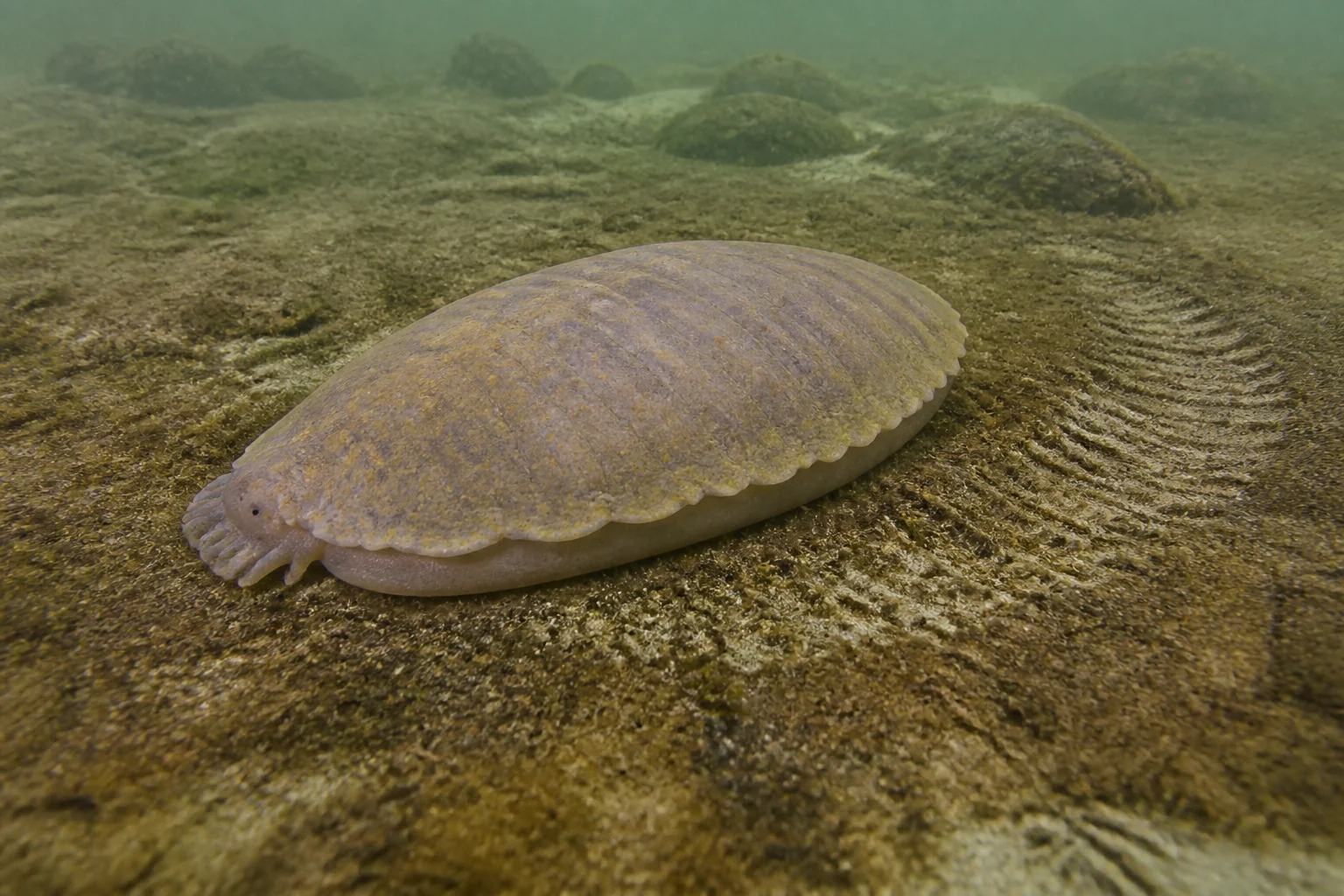
Its low oval body crawled across microbial mats while a front feeding structure left fan-shaped sets of scratches.
 View original image · 1536 × 1024
- Time range
- About 558–555 million years ago
- Final stage
- Late Ediacaran
- Geographic range
- Shallow Ediacaran seafloor · White Sea region of Russia
01 / ANSWER FIRST
What was Kimberella?
Kimberella quadrata was an Ediacaran animal that crawled on the seafloor and fed by scraping microbial mats. It is widely interpreted as a bilaterian with mollusc-like features.
It was first described from South Australia in 1966 and reconstructed as a jellyfish. Better-preserved White Sea specimens in Russia led to its reinterpretation in 1997.
02 / QUICK FACTS
Kimberella at a glance
- Interpretation
- Bilaterian with mollusc-like features; exact placement debated
- Minimum age
- Older than 555.3 ± 0.3 million years (White Sea ash)
- Named from
- South Australia (1966)
- Diet evidence
- Scratch traces and gut biomarkers: algae and bacteria
Was Kimberella a mollusc?
Fedonkin and Waggoner studied more than 35 White Sea specimens and concluded in 1997 that Kimberella was a bilaterian, more complex than a flatworm and more like a mollusc than any other animal group. They reconstructed a non-mineralized shell-like covering and a muscular foot.
That makes Kimberella a strong candidate for an early relative of molluscs, but not a confirmed snail or clam. Without a mineralized shell or radula preserved as hard parts, its exact position remains a scientific hypothesis.
03 / ANATOMY
How did Kimberella feed?
Fan-shaped scratch marks
Body fossils occur beside fan-shaped sets of scratches, interpreted as marks left by a front feeding structure raking microbial mats while the animal stayed in place.
A preserved gut
A 2022 biomarker study reported molecular traces of green algae and bacteria associated with Kimberella's gut, supporting a digestive tract and a diet of mat-forming microbes.
04 / DIET & BEHAVIOUR
What did Kimberella eat?
Microbial mats: biomarkers point to green algae and bacteria. This is unusually direct dietary evidence for an animal older than the Cambrian.
05 / DIET & BEHAVIOUR
How did it move?
The body plan and associated traces indicate slow crawling on a muscular underside across mat-covered seafloor.
06 / RANGE & HABITAT
How old is Kimberella?
Volcanic ash layers within the fossil-bearing rocks provide the key age constraint.
The White Sea date
A uranium–lead zircon date of 555.3 ± 0.3 million years from ash in the Zimnie Gory section shows that the fossils below it are older. It is a minimum age, not the date of one individual's death.
Australia and Russia
The species is known from South Australia and the White Sea region of Russia, both shallow Ediacaran seafloors.
07 / FOSSIL EVIDENCE
Why Kimberella matters
Animals before the Cambrian
A dated bilaterian that crawled and grazed shows complex animals existed before the Cambrian explosion.
From jellyfish to grazer
Its reinterpretation shows how new specimens can overturn a classification based on a few flattened fossils.
08 / DISAPPEARANCE & DEBATE
Why did Kimberella disappear?
The cited evidence does not establish a specific extinction cause.
Seafloor ecosystems changed across the Ediacaran–Cambrian transition, but a broad environmental change is not direct evidence of what ended this species.
09 / FREQUENTLY ASKED QUESTIONS
Kimberella FAQ
Was Kimberella a jellyfish?
No. It was first reconstructed as one, but White Sea specimens showed a crawling, bilaterally symmetrical animal.
How old is Kimberella?
White Sea specimens are older than 555.3 million years, based on a dated volcanic ash layer above them.
Did Kimberella have a shell?
It had a firm but non-mineralized covering, not a hard mineral shell like most living molluscs.
04 / SOURCES & FURTHER READING
Check the source record
Use the scientific name to compare taxonomy, occurrence records and the fossil record. Database coverage and classifications may differ.
05 / REVISION HISTORY
How has this record changed?
- Expanded answers to reader questions, clarified the scope of fossil evidence and improved routes to related explanations.
- Added a sourced bilingual topic hub covering size, discovery history, anatomy, diet, habitat, uncertainty and FAQs; updated search metadata.
- Verified authoritative entity sources and added three responsive reconstruction sizes.
- Initial bilingual species record published.
06 / CORRECTIONS & ADDITIONS