
Explore this animal in Size of Extinct Animals ↗
496 / Cenozoic
Brontornis
Brontornis burmeisteri
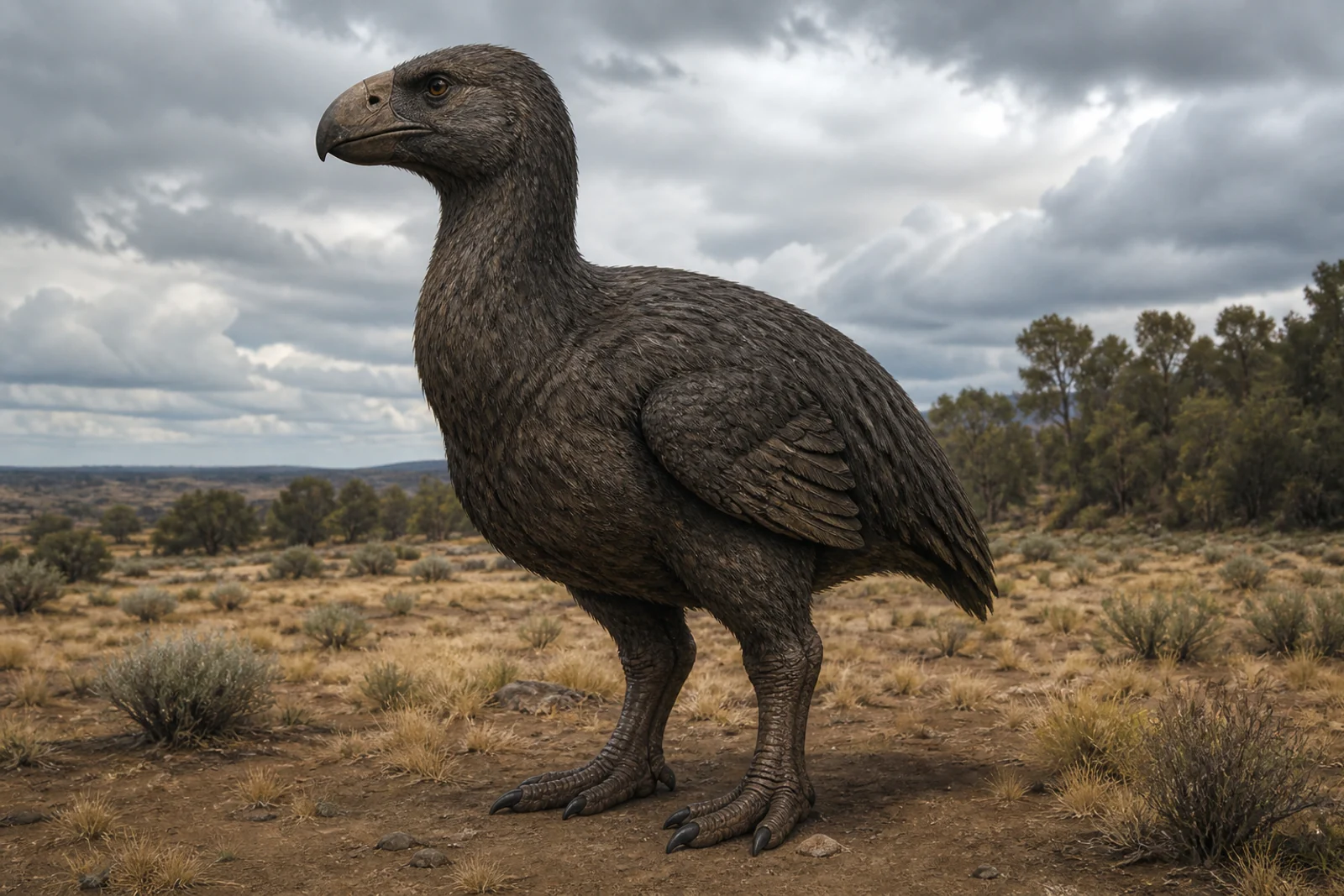
Brontornis burmeisteri was a giant flightless bird with exceptionally robust hind limbs.
 View original image · 1600 × 1067
- Time range
- Early–Middle Miocene fossil records
- Final stage
- Miocene; exact extinction date uncertain
- Geographic range
- Santa Cruz, Patagonia · Argentina
01 / ANSWER FIRST
What was Brontornis?
Brontornis burmeisteri was a huge flightless bird from Miocene Patagonia in Argentina. Its exceptionally robust hind limbs supported a heavy body, but researchers disagree about its place in the bird family tree.
Calling it a terror bird assumes membership of Phorusrhacidae. That assignment is disputed: giant body size and flightlessness evolved in several bird lineages and do not settle its identity.
02 / QUICK FACTS
Brontornis at a glance
- Fossil region
- Santa Cruz, Patagonia, Argentina
- Age
- Early–Middle Miocene records
- Published size estimate
- About 2.8 m tall; 350–400 kg (Agnolin, 2021)
- Diet
- Disputed; herbivory is one proposed interpretation
03 / ANATOMY
How big was Brontornis?
An estimate from incomplete remains
Agnolin's 2021 reassessment cites roughly 2.8 metres in height and 350–400 kilograms. These are reconstructions, not measurements of a complete living bird; the fossils are mainly parts of the hind limbs.
Legs built to carry weight
The short, broad proportions are described as graviportal: adapted to bearing a large mass. That differs from proving a particular running speed or hunting technique.
04 / DIET & BEHAVIOUR
What did Brontornis eat?
Agnolin (2021) argues for plant eating from its proposed relationships and attributed jaw anatomy. Older suggestions include scavenging. Neither a life illustration nor a family-tree placement is direct evidence of a meal.
05 / DIET & BEHAVIOUR
Was it a terror bird?
Worthy and colleagues (2017) recovered Brontornis among Neoaves near Cariamiformes. Agnolin (2021) instead placed it with giant galloanseran birds. LaBarge and colleagues (2024) emphasize the need for broader taxon sampling to resolve the disagreement.
06 / RANGE & HABITAT
Where and when did Brontornis live?
The reviewed material comes from Early–Middle Miocene localities in Santa Cruz province. A locality age describes the fossil-bearing rocks, not a precisely known birth or extinction date for the species.
Patagonian fossil collections
Some historical specimens lack detailed collection information. Comparing bones also requires checking whether isolated elements really belong to the same taxon.
07 / FOSSIL EVIDENCE
Why do reconstructions disagree?
Convergence in giant birds
Worthy et al. (2017) tested how fossil sampling and analytical methods affect the grouping of large flightless birds. Similar ways of supporting a heavy body can obscure ancestry.
Bones with uncertain associations
The 2021 paper discusses doubtful associations of some jaw, quadrate and vertebral material. A confident-looking reconstructed head can therefore convey more certainty than the specimen record warrants.
08 / DISAPPEARANCE & DEBATE
Why did Brontornis go extinct?
The studies cited here do not establish a specific extinction cause. Its Miocene fossil record ends long before modern humans appeared in Patagonia.
Explaining how giant birds are related is a different research problem from showing why their last populations disappeared.
09 / FREQUENTLY ASKED QUESTIONS
Brontornis FAQ
Could Brontornis fly?
It is interpreted as flightless. Its massive, weight-bearing hind limbs belong to a terrestrial giant bird.
Was Brontornis a carnivore?
That is not settled. The 2021 reassessment supports herbivory, while its classification and the identity of some attributed bones remain debated.
Was Brontornis the largest terror bird?
That ranking assumes it was a phorusrhacid, which is disputed. Compare published mass estimates separately from taxonomic membership.
04 / SOURCES & FURTHER READING
Check the source record
Use the scientific name to compare taxonomy, occurrence records and the fossil record. Database coverage and classifications may differ.
05 / REVISION HISTORY
How has this record changed?
- Expanded this profile with research sources, focused questions and explicit limits on reconstructions; updated search metadata.
- Verified authoritative entity sources and added three responsive reconstruction sizes.
- Initial bilingual species record published.
06 / CORRECTIONS & ADDITIONS