
Explore this animal in Size of Extinct Animals ↗
202 / Precambrian
Rangea
Rangea schneiderhoehni
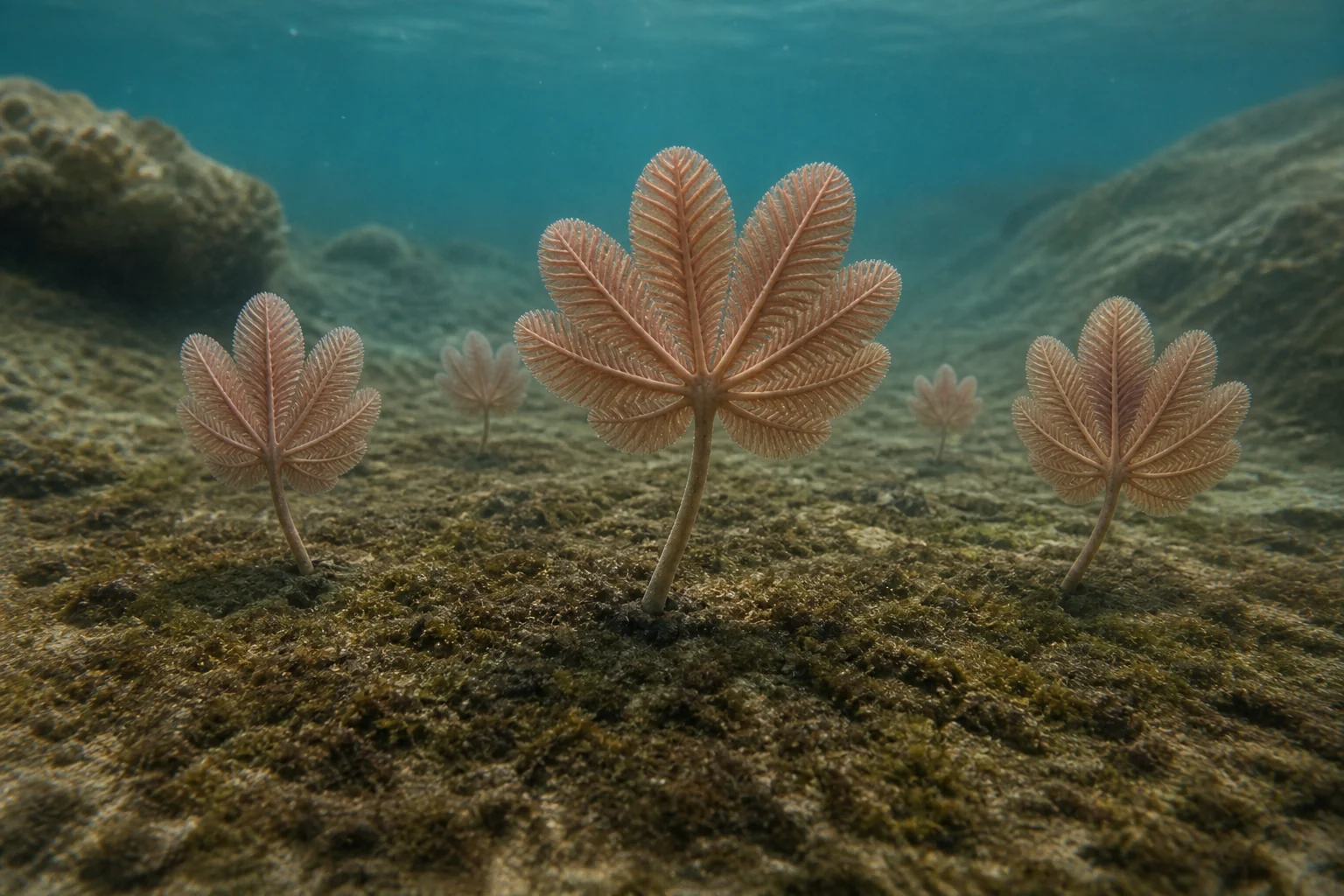
Six branching vanes surrounded a central axis, making the organism resemble a soft pine cone standing on the seabed.
 View original image · 1536 × 1024
- Time range
- About 558–549 million years ago
- Final stage
- Late Ediacaran
- Geographic range
- Marine microbial mats · Present-day Namibia and South Africa
01 / DEFINITION & ECOLOGY
What was Rangea?
Rangea (Rangea schneiderhoehni) was an extinct organism known from About 558–549 million years ago, with a range in Marine microbial mats · Present-day Namibia and South Africa.
Life and ecology
Rangea was a rangeomorph built from repeated self-similar branches. Its enormous surface area may have exchanged nutrients or intercepted material from slow currents.
02 / DISAPPEARANCE
Why did Rangea disappear?
Rangeomorphs disappeared across the Ediacaran–Cambrian transition, amid ecological turnover and changing sedimentary conditions; how those changes caused their loss is not established.
03 / EVIDENCE
How do scientists know about Rangea?
Three-dimensional casts and impressions preserve sixfold vanes, an axial region and several orders of branching.
04 / SOURCES & FURTHER READING
Check the source record
Use the scientific name to compare taxonomy, occurrence records and the fossil record. Database coverage and classifications may differ.
05 / REVISION HISTORY
How has this record changed?
- Rewrote an extinction cause that presented environmental or faunal turnover as established; it is now given as context the record does not prove.
- Verified authoritative entity sources and added three responsive reconstruction sizes.
- Initial bilingual species record published.
06 / CORRECTIONS & ADDITIONS