
304 / Precambrian
Grypania
Grypania spiralis
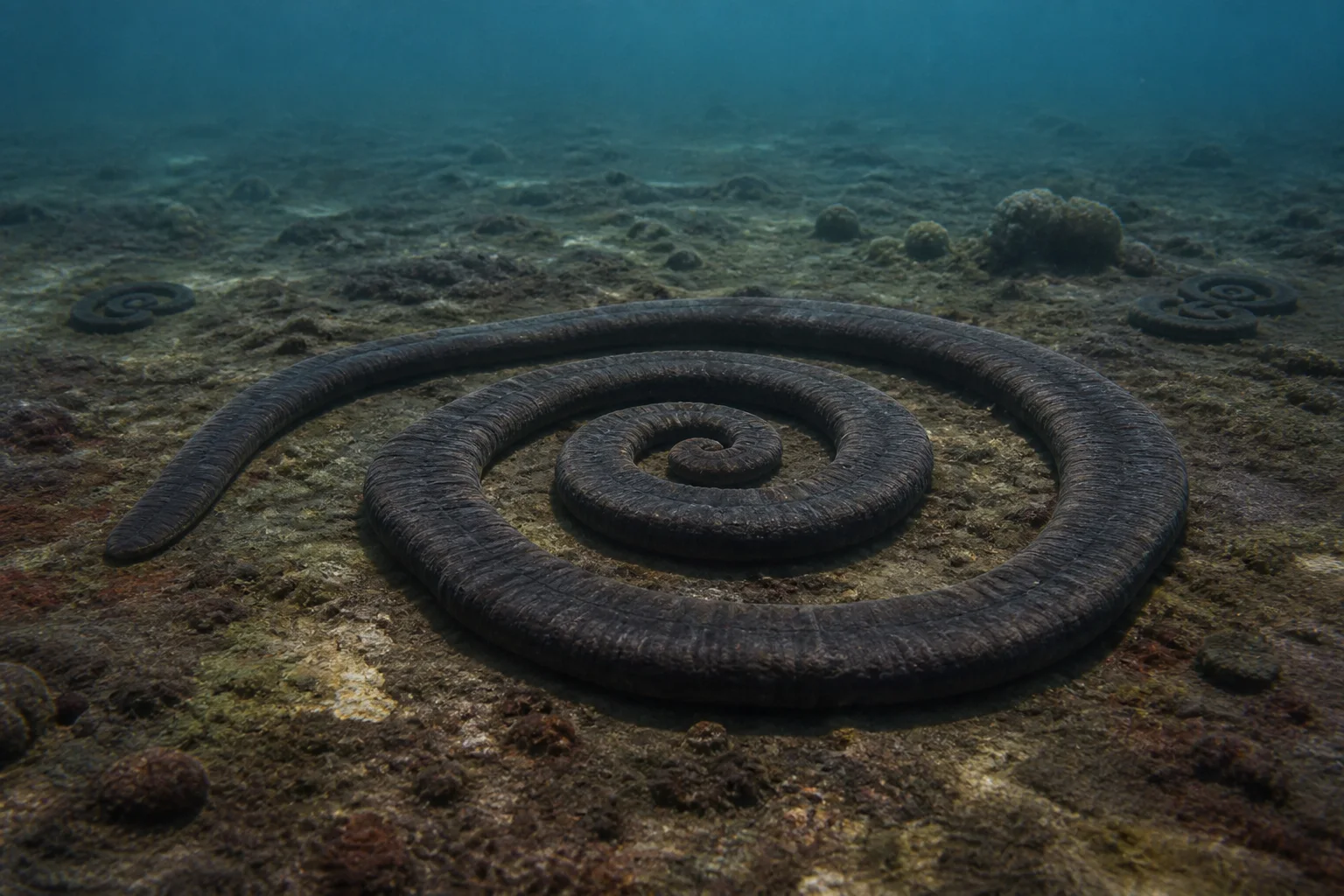
Millimetre-wide ribbons form centimetre-scale coils in Proterozoic rocks.
 View original image · 1536 × 1024
- Time range
- Proterozoic; age varies by fossil locality
- Final stage
- Exact final appearance uncertain
- Geographic range
- Marine sedimentary rocks · North America and Asia
Grypania spiralis: what the spiral fossil tells us
Grypania is a ribbon-like fossil that commonly forms coils in Proterozoic rocks. It is discussed as possible early eukaryotic life, but its visible shape alone cannot prove that it was an alga or reveal its cell structure.
Age depends on the locality
A date assigned to one rock unit is not the age of every Grypania fossil. Compare the North American and Asian records individually before calling any specimen the oldest.
Ribbon versus organism
Width, coil diameter and total ribbon length describe different measurements. A large visible structure is not automatically a single giant cell, nor does it establish multicellularity.
01 / ANSWER FIRST
What was Grypania spiralis?
Grypania spiralis is a name applied to large, coiled ribbon-like fossils from Proterozoic rocks. It is often interpreted as an early alga, but its biological identity remains disputed.
A recognizable fossil shape is not automatically a securely identified evolutionary lineage. Specimens separated by vast spans of time need to be compared, rather than assumed to represent one unchanged biological species.
02 / QUICK FACTS
Grypania at a glance
- Geological context
- Proterozoic; multiple fossil localities
- Form
- Coiled carbonaceous ribbons
- Ribbon width
- Millimetre scale, distinct from coil diameter
- Affinity
- Unresolved: eukaryotic or bacterial interpretations
03 / ANATOMY
How big was Grypania?
Ribbon versus coil
Knoll and colleagues' 2006 review describes ribbons up to 2 mm wide forming coils up to 24 mm across. A centimetre-scale coil does not mean a centimetre-wide filament.
What survives in rock
Flattened carbon-rich traces preserve outlines and curvature more readily than cellular anatomy. Shape alone cannot reveal a nucleus or establish how many cells made up the original organism.
04 / DIET & BEHAVIOUR
Was Grypania a eukaryote?
Han and Runnegar (1992) argued for a photosynthetic eukaryotic alga. Sharma and Shukla (2009) instead favoured a cyanobacterial affinity for Indian material. These are competing interpretations of evidence, not interchangeable labels.
05 / DIET & BEHAVIOUR
Was it an animal?
The cited studies do not establish an animal identity. The 2024 review still treats Grypania's claimed eukaryotic affinity as inconclusive. Calling it the first animal would add a claim the fossils do not demonstrate.
06 / RANGE & HABITAT
How old are Grypania fossils?
The answer depends on the fossil-bearing formation. A single start-and-end date hides both dating revisions and uncertainty about which fossils belong together.
Michigan
The 1992 paper's title used 2.1 billion years for the Negaunee material. The 2024 review discusses Grypania at approximately 1.9 billion years. Retain the original title when citing it, without treating its old age estimate as current.
Younger records
Mesoproterozoic material is reported from Montana, China and India. The approximately 1.45-billion-year-old Helena Formation is one example discussed in the 2006 review.
07 / FOSSIL EVIDENCE
Why does its identity remain debated?
Visible size is not a diagnosis
The useful test is which preserved structures discriminate between hypotheses. A large outline alone does not decide between an algal body and a bacterial construction.
Compare populations, not just pictures
The 2009 study examines coiled and related forms from India's Rohtas Formation. Its different conclusion is a reason to identify the material behind each reconstruction.
08 / DISAPPEARANCE & DEBATE
Why did Grypania disappear?
The cited studies do not establish a specific extinction mechanism or a single final extinction date.
A fossil form dropping out of a sampled sequence does not show that more complex algae outcompeted it. Preservation, sampling and the meaning of the fossil name must first be resolved.
09 / FREQUENTLY ASKED QUESTIONS
Grypania FAQ
Is Grypania the oldest confirmed eukaryote?
It is an early candidate, not an uncontested record. Age and biological identity are separate questions.
Was Grypania multicellular?
Its macroscopic size does not settle cellular organization. That claim requires anatomical evidence beyond the coiled outline.
04 / SOURCES & FURTHER READING
Check the source record
Use the scientific name to compare taxonomy, occurrence records and the fossil record. Database coverage and classifications may differ.
05 / REVISION HISTORY
How has this record changed?
- Expanded answers to reader questions, clarified the scope of fossil evidence and improved routes to related explanations.
- Expanded this profile with research sources, focused questions and explicit limits on reconstructions; updated search metadata.
- Verified authoritative entity sources and added three responsive reconstruction sizes.
- Initial bilingual species record published.
06 / CORRECTIONS & ADDITIONS