
THERIZINOSAURUS TOPIC HUB · CLAW FUNCTION
What Did Therizinosaurus Use Its Claws For?
Compare feeding, display and defence evidence.
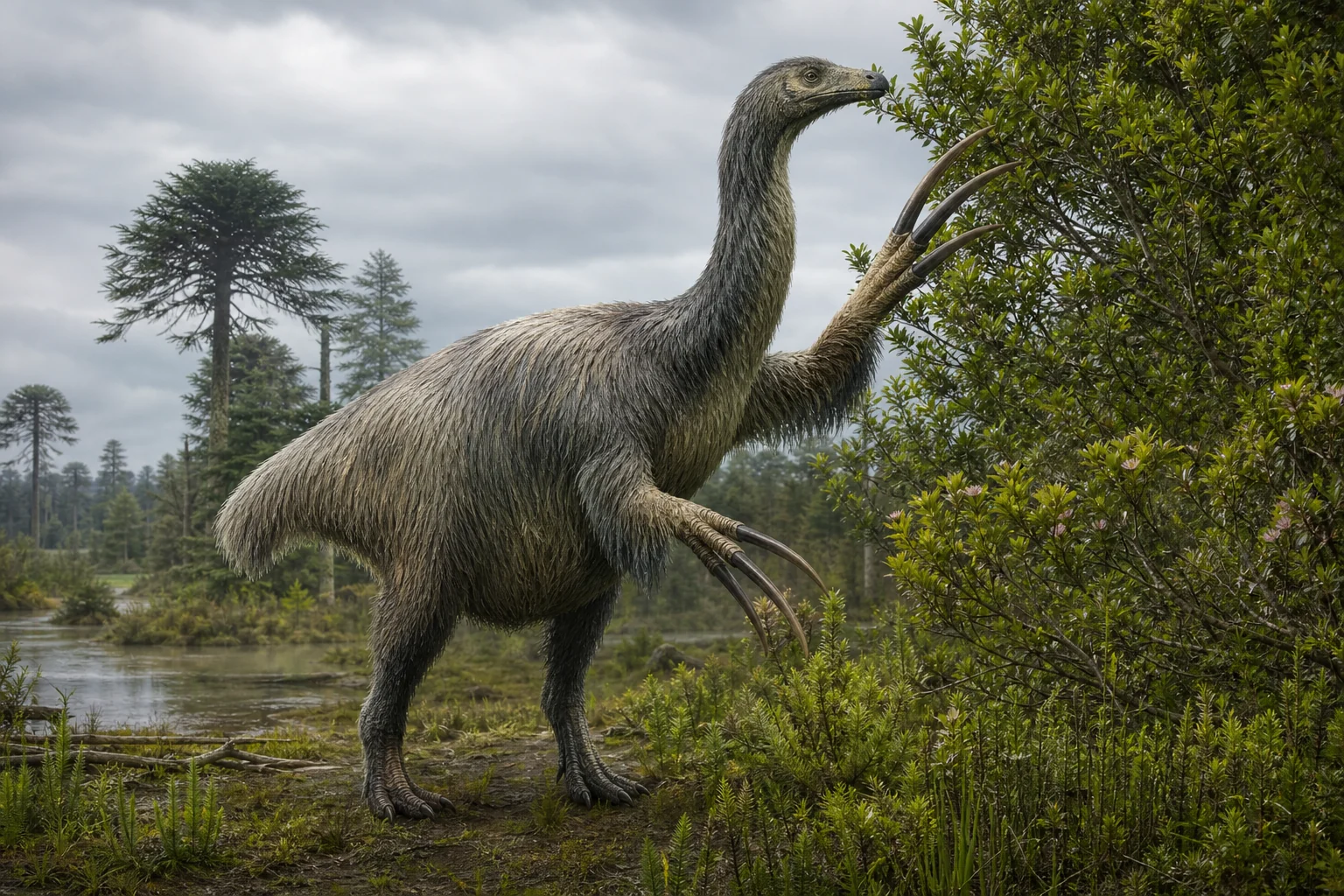 View full-resolution reconstruction ↗
This is an original generative reconstruction, not a photograph or scientific plate. Measurements and interpretations below are tied to named sources.
01 / SHORT ANSWER
What were the giant claws for?
The claws were extremely long but thin, with curvature and stress performance better suited to hooking vegetation, display and deterrence than to absorbing repeated high-force slashes into struggling prey.
Defence remains plausible at close range, especially because reach made the animal dangerous. One exclusive use is unlikely: feeding, signalling and protection could all act on the same structure.
02 / ECOLOGY
What did Therizinosaurus eat and how did it live?
What did Therizinosaurus eat?: Broad jaws and leaf-shaped teeth in relatives, a long neck and a large gut support mainly plant food, though opportunistic omnivory cannot be excluded.
How did it defend itself?: Great size, reach and claws could deter Tarbosaurus, yet no fossil records a fight or confirms a particular defensive stroke.
03 / PLACE & TIME
Where did Therizinosaurus live?
Definite remains come from the Nemegt Formation of Mongolia, a relatively humid Late Cretaceous landscape with rivers, woodland and seasonal floodplains.
Nemegt Basin: Type arms and hindlimbs anchor the genus.
River channels: Water supported productive vegetation.
Woodland: Tall and low plants offered browse.
Shared fauna: Tarbosaurus, hadrosaurs and ornithomimids shared the ecosystem.
04 / SOURCE RECORD
How do scientists know about Therizinosaurus?
Forelimbs: Arm and claw bones directly establish extraordinary reach.
Hindlimbs: Robust feet constrain size and support.
Close relatives: Complete skeletons supply skull, torso and feathers.
Biomechanics: Stress tests compare digging, cutting, hooking and display.
05 / SCIENTIFIC DEBATE
What remains uncertain?
Primary claw function.
Exact maximum size.
Feather density in adults.
Degree of omnivory.
06 / EVIDENCE VERDICT
How much of Therizinosaurus is reconstructed?
The giant arms, claws and parts of the hindlimbs are direct; much of the skull, trunk, neck, feathers and total size comes from close relatives and scaling.
A responsible image keeps those evidence levels visible instead of treating a composite as one complete specimen.
FREQUENTLY ASKED QUESTIONS
Questions readers ask
How big was Therizinosaurus?
It is commonly reconstructed around 9–10 metres, but remains are incomplete.
How long were the claws?
The bony cores approached one metre, with keratin sheaths extending farther.
Was it a meat-eater?
It was primarily herbivorous despite theropod ancestry.
Did it have feathers?
Feathers are strongly inferred from close relatives.
Could it kill with its claws?
They could defend, but repeated slashing was probably not their main design.
Where was it found?
In Mongolia's Nemegt Formation.
SOURCES & FURTHER READING
Evidence used in this guide
Measurements and interpretations are tied to museum resources or peer-reviewed studies; disputed conclusions include evidence on both sides.
- 01Therizinosaurus ↗Natural History Museum, London
Museum synthesis of fossils, size, diet, feathers and claws.
- 02Therizinosaurus ↗Paleobiology Database
Taxonomic and occurrence record.
- 03Therizinosaurus cheloniformis ↗GBIF
Stable biodiversity identifier.