
THERIZINOSAURUS TOPIC HUB · SIZE & RECONSTRUCTION
Therizinosaurus Size, Claws, Body and Feathers
Map direct bones against relative-based reconstruction.
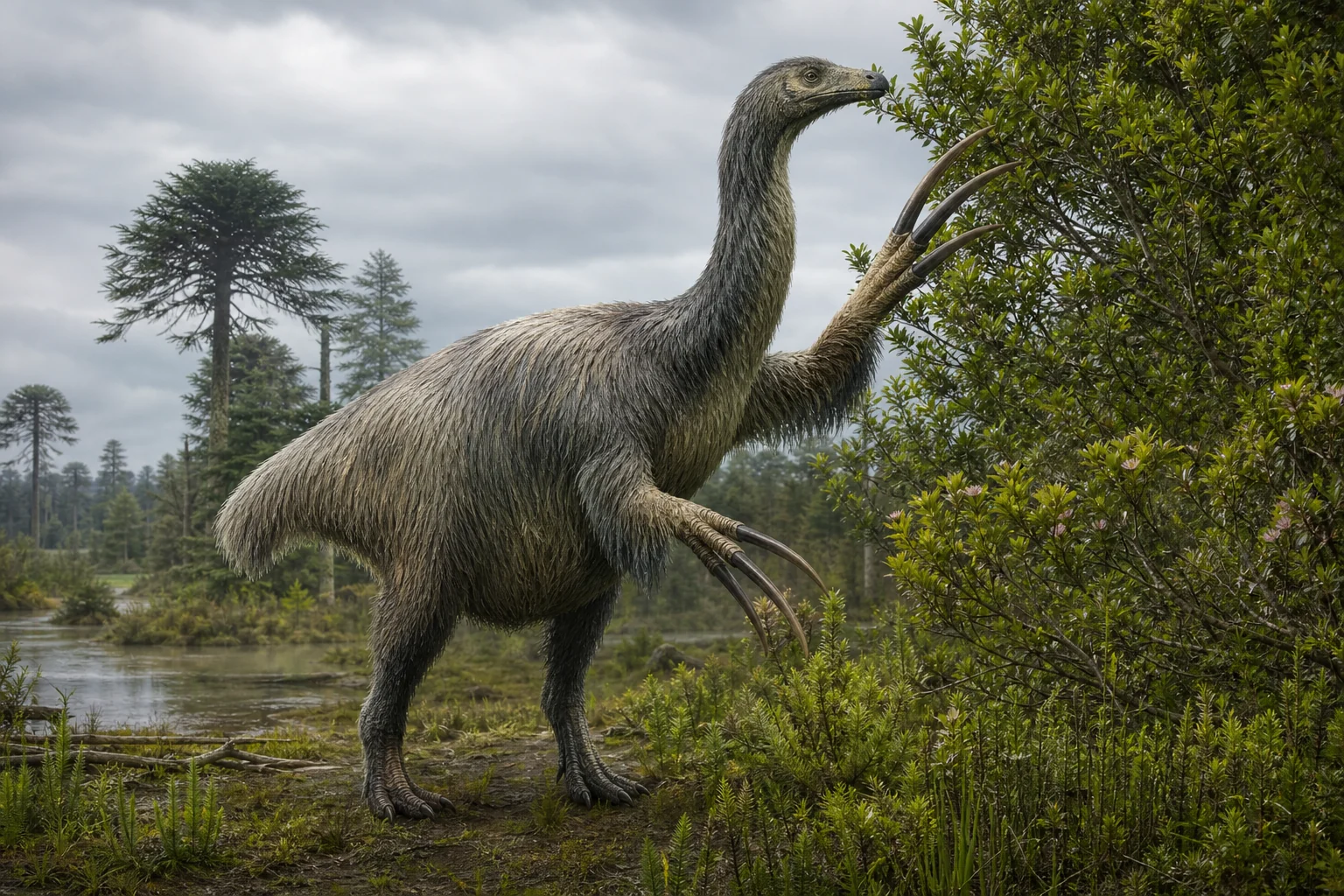 View full-resolution reconstruction ↗
This is an original generative reconstruction, not a photograph or scientific plate. Measurements and interpretations below are tied to named sources.
01 / QUICK ANSWER
What was Therizinosaurus?
Therizinosaurus was a very large, long-necked theropod from Late Cretaceous Mongolia with enormous narrow hand claws and a plant-processing body plan.
It belongs inside Theropoda despite looking unlike a predator. The genus is known mainly from arms, claws and hindlimb fragments, so its pot belly, small head and feathers are reconstructed from more complete therizinosaur relatives.
02 / MEASUREMENTS
How large was Therizinosaurus?
Scientific name: Therizinosaurus cheloniformis · Age: ~70 million years ago · Length: About 9–10 m; inferred · Mass: Several tonnes; uncertain · Claws: Bony cores up to ~1 m · Diet: Primarily herbivorous · Covering: Feathers inferred from relatives · Range: Mongolia
03 / ANATOMY
A giant theropod re-engineered for plants
Long hand claws: Three narrow unguals carried larger keratin sheaths.
Long neck: Relatives show a small head reaching broad feeding space.
Wide pelvis: A deep abdomen housed a large fermenting gut.
Feathered body: Basal relatives preserve filamentous feathers directly.
04 / FUNCTION
What were the giant claws for?
The claws were extremely long but thin, with curvature and stress performance better suited to hooking vegetation, display and deterrence than to absorbing repeated high-force slashes into struggling prey.
Defence remains plausible at close range, especially because reach made the animal dangerous. One exclusive use is unlikely: feeding, signalling and protection could all act on the same structure.
05 / FOSSIL EVIDENCE
How do scientists know about Therizinosaurus?
Forelimbs: Arm and claw bones directly establish extraordinary reach.
Hindlimbs: Robust feet constrain size and support.
Close relatives: Complete skeletons supply skull, torso and feathers.
Biomechanics: Stress tests compare digging, cutting, hooking and display.
06 / EVIDENCE VERDICT
How much of Therizinosaurus is reconstructed?
The giant arms, claws and parts of the hindlimbs are direct; much of the skull, trunk, neck, feathers and total size comes from close relatives and scaling.
A responsible image keeps those evidence levels visible instead of treating a composite as one complete specimen.
FREQUENTLY ASKED QUESTIONS
Questions readers ask
How big was Therizinosaurus?
It is commonly reconstructed around 9–10 metres, but remains are incomplete.
How long were the claws?
The bony cores approached one metre, with keratin sheaths extending farther.
Was it a meat-eater?
It was primarily herbivorous despite theropod ancestry.
Did it have feathers?
Feathers are strongly inferred from close relatives.
Could it kill with its claws?
They could defend, but repeated slashing was probably not their main design.
Where was it found?
In Mongolia's Nemegt Formation.
SOURCES & FURTHER READING
Evidence used in this guide
Measurements and interpretations are tied to museum resources or peer-reviewed studies; disputed conclusions include evidence on both sides.
- 01Therizinosaurus ↗Natural History Museum, London
Museum synthesis of fossils, size, diet, feathers and claws.
- 02Therizinosaurus ↗Paleobiology Database
Taxonomic and occurrence record.
- 03Therizinosaurus cheloniformis ↗GBIF
Stable biodiversity identifier.