
PARASAUROLOPHUS TOPIC HUB · DIET & LIFE
What Did Parasaurolophus Eat and How Did It Live?
Rebuild feeding, locomotion, habitat and social evidence.
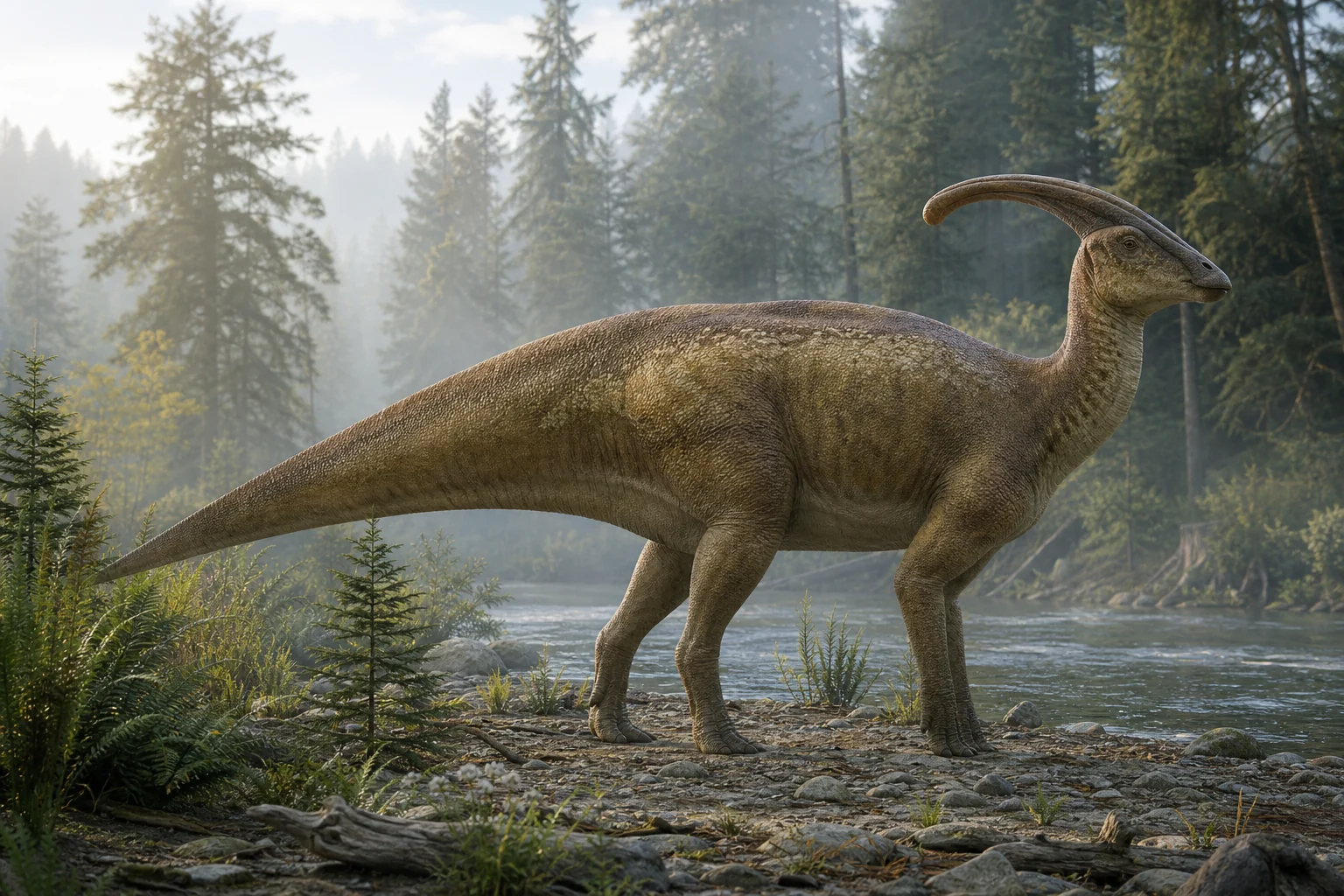 View full-resolution reconstruction ↗
This is an original generative reconstruction, not a photograph or scientific plate. Measurements and interpretations below are tied to named sources.
01 / SHORT ANSWER
What did the crest sound like?
CT scans map the looping nasal passages and allow researchers to model resonant frequencies, generally favouring low calls. Longer adult crests would resonate differently from shorter juvenile crests.
Resonance does not reveal the exact source sound, volume or rhythm. The crest was also visually conspicuous and varied by species and growth stage, making combined communication and recognition more plausible than a single function.
02 / ECOLOGY
What did Parasaurolophus eat and how did it live?
What did Parasaurolophus eat?: Its beak cropped plants while dental batteries shredded leaves, twigs and other vegetation from low to moderate height.
Did it live in herds?: Hadrosaur bonebeds and tracks support social aggregation broadly, but Parasaurolophus herd size and organisation are not directly measured.
03 / PLACE & TIME
Where did Parasaurolophus live?
Species are known from Alberta, Utah and New Mexico in river-rich coastal plains along the Western Interior Seaway.
Alberta: P. walkeri preserves the classic long crest.
Utah: P. cyrtocristatus broadens southern distribution.
New Mexico: P. tubicen preserves detailed crest anatomy.
Coastal plains: Forests, channels and wetlands supplied vegetation.
04 / SOURCE RECORD
How do scientists know about Parasaurolophus?
Skulls: Complete crests reveal nasal passage geometry.
CT scans: Digital airways support resonance tests.
Juveniles: Small crests document rapid growth and changing proportions.
Skeletons and skin: Posture, scale and body outline constrain reconstructions.
05 / SCIENTIFIC DEBATE
What remains uncertain?
Exact call frequencies.
Soft-tissue sound source.
Relative display and acoustic roles.
Herd structure.
06 / EVIDENCE VERDICT
Was the crest only a musical instrument?
No. Sound is strongly supported by airway anatomy, while display, species recognition and growth-stage signalling probably worked alongside it.
The fossil determines tube shape, not the living call. Responsible audio presents a model range and names assumptions.
FREQUENTLY ASKED QUESTIONS
Questions readers ask
How big was Parasaurolophus?
About 9–10 metres long and roughly 2.5–4 tonnes.
Was the crest hollow?
Yes; looping nasal passages ran through it.
Could it make sounds?
The crest could resonate low frequencies, but the exact call is unknown.
Did it breathe underwater?
No; the crest was not a snorkel.
What did it eat?
A broad range of terrestrial vegetation processed by a beak and dental battery.
Did it walk on four legs?
It could move on both two and four legs.
SOURCES & FURTHER READING
Evidence used in this guide
Measurements and interpretations are tied to museum resources or peer-reviewed studies; disputed conclusions include evidence on both sides.
- 01Parasaurolophus walkeri redescription ↗PeerJ
Modern skull, crest and soft-tissue attachment review.
- 02Parasaurolophus ↗Paleobiology Database
Taxonomic and occurrence record.
- 03Parasaurolophus ↗GBIF
Stable biodiversity identifier.