
CARNOTAURUS TOPIC HUB · HUNTING & SPEED
How Did Carnotaurus Hunt and Run?
Test tail muscles, turning, jaws and prey without a speed myth.
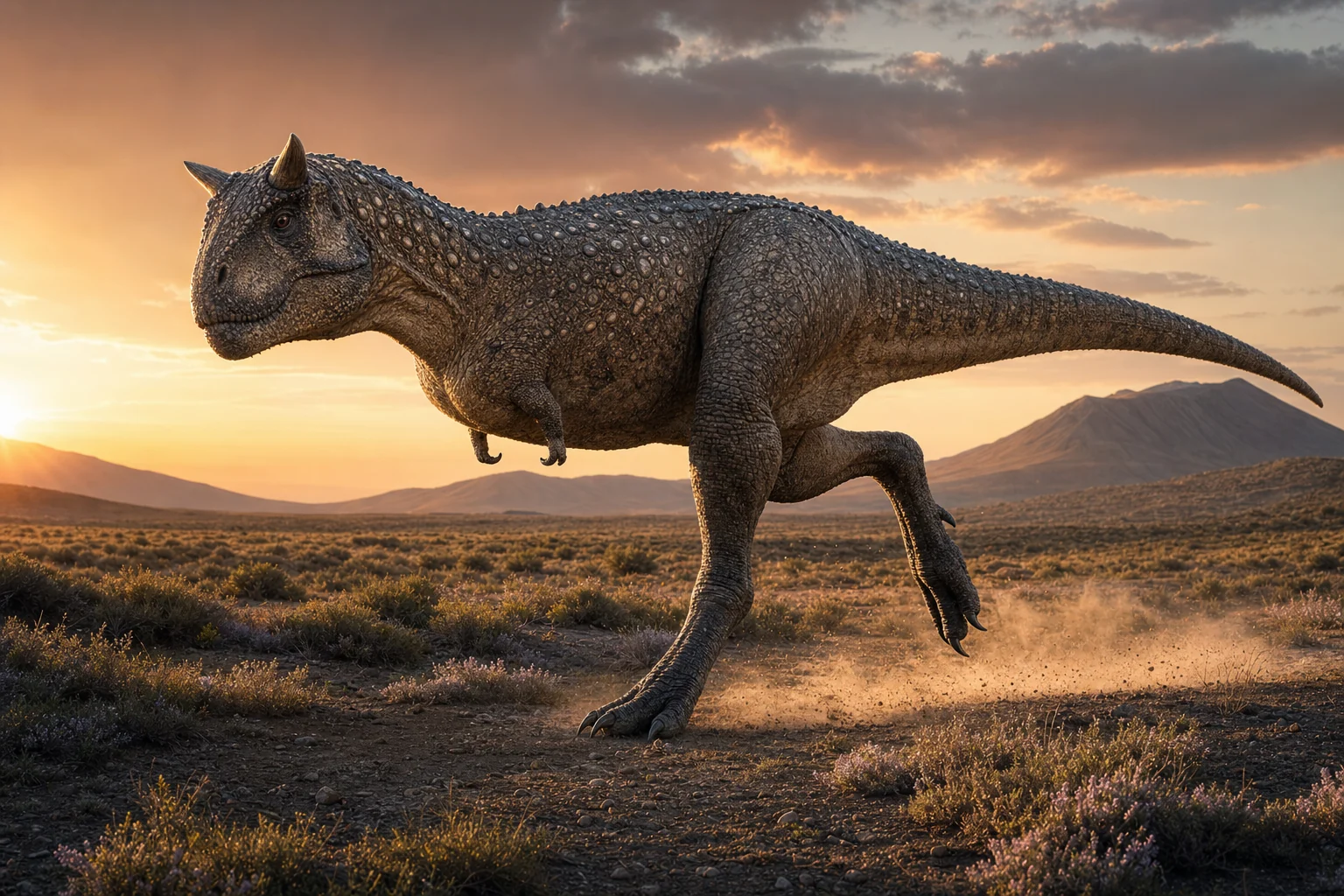 View full-resolution reconstruction ↗
This is an original generative reconstruction, not a photograph or scientific plate. Measurements and interpretations below are tied to named sources.
01 / SHORT ANSWER
What made Carnotaurus unlike other giant theropods?
The skull was unusually short and narrow from the front, while thickened bones above the eyes supported keratin-covered horns. The arms were proportionally smaller than those of Tyrannosaurus and had reduced, immobile-looking digits.
Skin impressions show a mosaic of small scales interrupted by larger conical feature scales, not rows of osteoderms. No direct feather evidence is known for Carnotaurus, but preserved patches still do not expose every body region.
02 / ECOLOGY
What did Carnotaurus eat and how did it live?
How did Carnotaurus hunt?: Long hind limbs support fast straight-line acceleration, while skull and teeth fit repeated bites into medium or large prey; exact speed remains modelled.
What were the horns for?: Display, species recognition and close contact are plausible. Bone strength does not by itself prove high-speed headbutting.
03 / PLACE & TIME
Where did Carnotaurus live?
The only definite skeleton comes from Argentina's La Colonia Formation, a landscape of rivers, floodplains, coastal lagoons and seasonal climate.
Chubut: The holotype anchors the species in southern Patagonia.
Floodplains: River deposits preserved terrestrial vertebrates.
Coastal influence: Nearby estuarine settings broadened prey communities.
Southern Gondwana: Abelisaurids occupied predator roles unlike northern tyrannosaurids.
04 / SOURCE RECORD
How do scientists know about Carnotaurus?
Holotype skeleton: A single associated individual preserves most major regions.
Skin impressions: Multiple patches reveal scale size and distribution.
Muscle models: Tail and limb reconstructions test locomotion.
Skull mechanics: Joint and stress models test bite and horn hypotheses.
05 / SCIENTIFIC DEBATE
What remains uncertain?
Maximum running speed.
Horn function.
Bite style and prey size.
Soft-tissue extent around the arms.
06 / EVIDENCE VERDICT
What remains uncertain about Carnotaurus?
Carnotaurus is anatomically vivid but represented by one incomplete individual, so population variation, maximum size, horn behaviour and precise running speed remain unresolved.
The skeleton and skin make some details unusually secure; they do not turn biomechanical possibilities into observed behaviour.
FREQUENTLY ASKED QUESTIONS
Questions readers ask
How big was Carnotaurus?
About eight metres long and roughly 1.3–2 tonnes.
Did it have horns?
Yes, paired bony cores above the eyes carried keratin coverings.
Why were its arms so small?
They were evolutionarily reduced and probably contributed little to prey capture.
Did it have scales?
Yes; extensive skin impressions preserve a varied scale mosaic.
Was it faster than T. rex?
No fossil provides a measured race; models suggest strong acceleration but limited turning.
Where was it found?
In Chubut Province, Patagonia, Argentina.
SOURCES & FURTHER READING
Evidence used in this guide
Measurements and interpretations are tied to museum resources or peer-reviewed studies; disputed conclusions include evidence on both sides.
- 01Carnotaurus ↗Natural History Museum, London
Museum synthesis of size, horns, skin and missing anatomy.
- 02Carnotaurus entity record ↗Paleobiology Database
Taxonomic and occurrence context for the genus.
- 03Carnotaurus sastrei ↗GBIF
Stable biodiversity identifier for the species.