
SARCOSUCHUS TOPIC HUB · DIET EVIDENCE
Did Sarcosuchus Eat Dinosaurs?
Test prey claims against teeth, habitat and missing bite marks.
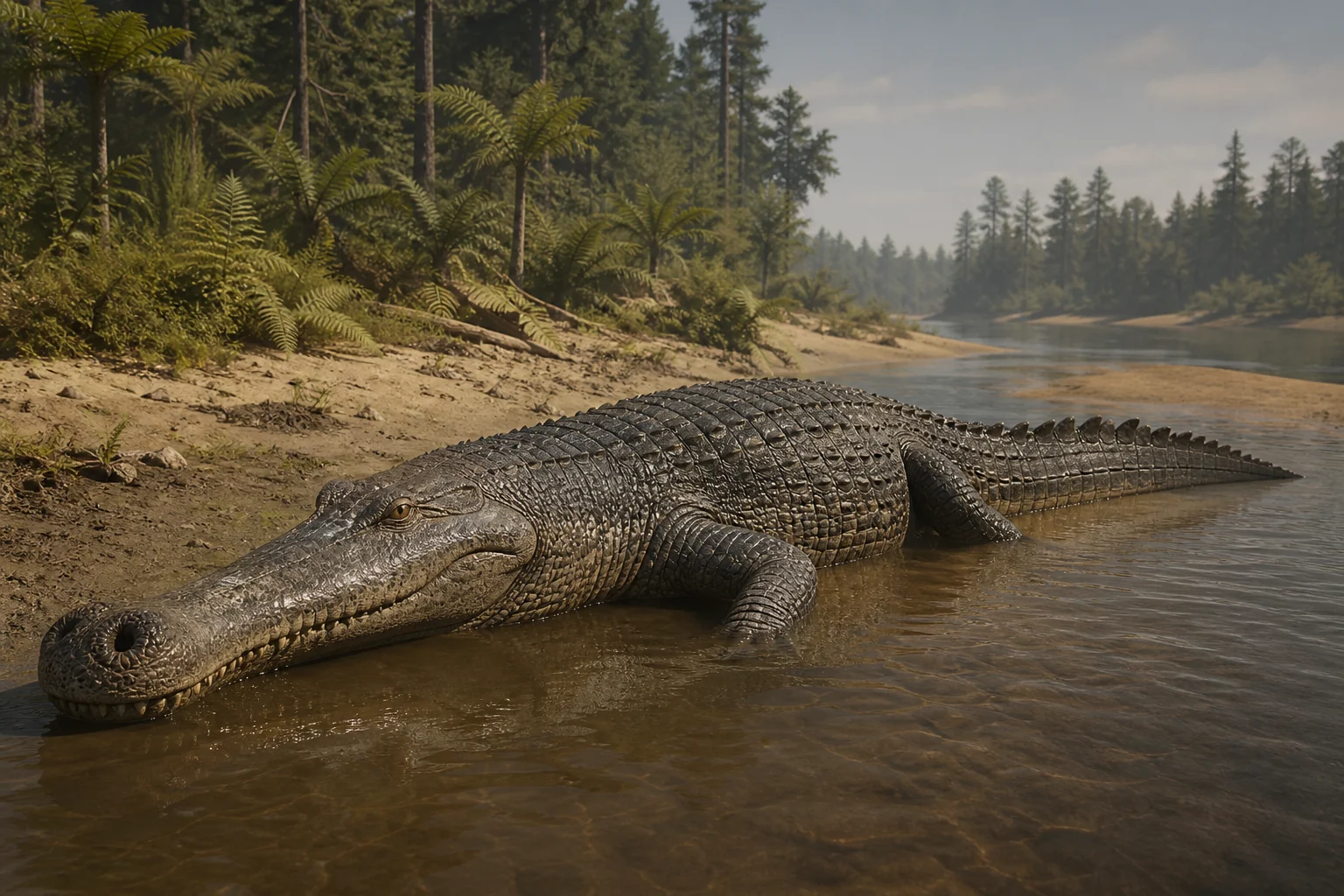 View full-resolution reconstruction ↗
This is an original generative reconstruction, not a photograph or scientific plate. Measurements and interpretations below are tied to named sources.
01 / SHORT ANSWER
Did Sarcosuchus really eat dinosaurs?
Its huge jaws and robust teeth could seize large vertebrates at the water's edge, and dinosaurs shared its river systems. That makes occasional predation plausible, but no published bite-marked dinosaur bone securely identifies Sarcosuchus as the attacker.
Fish were abundant and the long snout retains a fish-catching signal. A flexible diet resembling large living crocodilians is safer than portraying every adult as a dinosaur specialist.
02 / ECOLOGY
What did Sarcosuchus eat and how did it live?
How large did it grow?: The best skulls and growth series support a giant animal, but total length depends on the living crocodilian proportions selected for scaling.
How did it hunt?: Ambush at channels and banks is plausible. Exact death rolls, prey preference and bite force remain biomechanical inferences.
03 / PLACE & TIME
Where did Sarcosuchus live?
Secure fossils come from Early Cretaceous river deposits of Niger and nearby Saharan regions, when northern Africa held broad freshwater systems.
Niger: Major skulls and armour anchor the species.
Sahara: Today-dry rocks preserve former rivers.
Freshwater channels: Large fish and reptiles shared the habitat.
Gondwanan floodplains: Dinosaurs approached the same water margins.
04 / SOURCE RECORD
How do scientists know about Sarcosuchus?
Skulls: Several partial skulls constrain snout and jaw size.
Osteoderm rings: Growth marks suggest slow growth over decades.
Teeth: Crown form tests gripping and diet hypotheses.
Comparative scaling: Living crocodylians bracket, but do not measure, total length.
05 / SCIENTIFIC DEBATE
What remains uncertain?
Maximum body length.
Function of the snout bulla.
Importance of dinosaur prey.
Growth rate and lifespan.
06 / EVIDENCE VERDICT
How certain is the 'SuperCroc' reconstruction?
Its giant size and aquatic ambush anatomy are secure; exact maximum length, soft-tissue outline and frequency of dinosaur predation are not.
The most useful reconstruction shows estimates as ranges and keeps direct fossils separate from behaviour inferred by analogy.
FREQUENTLY ASKED QUESTIONS
Questions readers ask
How big was Sarcosuchus?
Large adults are often estimated around 9–11.5 metres, with uncertainty.
Was it a dinosaur?
No, it was an extinct crocodyliform.
Did it eat dinosaurs?
Possibly on occasion, but direct bite-mark evidence is lacking.
What did it eat?
Fish and available vertebrates near rivers.
Where was it found?
Primarily in Niger and nearby Saharan rocks.
Was it a modern crocodile?
No, it belonged to a separate extinct branch.
SOURCES & FURTHER READING
Evidence used in this guide
Measurements and interpretations are tied to museum resources or peer-reviewed studies; disputed conclusions include evidence on both sides.
- 01SuperCroc ↗Science / PubMed
Primary description of new skulls, body estimates and growth.
- 02Researchers discover 40-foot crocodile fossil ↗Yale University
Institutional account of the expedition and evidence.
- 03Sarcosuchus imperator ↗Paleobiology Database
Taxonomic and occurrence record.