
STELLER'S SEA COW TOPIC HUB · BODY & DIET
Steller's Sea Cow Size, Body and Kelp Diet
Combine eyewitness notes, skeletons and genome evidence.
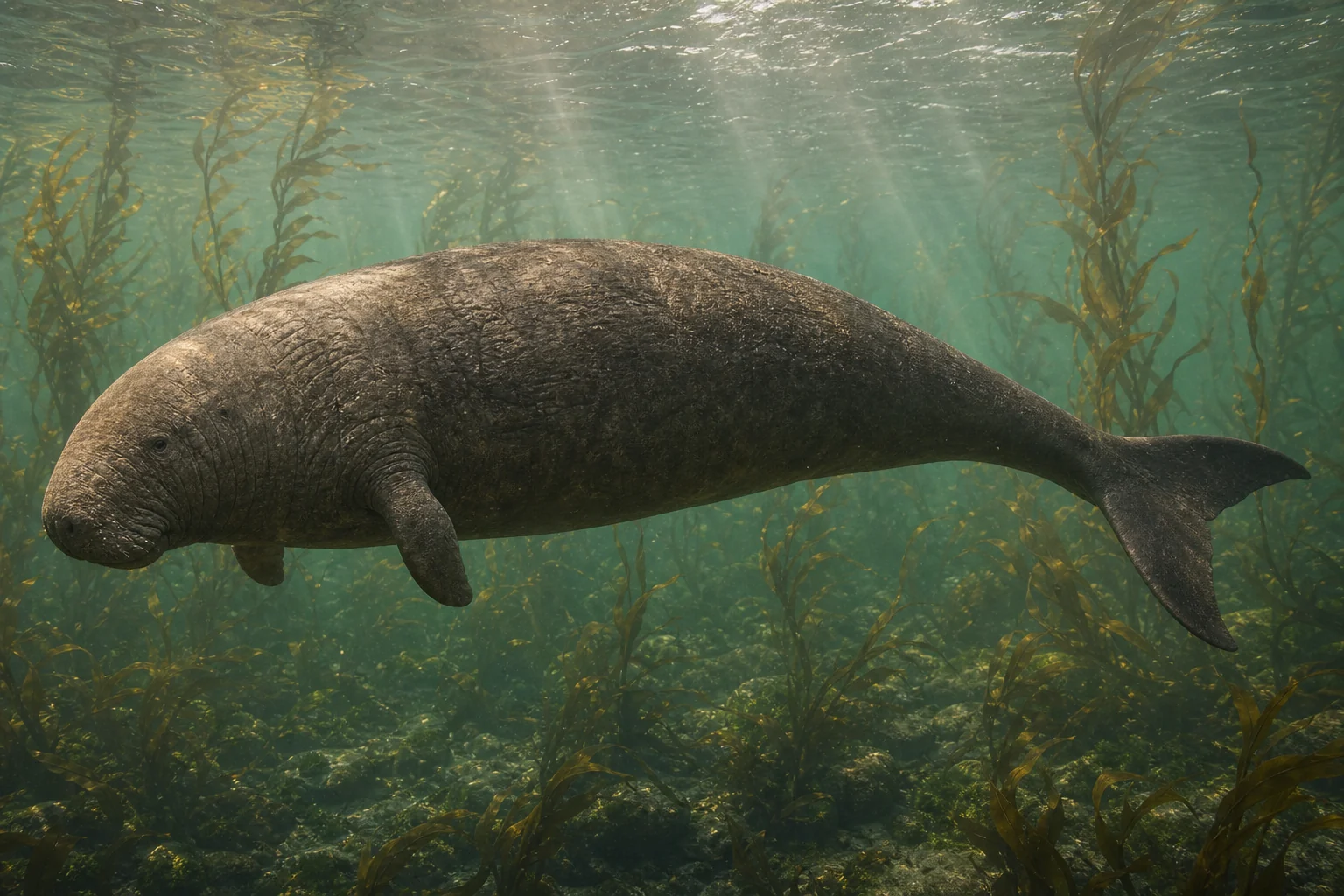 View full-resolution reconstruction ↗
This is an original generative reconstruction, not a photograph or scientific plate. Measurements and interpretations below are tied to named sources.
01 / QUICK ANSWER
What was Steller's Sea Cow?
Steller's Sea Cow was an enormous cold-water sirenian, up to about eight metres long, that grazed kelp in shallow seas around the Commander Islands.
Georg Wilhelm Steller described it alive in 1741 after the surviving population had become restricted to a tiny refuge. Fur-hunting crews then killed it for meat and fat, and it was gone by 1768.
02 / MEASUREMENTS
How large was Steller's Sea Cow?
Scientific name: Hydrodamalis gigas · Extinction: 1768 · Length: Up to about 8 m · Mass: Several tonnes · Diet: Kelp and other seaweeds · Teeth: None; keratinous chewing pads · Range at discovery: Commander Islands · Closest living relatives: Dugongs and manatees
03 / ANATOMY
A giant sirenian adapted to cold kelp forests
Thick hide: Dark, cracked skin and blubber insulated the body.
Small flippers: Forelimbs steered and braced against rocks while feeding.
Forked tail: A broad horizontal fluke supplied propulsion.
Chewing plates: Keratinous pads crushed tough seaweed without teeth.
04 / FUNCTION
Why did Steller's Sea Cow go extinct?
Its final population lived in shallow, predictable kelp beds and moved slowly near the surface. Hunting crews killed animals for large quantities of meat and oil, removing adults from an already restricted and probably small population.
Hunting is the direct historical cause. Earlier range contraction may reflect post-Ice-Age habitat change, and sea-otter depletion may have altered kelp forests indirectly, but those mechanisms do not replace the documented slaughter.
05 / FOSSIL EVIDENCE
How do scientists know about Steller's Sea Cow?
Steller's account: A trained naturalist described living anatomy and behaviour.
Skeletons: Museum bones constrain size and sirenian identity.
Fossil range: Older remains document contraction before 1741.
Ancient genome: DNA tests population history and skin adaptations.
06 / EVIDENCE VERDICT
Was extinction inevitable before Europeans arrived?
No. The population was restricted and vulnerable, but it persisted until sustained hunting removed breeding adults over only a few decades.
Genomic vulnerability and habitat history explain risk; the historical record identifies the terminal pressure.
FREQUENTLY ASKED QUESTIONS
Questions readers ask
When did Steller's Sea Cow go extinct?
The last accepted record is 1768.
How big was it?
Up to about eight metres and several tonnes.
What did it eat?
Kelp and other large seaweeds.
Why did it go extinct?
Intensive hunting eliminated its final small population.
Did it have teeth?
No, adults used keratinous chewing pads.
Where did it live?
At discovery, only around the Commander Islands.
SOURCES & FURTHER READING
Evidence used in this guide
Measurements and interpretations are tied to museum resources or peer-reviewed studies; disputed conclusions include evidence on both sides.
- 01Steller's sea cow ↗Natural History Museum, London
Historical extinction, anatomy and ecology synthesis.
- 02Steller's sea cow genome ↗Nature Communications
Ancient genome and population-history evidence.
- 03Sea Cow ↗Smithsonian Institution
Museum specimen and species overview.