
PASSENGER PIGEON TOPIC HUB · FLOCKS & MIGRATION
Passenger Pigeon Size, Flocks and Migration
Reconstruct movement without treating estimates as censuses.
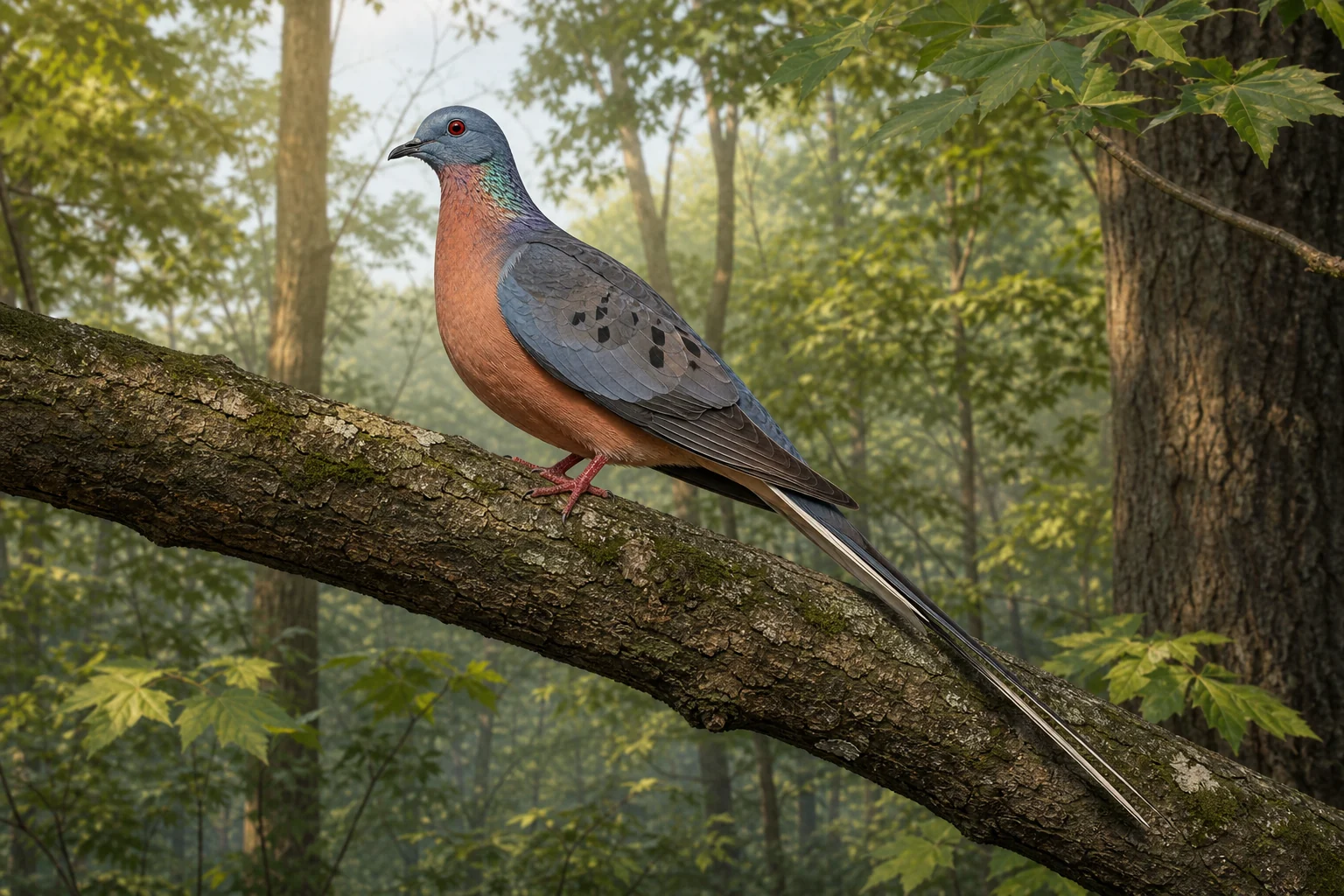 View full-resolution reconstruction ↗
This is an original generative reconstruction, not a photograph or scientific plate. Measurements and interpretations below are tied to named sources.
01 / QUICK ANSWER
What was the Passenger Pigeon?
The Passenger Pigeon was a fast, highly social North American forest pigeon whose migrating flocks once contained hundreds of millions—and perhaps more than a billion—birds.
Its abundance did not protect it. Telegraphs and railways helped commercial hunters locate and ship vast harvests while forest clearing disrupted nesting and food; the final captive bird, Martha, died in 1914.
02 / MEASUREMENTS
How large was Passenger Pigeon?
Scientific name: Ectopistes migratorius · Extinction: 1914 · Length: About 38–41 cm · Flight: Fast long-distance migrant · Flocks: Millions to immense aggregations · Diet: Acorns, beechnuts, seeds and fruit · Range: Eastern and central North America · Last individual: Martha, Cincinnati Zoo
03 / ANATOMY
A long-winged pigeon built for continental movement
Pointed wings: Long primaries supported fast sustained migration.
Streamlined body: A narrow head and strong breast reduced flight costs.
Sexual colour: Males had richer breast and neck colours than females.
Social senses: Vision and flock response coordinated dense movement.
04 / FUNCTION
Why did the Passenger Pigeon go extinct?
Industrial market hunting removed adults and nestlings on an unprecedented scale. Railroads carried carcasses to cities and telegraphs rapidly reported nesting colonies, turning mobile abundance into a trackable commodity.
Forest clearing reduced mast food and large nesting areas, while the pigeon's social breeding may have worked poorly below a critical density. Hunting was the direct documented pressure; habitat loss and group dependence magnified collapse.
05 / FOSSIL EVIDENCE
How do scientists know about the Passenger Pigeon?
Museum specimens: Skins and skeletons preserve sex, age and anatomy.
Written accounts: Observers describe flock duration, nesting and harvest.
Commercial records: Rail shipments quantify industrial removal.
Genomes: Historical DNA tests population history and adaptation.
06 / EVIDENCE VERDICT
How could such an abundant bird disappear?
Abundance was concentrated into predictable colonies. Industrial technology removed birds faster than they reproduced, and once numbers fell, habitat change and social dependence impeded recovery.
The extinction warns that total numbers matter less than reproductive rate, spatial concentration and the speed of exploitation.
FREQUENTLY ASKED QUESTIONS
Questions readers ask
When did the Passenger Pigeon go extinct?
The last known individual died in 1914.
How many once existed?
Billions are plausible, but exact historical totals are uncertain.
Why did it go extinct?
Industrial hunting, habitat loss and group dependence drove collapse.
What did it eat?
Mostly forest nuts, seeds and fruit.
Who was Martha?
The last known Passenger Pigeon.
Could captive breeding save it?
The remaining captive flock was too small and bred poorly.
SOURCES & FURTHER READING
Evidence used in this guide
Measurements and interpretations are tied to museum resources or peer-reviewed studies; disputed conclusions include evidence on both sides.
- 01The Passenger Pigeon ↗Smithsonian Institution
Institutional history, ecology, specimens and extinction evidence.
- 02Ectopistes migratorius ↗Paleobiology Database
Taxonomic and fossil-occurrence record.
- 03Ectopistes migratorius ↗GBIF
Stable biodiversity record.