
ICHTHYOSAURUS TOPIC HUB · BODY & SENSES
Ichthyosaurus Size, Body, Eyes and Fins
Reconstruct its outline from bones and soft-tissue traces.
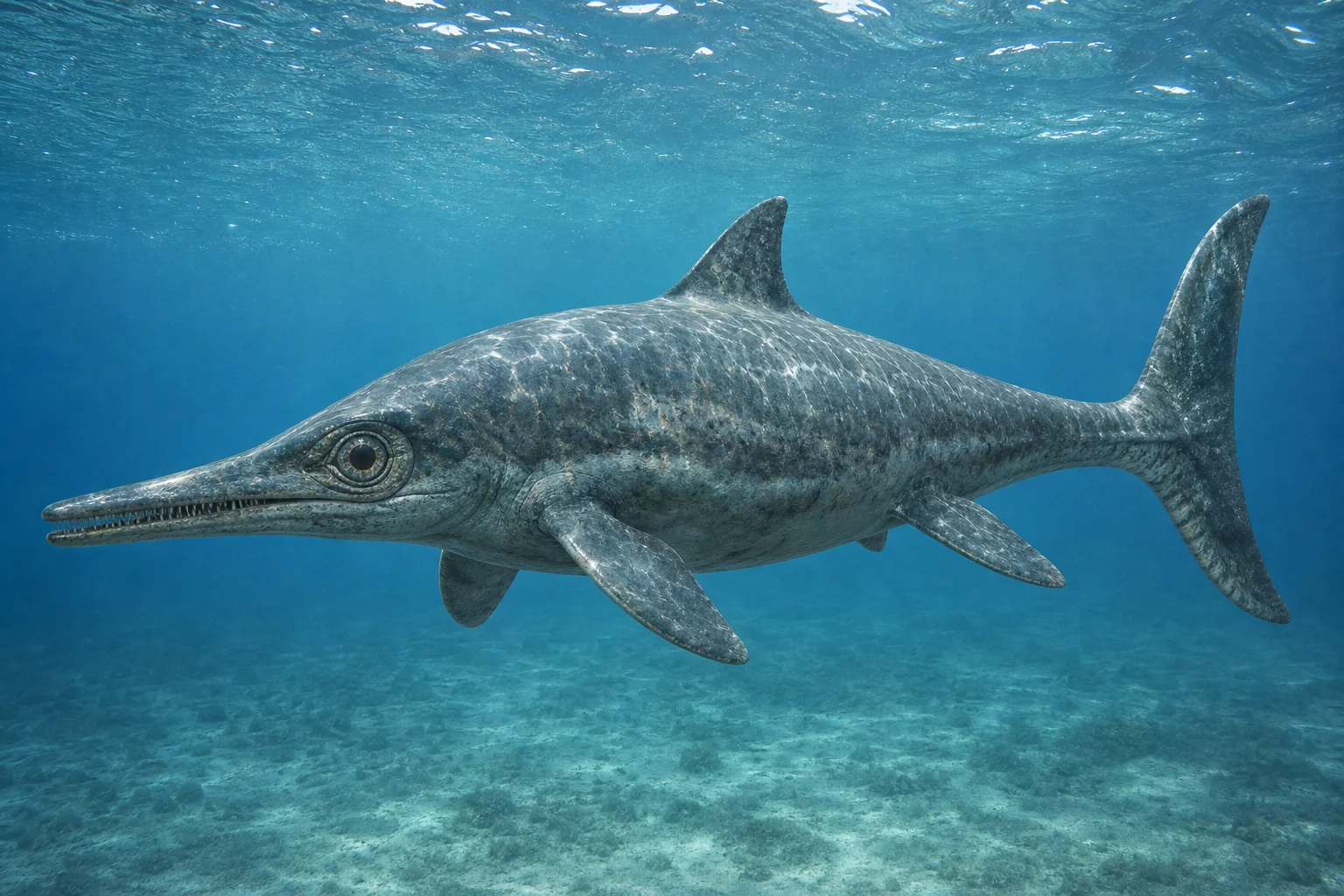 View full-resolution reconstruction ↗
This is an original generative reconstruction, not a photograph or scientific plate. Measurements and interpretations below are tied to named sources.
01 / QUICK ANSWER
What was Ichthyosaurus?
Ichthyosaurus was a fully marine reptile from Early Jurassic Europe with a streamlined body, paddle-like limbs, a fish-shaped tail and very large eyes.
Its dolphin-like outline evolved independently and does not make it a mammal or dinosaur. Skeletons, skin outlines, stomach contents and embryos provide an unusually rich record of how it swam, fed and reproduced.
02 / MEASUREMENTS
How large was Ichthyosaurus?
Scientific name: Ichthyosaurus communis · Age: ~201–182 million years ago · Length: Usually about 2–3.3 m · Body: Streamlined marine reptile · Eyes: Large, reinforced by sclerotic rings · Diet: Fish and cephalopods · Birth: Live young · Range: European Jurassic seas
03 / ANATOMY
Convergent streamlining built from reptile bones
Tail fluke: A downward-bent backbone supported the lower lobe of a vertical tail.
Paddles: Shortened arm and finger bones formed rigid hydrofoils.
Large eyes: Bony rings supported eyes adapted to dim water and changing pressure.
Long jaws: Many small teeth seized slippery prey.
04 / FUNCTION
How did Ichthyosaurus swim, feed and give birth?
A crescent tail supplied most thrust while paired paddles steered and stabilised. Streamlining, vertebral form and preserved soft outlines indicate efficient open-water swimming, although exact cruising speed is modelled rather than measured.
Narrow jaws and numerous teeth took fish and squid-like prey. Embryos preserved within related ichthyosaurs—and pregnant specimens assigned to Ichthyosaurus—show that young developed inside the mother and were born at sea.
05 / FOSSIL EVIDENCE
How do scientists know about Ichthyosaurus?
Articulated skeletons: Complete bodies constrain proportions and swimming.
Soft-tissue outlines: Rare films preserve dorsal fins and tail profiles.
Stomach contents: Fish scales and cephalopod hooks reveal meals.
Embryos: Pregnant skeletons demonstrate live birth at sea.
06 / EVIDENCE VERDICT
Was Ichthyosaurus a dolphin?
No. It was a reptile whose dolphin-like body evolved independently because both lineages faced similar hydrodynamic demands.
The resemblance is a classic example of convergent evolution, while skull, limb and reproductive anatomy preserve distinct ancestry.
FREQUENTLY ASKED QUESTIONS
Questions readers ask
How big was Ichthyosaurus?
Most species were around two to three metres long.
Was it a dinosaur?
No, it was a separate marine-reptile lineage.
Did it have gills?
No, it breathed air with lungs.
Did it lay eggs?
No, fossil embryos show live birth.
What did it eat?
Mainly fish and cephalopods.
Why did it look like a dolphin?
Convergent evolution produced similar streamlining.
SOURCES & FURTHER READING
Evidence used in this guide
Measurements and interpretations are tied to museum resources or peer-reviewed studies; disputed conclusions include evidence on both sides.
- 01What is an ichthyosaur? ↗Natural History Museum, London
Museum synthesis of anatomy, swimming, diet and live birth.
- 02Ichthyosaurus ↗Paleobiology Database
Taxonomic and occurrence record.
- 03Ichthyosaurus communis ↗GBIF
Stable biodiversity identifier.