
ARCHAEOPTERYX TOPIC HUB · FLIGHT EVIDENCE
Archaeopteryx Size, Feathers and Flight
Compare feather asymmetry, wing bones and launch hypotheses.
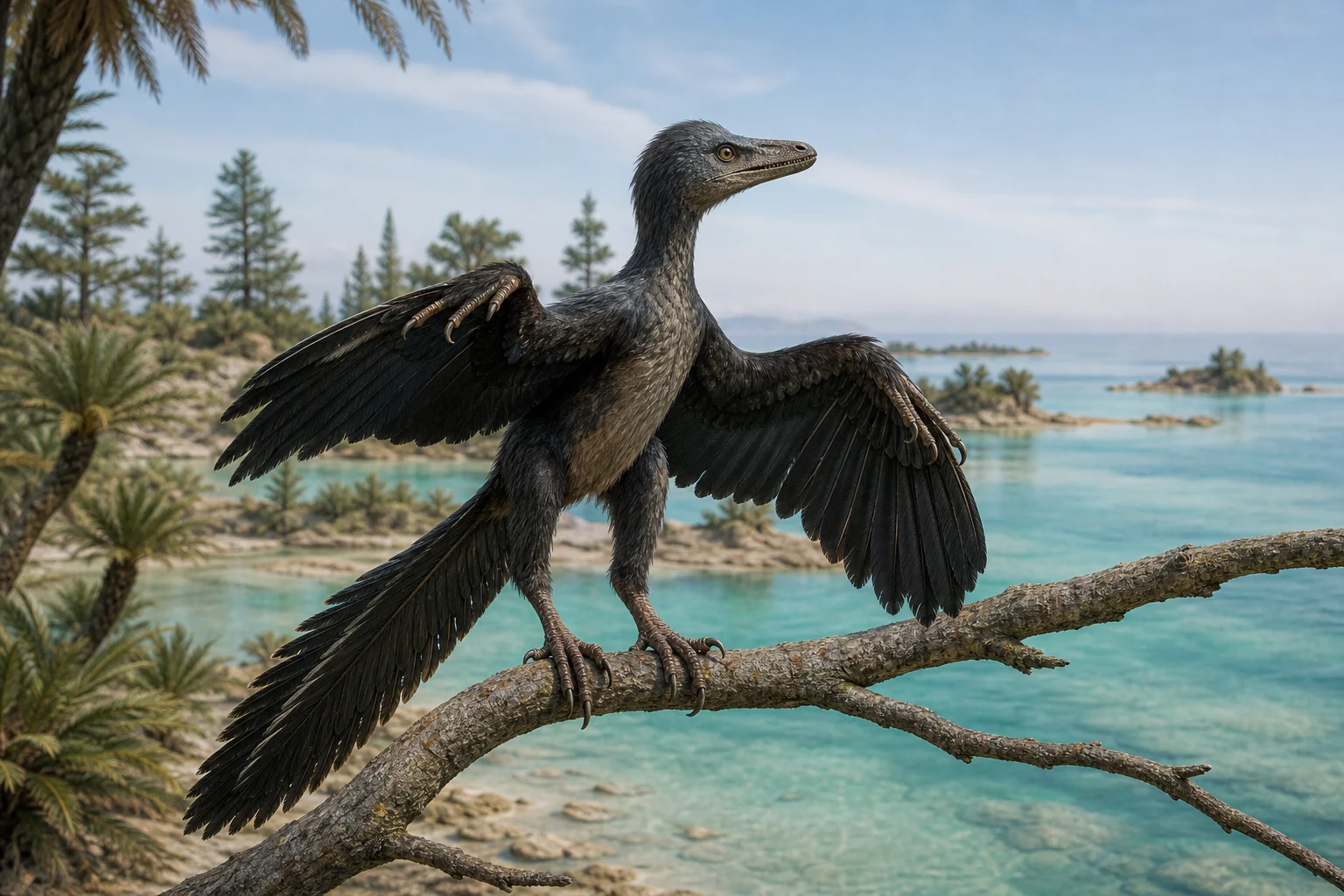 View full-resolution reconstruction ↗
This is an original generative reconstruction, not a photograph or scientific plate. Measurements and interpretations below are tied to named sources.
01 / QUICK ANSWER
What was Archaeopteryx?
Archaeopteryx was a raven-sized feathered paravian from Late Jurassic Germany that combined aerodynamic flight feathers with teeth, clawed fingers and a long bony tail.
It is not a half-bird frozen midway through evolution, but a complete branch close to early birds. Multiple specimens show that bird-like flight structures evolved while many non-avian dinosaur traits persisted.
02 / MEASUREMENTS
How large was Archaeopteryx?
Scientific name: Archaeopteryx lithographica · Age: ~150–148 million years ago · Length: About 50 cm · Mass: Roughly 0.5–1 kg · Wings: Asymmetrical flight feathers · Mouth: Small teeth · Tail: Long bony feathered tail · Range: Solnhofen, Germany
03 / ANATOMY
Bird-like wings on a toothed dinosaur skeleton
Flight feathers: Long asymmetrical feathers formed wings and a tail fan.
Clawed hands: Three separate fingers projected from each wing.
Teeth: Small teeth lined jaws instead of a modern beak.
Long tail: Many vertebrae supported paired feathers along the tail.
04 / FUNCTION
Could Archaeopteryx really fly?
Asymmetrical primary feathers and wing shape are aerodynamic, while bone geometry indicates loading associated with flapping. Its shoulder and sternum differed from modern strong fliers, so flight style was probably limited and distinctive.
It may have used short powered flights, inclined running, leaping or gliding in combination. Fossils cannot select one launch behaviour for every situation, and modern wind-tunnel models depend on reconstructed muscles and posture.
05 / FOSSIL EVIDENCE
How do scientists know about Archaeopteryx?
Feather impressions: Primary, secondary and tail feathers preserve vane geometry.
Skeletons: Multiple individuals record teeth, fingers and tail.
Bone microstructure: Growth and wing loading inform flight models.
Melanosomes: Microscopic structures suggest dark colour in one feather.
06 / EVIDENCE VERDICT
Was Archaeopteryx a bird or a dinosaur?
It was both a feathered theropod dinosaur and an early avialan near the origin of birds; the categories are nested, not mutually exclusive.
Its exact branch position shifts with new fossils, but its mixture of flight feathers and dinosaur anatomy remains direct evidence of evolutionary transition.
FREQUENTLY ASKED QUESTIONS
Questions readers ask
How big was Archaeopteryx?
About 50 centimetres long and around 0.5–1 kilogram.
Could it fly?
Evidence supports some powered flight, probably less capable than many modern birds.
Did it have feathers?
Yes; multiple skeletons preserve detailed flight feathers.
Did it have teeth?
Yes, small teeth lined its jaws.
Was it the first bird?
It is an early avialan, but 'first bird' depends on definition and phylogeny.
What colour was it?
One feather may have been black; whole-body colour is unknown.
SOURCES & FURTHER READING
Evidence used in this guide
Measurements and interpretations are tied to museum resources or peer-reviewed studies; disputed conclusions include evidence on both sides.
- 01Archaeopteryx ↗Natural History Museum, London
Museum synthesis of fossils, feathers, flight and colour evidence.
- 02What were the first birds like? ↗Natural History Museum, London
Evolutionary context for early avialans.
- 03Archaeopteryx lithographica ↗Paleobiology Database
Taxonomic and occurrence record.